
LSA-730
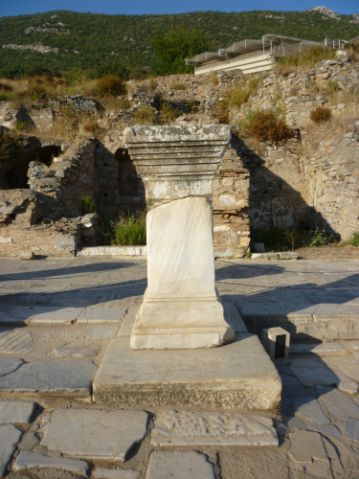
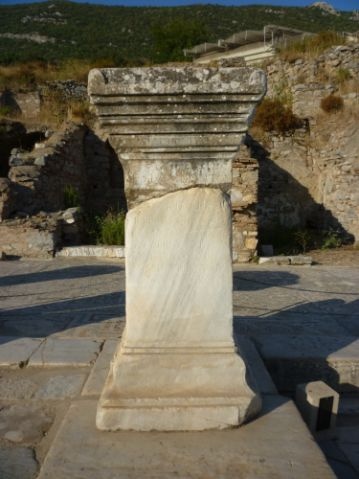
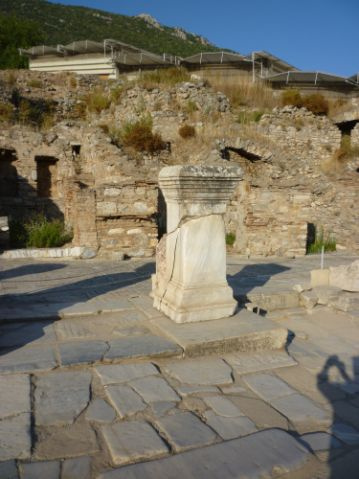
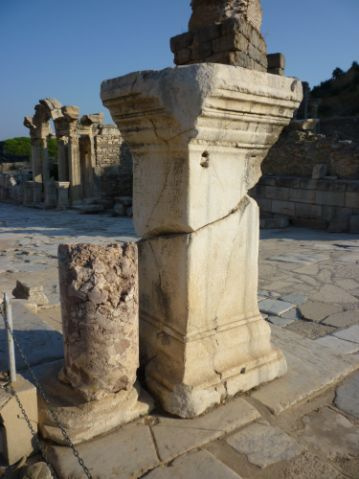
Base for statue of Messalinus, governor of Asia. Ephesus (Asia). Fourth to fifth century
Record details
Photographs
Inscription
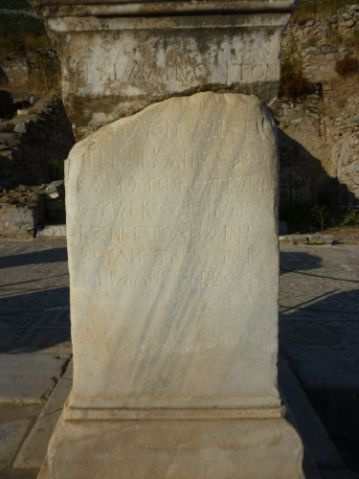
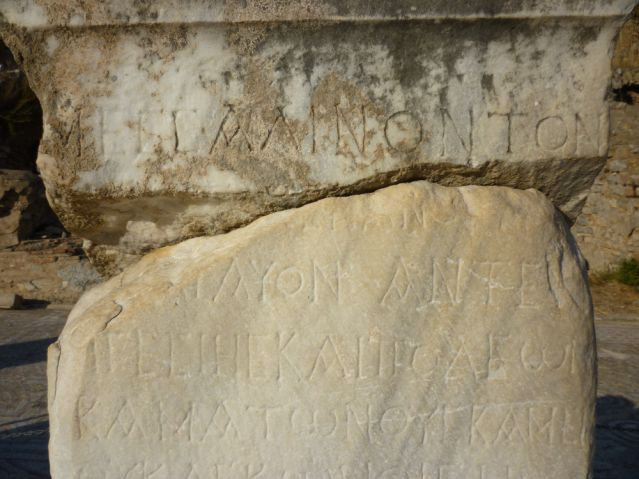
ἀγαθῆι τύχηι· / Μεσσαλίνον τὸν /(3) [ἄρισ]τ[ον] ἐν ἀνθ/υπάτοι]/[σιν] ἀγαυόν ἀντ’ ε[ὐ]/ηργεσίης καὶ πόλεων /(7) καμάτων, οὓς κάμεν / οὐκ ἀέκων, οἷς ἠ/έξησε πόληας ἡ /(10) βουλὴ στῆσε(ν) τῆς / μεγάλης Ἐφέσου. (leaf)
Inscription translation
To Good Fortune. Admirable Messalinus, the best among proconsuls; for his benefaction and the many toils which he undertook, not unwillingly, [and] by which he enhanced the cities, the council of great Ephesus set [him] up. (leaf)
Bibliography
- Bauer, F. A., Stadt, Platz und Denkmal in der Spätantike, Mainz 1996, 424
- Engelmann, H. Knibbe, D. & R. Merkelbach, Die Inschriften von Ephesos Teil IV. Inschriften griechischer Städte aus Kleinasien, vol. 14, Bonn 1980, 166, no.1307
- Malcus, B. 'Die Prokonsuln von Asien von Diokletian bis Theodosius II', Opuscula Atheniensa, 7 (1967) 91-154, 130-131 no. 1
Discussion
INSCRIPTION
Verse inscription of two elegiac distichs laid out in ten lines and introduced by an invocation, in all eleven lines:
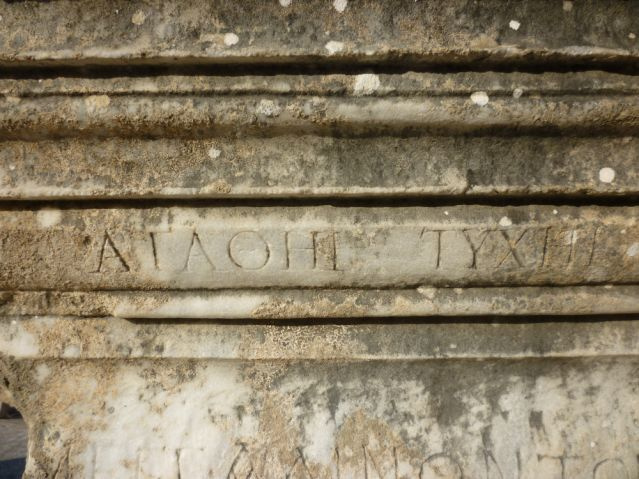
ἀγαθῆι τύχηι· /
Μεσσαλίνον τὸν /(3) [ἄρισ]τ[ον] ἐν ἀνθ/υπάτοι]/[σιν] ἀγαυόν
ἀντ’ ε[ὐ]/ηργεσίης καὶ πόλεων /(7) καμάτων,
οὓς κάμεν / οὐκ ἀέκων, οἷς ἠ/έξησε πόληας
ἡ /(10) βουλὴ στῆσε(ν) τῆς / μεγάλης Ἐφέσου. (leaf)
'To Good Fortune. Admirable Messalinus, the best among proconsuls; for his benefaction and the many toils which he undertook, not unwillingly, [and] by which he enhanced the cities, the council of great Ephesus set [him] up. (leaf)'
Letter height 3 -5 cm. The first line of the inscription, with the invocation to Good Fortune, is written on the upper moulding in a different (and much more regular) script to the main inscription. As argued by Roueché, it is almost certainly the remains of an earlier inscription, otherwise erased to make way for the dedication to Messalinus. Below the main inscription are a leaf and twig.
DESCRIPTION
White marble base: H 178, W 86, D 86 cm.
Monolithic base broken at two-thirds height, but reassembled by its excavator, Miltner. The base has been used three times: on our face one line of an earlier inscription survives (see above, 'Inscription'), and on the opposite face is an inscription for another late antique governor of Asia, Aelius Claudius Dulcitius, datable to 361/3 (LSA-733).
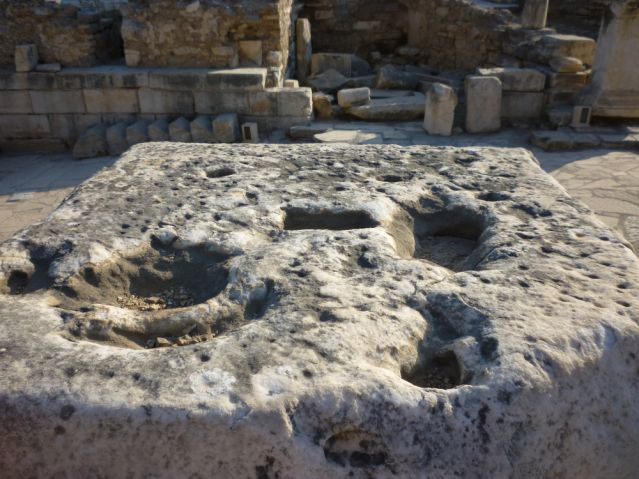
Base moulding with tall simple profile; undecorated shaft with simple torus at the bottom. Crown moulding with sequence of three tori/trochili. Upper part square with beak-like acroteria in relief. Top of the base roughly finished and with various cuttings, including two round dowel holes (not footprints) for the support of a bronze statue. However, the position of these holes indicate that this bronze statue faced the inscription of Dulcitius (LSA-733). The dedication to Messalinus is probably to be associated with some of the other smaller dowel holes (which may have been used to secure a marble statue above).
PROVENANCE AND CURRENT LOCATION
The lower portion of the base was found in 1956 by Miltner, apparently in situ, in front of the Stoa of the Alytarchs; the upper part further west, close to the Baths of Scholasticia (Auinger 2009). The monument is today standing in situ, both portions mounted together.
HONORAND, AWARDER AND DATE
Messalinus, the honorand, was a governor (proconsul) of Asia, as our inscription makes clear ('the best among proconsuls', ἄριστον ἐν ἀνθυπάτοισιν, lines 3-5; PLRE I, 600 Messalinus 1). He is praised for his brilliance and hard work, usual formulae in encomiastic verse inscriptions to late antique governors. Messalinus is known from another inscription in Ephesus, recording a repair by him to the theatre (Inschriften von Ephesos no. 2043).
The statue to Messalinus was set up by the council (boule) of Ephesus (lines 10-11).
Verse inscriptions of this kind were set up to governors throughout the 4th and 5th centuries, and there is at present no way of knowing when within this broad period Messalinus' governorship occurred (Foss 1979, 13 dated it to the later 4th century, but without giving any reasons). All we can be certain of, is that it occurred some time either before or after the governorship of Aelius Claudius Dulcitius of 361/3, since this same base was used for a statue to Dulcitius (LSA-733). If the lower portion of the base was found in situ (see above, 'Provenance and Current Location'), then our dedication to Messalinus, which faces the street, is almost certainly later than that to Dulcitius.
FURTHER DISCUSSION
Evidence for the re-use of bases is so common, that it can with confidence be said to have been the norm for statuary in Late Antiquity. However, this base is a particularly fine example of the practice - with traces of a much earlier original use, and then two successive uses, both for late antique governors (our Messalinus, and Dulcitius LSA-733).
Discussion references
- Auinger, J. 'Zum Umgang mit Statuen hoher Würdenträger in spätantiker und nachantiker Zeit entlang der Kurenstrasse in Ephesos', Vienna 2009, 33
- Foss, C., Ephesus after Antiquity, Cambridge 1979
- Jones, A. H. M. et al., The Prosopography of the Later Roman Empire. Vol. I 260-395, Cambridge et al. 1971 (1975)
- Malcus, B. 'Die Prokonsuln von Asien von Diokletian bis Theodosius II', Opuscula Atheniensa, 7 (1967) 91-154
- Roueche, C. 'The Kuretenstrasse: the Imperial Presence in Late Antiquity', Ladstaetter, S. (ed.), Neue Forschungen zur Kuretenstrasse von Ephesos, Acts of a Symposium for Hilke Thür, December 13, 2006 at the Austrian Academy of Sciences, Vienna 2009
Cite: Last Statues of Antiquity, LSA-730 (A. Sokolicek).