
LSA-731
Base for statue of Nonnus, governor of Asia. Ephesus (Asia). Later fourth to fifth century
Record details
Photographs
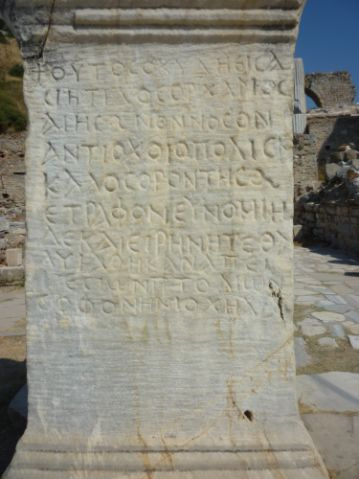
Inscription
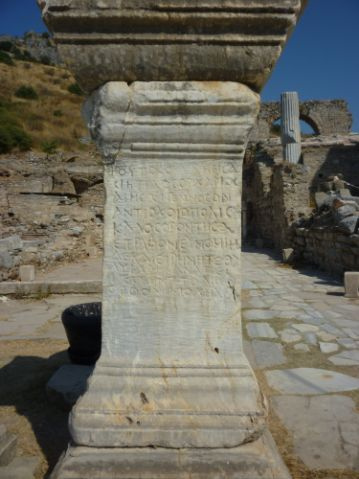
οὗτος ὁ κυδήεις Ἀ/σιήτιδος ὄρχαμος / αἴης Νόννος, ὃν / Ἀντιόχοιο πόλις κ(αὶ) /(5) καλὸς Ὀρόντης / ἔτραφον· Εὐνομίη / δὲ καὶ Εἰρήνη τεθα/λυῖα / (9) θῆκαν ἀπει/ρεσίων πτολίων / σοφὸν ἡνιοχῆα.
Inscription translation
He, the glorious leader of the land of Asia, Nonnus, whom the city of Antioch and the beautiful Orontes nourished. Justice and abounding peace made him the wise driver of innumerable cities.
Bibliography
- Engelmann, H. Knibbe, D. & R. Merkelbach, Die Inschriften von Ephesos Teil IV. Inschriften griechischer Städte aus Kleinasien, vol. 14, Bonn 1980, 166-7, no. 1308
Discussion
INSCRIPTION
Verse inscription of four hexameters laid out in eleven lines:
☩ οὗτος ὁ κυδήεις Ἀ/σιήτιδος ὄρχαμος / αἴης
Νόννος, ὃν / Ἀντιόχοιο πόλις κ(αὶ) /(5) καλὸς Ὀρόντης /
ἔτραφον· Εὐνομίη / δὲ καὶ Εἰρήνη τεθα/λυῖα /
(9) θῆκαν ἀπει/ρεσίων πτολίων / σοφὸν ἡνιοχῆα.
'(cross) He, the glorious leader of the land of Asia, Nonnus, whom the city of Antioch and the beautiful Orontes nourished. Justice and abounding peace made him the wise driver (eniochos) of innumerable cities.'
(Translation J. Lenaghan).
Letter height 3 cm.
In the final line, the image of the 'wise driver of cities' is that of the charioteer who, in poems like the Iliad, guides the hero's chariot through the perils of battle. The same image is used on LSA-747.
DESCRIPTION
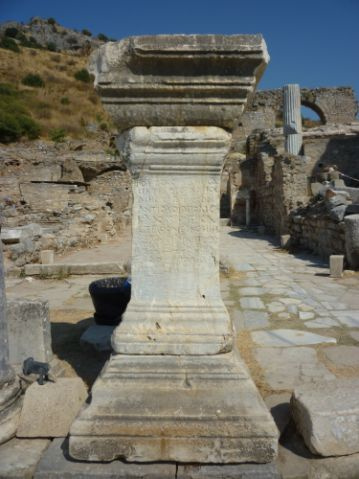
Composite white marble base with separate crown and base mouldings. Total monument, with both mouldings: H 195, W 62, D 60 cm. Shaft (with its own mouldings): H 110, W 62, D 60 cm. Crown and base mouldings: H 39, W 91, D 91 cm.
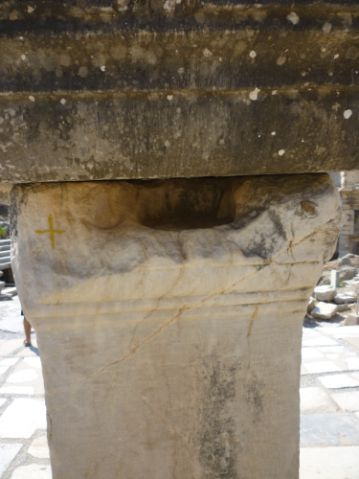
The shaft is a monolithic base for an earlier bronze statue, to which large base and crown mouldings have been added. The base moulding is tall and simple, and sits on a rectangular plinth. The shaft is plain, without a frame for the inscription. It was turned 90 degrees from its original orientation when reused for Nonnus: on what is now the left side of the base, are the flat chisel marks and shallow grooves that testify to the removal of the original inscription.
The crown moulding has an oblique embossment below, and two chamfers above. At its top is a square abacus/plinth with notched corners. The top of the crown has various cuttings, among them those for a bronze statue, facing towards the inscription. Other small cuttings may once have secured a plinth.
When Keil documented this base in the sketchbooks of 1905 he did not discuss the prominent mouldings that now constitute such a major feature of the monument. It is very possible that they are additions that never belonged with the shaft.
PROVENANCE AND CURRENT LOCATION
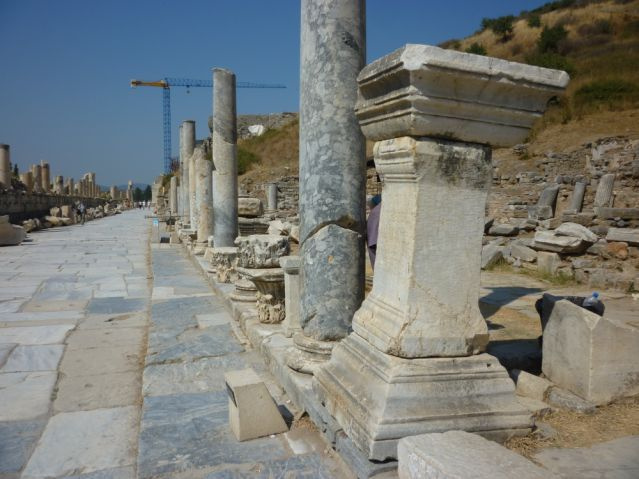
The base was found at the southern end of the 'Marble Street', built into a late wall. It is today set up close to its findspot (Auinger 2009).
HONORAND, AWARDER AND DATE
Nonnus, the honorand, was a high-ranking state official (ὄρχαμος 'leader', line 2), probably a governor (proconsul) of Asia (PLRE II, 787 Nonnus 1; Malcus 1967, 135), as suggested by the references to the 'Asian land' (lines 2-3) and to the 'innumerable cities' (line 10), for which Asia was famous. He is praised for his justice (line 6) and wisdom (line 11), and for the peace resulting from his good governorship.
The awarder of the inscription is not stated. It was possibly the city of Ephesus; the province, however, or another political body - depending on Nonnus' actual office - can not be excluded.
Some of the poetic motifs of our inscription, most notably the lyrical reference to Nonnus' native city Antioch (in lines 4-5), also occur in another Ephesian inscription to a different proconsul of Asia, Isidorus (LSA-729), whose governorship can be dated with confidence to the years between 405 and 410. The wordings of the two inscriptions were therefore closely related by Feissel 1998, 100, and our Nonnus' governorship dated to the very early 5th century by both Robert 1948, 4. 44. 97-8 and Feissel 1998. In our view, however, there is a danger of constructing too tight a chronology and too tight a relationship between the two inscriptions. The inscription to Isidorus (LSA-729) is not from his time in office as proconsul, and could be as late as 435. Moreover, the praise of a man's native land is a standard formula in late antique encomiastic literature, with which honorific verse epigrams like ours are closely related. Furthermore, the inscription to Isidorus is in elegiac distichs, while ours to Nonnus is in hexameters. In short, we see no overriding reason to associate Nonnus' governorship closely with that of Isidorus.
Verse inscriptions to high ranking state officials were in use in the Greek East through the 4th and 5th centuries. The Christian cross which opens our inscription, however, points to a date not earlier than the later 4th century.
Discussion references
- Auinger, J. 'Zum Umgang mit Statuen hoher Würdenträger in spätantiker und nachantiker Zeit entlang der Kurenstrasse in Ephesos', Vienna 2009, 37 (find location)
- Feissel, D. 'Vicaires et proconsuls d’Asie du IVe au VIe siècle. Remarques sur l’administration du diocèse asianique au Bas-Empire', Antiquité tardive. Revue internationale d’histoire et d’archéologie, 6, 91-104, Paris 1998, p. 100
- Malcus, B. 'Die Prokonsuln von Asien von Diokletian bis Theodosius II', Opuscula Atheniensa, 7 (1967) 91-154, 135
- Robert, L., Epigrammes du Bas-Empire (Hellenica IV), Paris 1948, pp. 44. 97-8
Cite: Last Statues of Antiquity, LSA-731 (A. Sokolicek and Ulrich Gehn).