
LSA-732
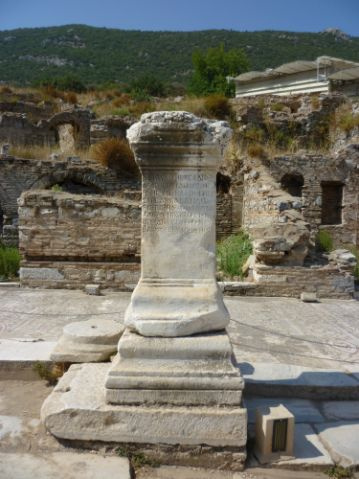
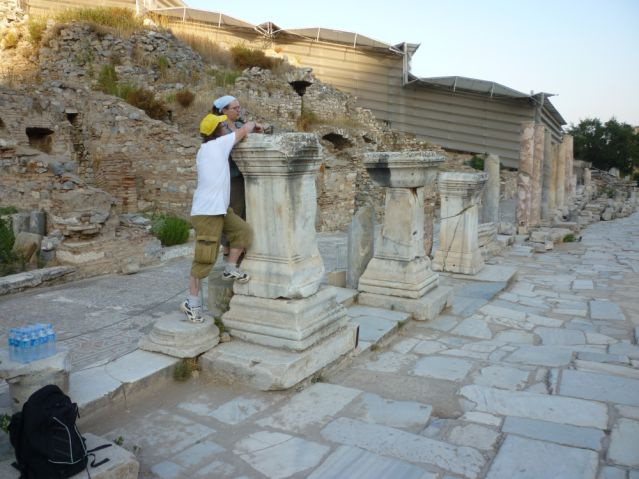
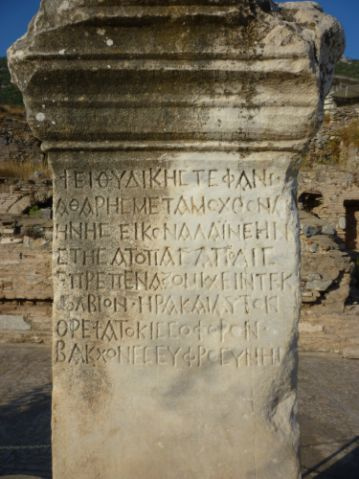
Base for statue of Stephanus, governor of Asia. Ephesus (Asia). Later fourth to fifth century, probably early fifth
Record details
Photographs
Inscription
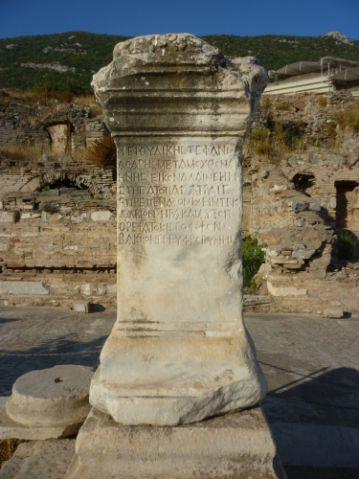
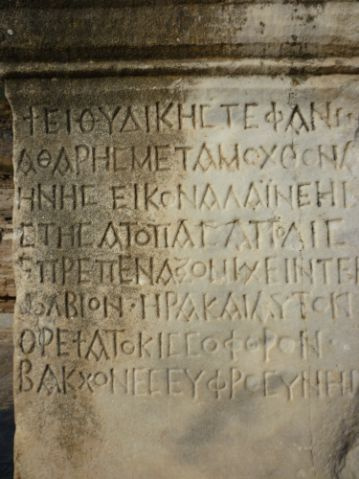
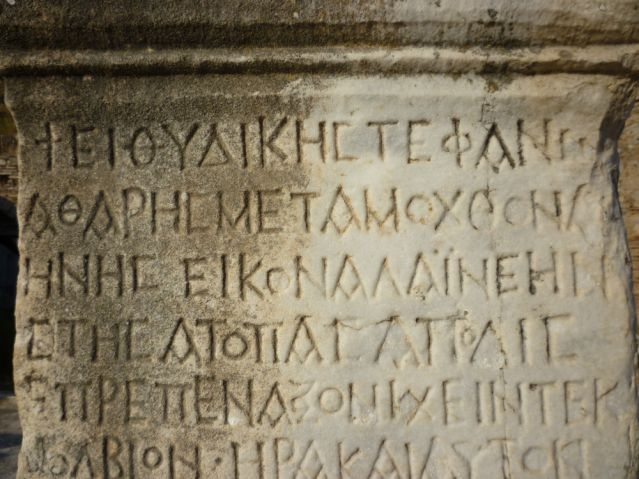
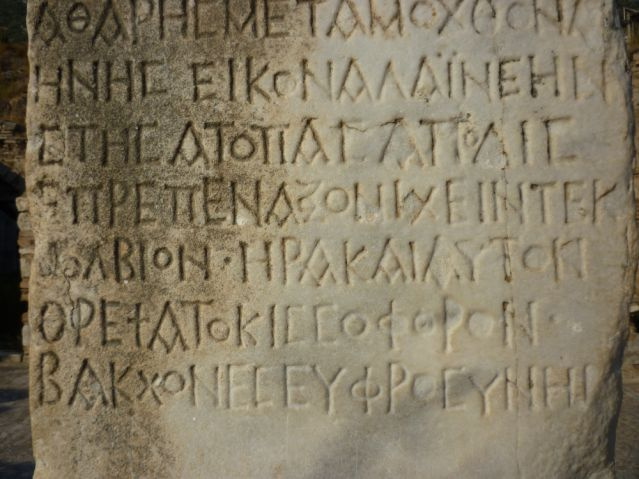
είθυδίκῃ Στεφάνῳ κ/αθαρῆς μετὰ μόχθον ἀ[π]/ήνης
εἰκόνα λαϊνέην / στήσατο πᾶσα πόλις· /(5) ἔπρεπε Νάξον <ἔ>χειν τέκος / ὄλβιον, ἥ ῥα καὶ / αὐτὸν / θρέψατο κισσοφόρον / Βάκχον ἐς εὐφροσύνην.
Inscription translation
For Stephanus the just. After the labour of a spotless chariot, the entire city erected a statue of marble. It was fitting that Naxos had this fortunate son--Naxos which raised for good cheer also that ivy-bearing Bacchus.
Bibliography
- Engelmann, H. Knibbe, D. & R. Merkelbach, Die Inschriften von Ephesos Teil IV. Inschriften griechischer Städte aus Kleinasien, vol. 14, Bonn 1980, 167-8, no. 1310
Discussion
INSCRIPTION
Verse inscription of two elegiac distichs laid out in nine lines:
☩ είθυδίκῃ Στεφάνῳ κ/αθαρῆς μετὰ μόχθον ἀ[π]/ήνης
εἰκόνα λαϊνέην / στήσατο πᾶσα πόλις· /
(5) ἔπρεπε Νάξον <ἔ>χειν τέκος / ὄλβιον, ἥ ῥα καὶ / αὐτὸν /
θρέψατο κισσοφόρον / Βάκχον ἐς εὐφροσύνην.
'(cross) For Stephanus the just. After the labour of a spotless chariot, the entire city erected a statue of marble. It was fitting that Naxos had this fortunate son--Naxos which raised for good cheer also that ivy-bearing Bacchus.'
(Trans J. Lenaghan)
Letter height 2.5 cm.
In lines 2-3, 'the labour of a spotless chariot' (καθαρῆς μετὰ μόχθον ἀπήνης) uses one of the prerogatives of the office of governor, the right to ride in a chariot, as a metaphor for Nonnus' incorruptibility (Gehn 2012, 269).
DESCRIPTION
White marble base, on separately worked base moulding. Base: H 147, W 42, D 42 cm. Moulding: H 39, B 91, D 91 cm. Total H with lower moulding 192 cm.
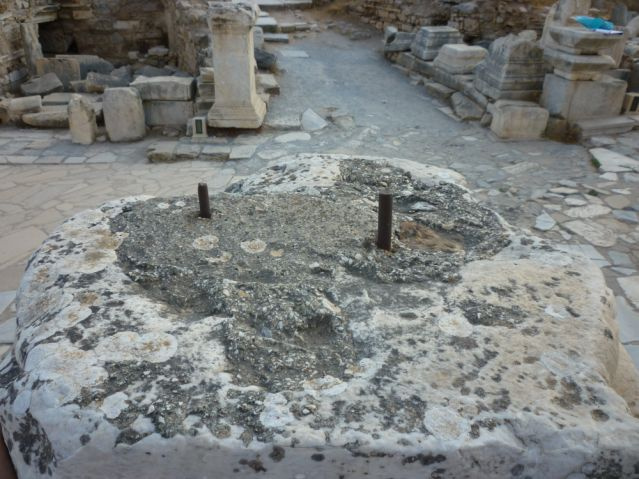
The main part of the base is monolithic, with its own lower and crown mouldings. The separately worked lower moulding is tall and simple, and set on a rectangular plinth. The shaft is plain, with no frame around the inscription. The crown moulding has an oblique embossment below, and two chamfers above. At the top is a square abacus/plinth, with damaged corners, crowned with a wreath with central flower. The top surface has cuttings for a bronze statue, facing towards the inscription, now mainly obscured by modern concrete. These cuttings prove that the base is a reused piece (probabaly of high imperial date), since our inscription is explicit that the statue to Stephanus was of marble.
Close to the base was found a statue (now in the museum), dated stylistically to the late 5th or early 6th century (LSA-698). Since our inscription is almost certainly much earlier in date than this statue (see below), if the latter did stand on our base, our inscription must have been plastered over at the time .
PROVENANCE AND CURRENT LOCATION
Found on the Embolos, in front of the south-east corner of the Baths of Scholasticia in 1956. The base has been moved to the Marble street, where it stands today.
HONORAND, AWARDER AND DATE
Stephanus, the honorand, was a high ranking imperial official with judicial authority (είθυδίκῃ, 'just', line 1), most probably a governor (proconsul) of Asia, here honoured in his provincial capital (PLRE I, 1028-9 Stephanus 3). He is praised for his justice, his toils, and his incorruptibility.
The inscription was set up by the city of Ephesus (στήσατο πᾶσα πόλις, line 4).
The Christian cross which opens the inscription points to a date not earlier than the later 4th century. Feissel 1998, 100-101, and others, have drawn attention to similarities between the wording of our inscription and that of another Ephesian inscription, to the proconsul Isidorus, whose governorship can be confidently be dated to the years between 405 and 410 (LSA-729). In particular the two inscriptions share a verse form (elegiac distichs - however, this is the usual verse throughout the 4th and 5th century), an emphasis, in lyrical terms, on the birthplace of the two governors, and poetic allusions to pagan gods (here Bacchus; in the case of Isidorus, Demeter). Feissel thought that these similarities are close enough to suggest that our inscription to Stephanus may well be roughly contemporary to that of Isidorus, and therefore of the early 5th century (but this leads to a conflict with the date of the belonging statue LSA-698, see above, 'Description').
Discussion references
- Auinger, J. 'Zum Umgang mit Statuen hoher Würdenträger in spätantiker und nachantiker Zeit entlang der Kurenstrasse in Ephesos', Vienna 2009, 33-5
- Feissel, D. 'Vicaires et proconsuls d’Asie du IVe au VIe siècle. Remarques sur l’administration du diocèse asianique au Bas-Empire', Antiquité tardive. Revue internationale d’histoire et d’archéologie, 6, 91-104, Paris 1998
- Gehn, U., Ehrenstatuen in der Spätantike. Chlamydati und Togati, Wiesbaden 2012
- Malcus, B. 'Die Prokonsuln von Asien von Diokletian bis Theodosius II', Opuscula Atheniensa, 7 (1967) 91-154, 132
Cite: Last Statues of Antiquity, LSA-732 (A. Sokolicek & Ulrich Gehn).