
LSA-733
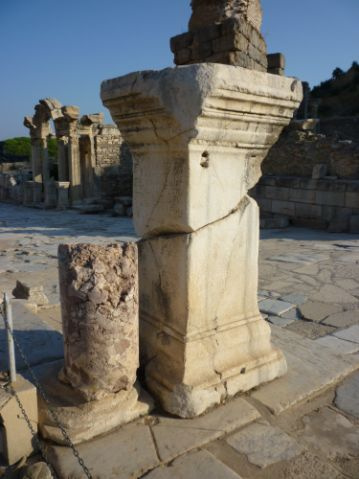
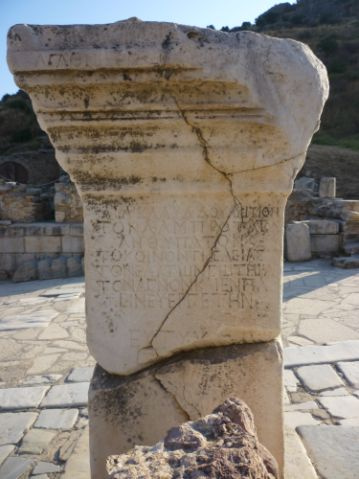
Base for statue of Dulcitius, governor of Asia. Ephesus (Asia). 361-363
Record details
Photographs
Inscription
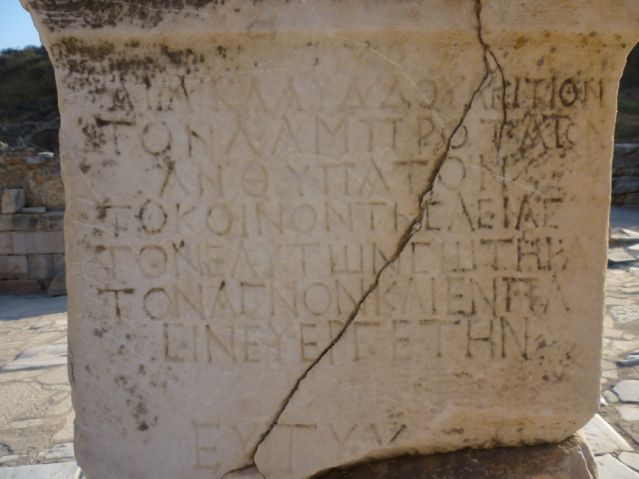
ἀγαθῆι [τύχηι·] / Αἴλ(ιον) Κλαύδ(ιον) Δουλκίτιον / τὸν λαμπρότατον / ἀνθύπατον, /(5) τὸ κοινὸν τῆς Ἀσίας / τὸν ἑαυτῶν σωτῆρα / τὸν ἁγνότατον καὶ ἐν πᾶ/σιν εὐεργέτην· / εὐτυχ[ῶς.]
Inscription translation
'To Good Fortune. Aelius Claudius Dulcitius, governor (proconsul) of clarissimus rank. The assembly (koinon) of Asia [honours] their purest saviour and benefactor in all things. With good luck'.
Bibliography
- Engelmann, H. Knibbe, D. & R. Merkelbach, Die Inschriften von Ephesos Teil IV. Inschriften griechischer Städte aus Kleinasien, vol. 14, Bonn 1980, 168-9, no. 1312
Discussion
INSCRIPTION
In nine lines:
ἀγαθῆι [τύχηι·] / Αἴλ(ιον) Κλαύδ(ιον) Δουλκίτιον / τὸν λαμπρότατον / ἀνθύπατον, /(5) τὸ κοινὸν τῆς Ἀσίας / τὸν ἑαυτῶν σωτῆρα / τὸν ἁγνότατον καὶ ἐν πᾶ/σιν εὐεργέτην· / εὐτυχ[ῶς.]
'To Good Fortune. Aelius Claudius Dulcitius, governor (proconsul) of clarissimus rank. The assembly (koinon) of Asia [honours] their purest saviour and benefactor in all things. With good luck'.
(Trans J. Lenaghan)
Letter height 3 - 5 cm.
DESCRIPTION
Monolithic white marble base: H 178, W 86, D 86 cm. Broken at two-thirds height, but reassembled by its excavator, Miltner. The base has been used three times: on the opposite side to our inscription there is the trace of a high-imperial use, and an inscription to another late antique governor, Messalinus (LSA-730).
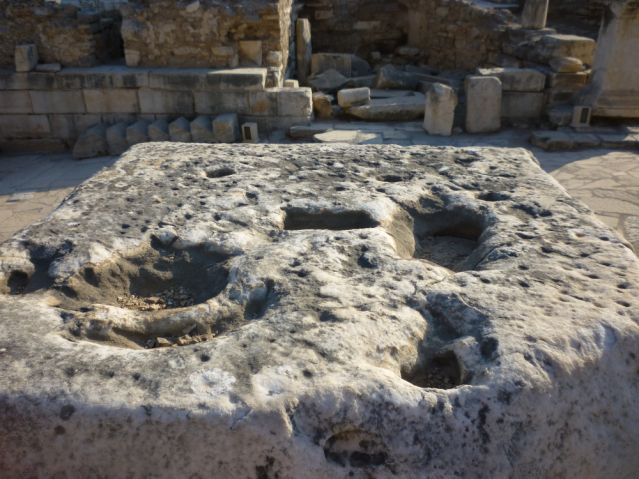
Base moulding with tall simple profile; undecorated shaft with simple torus at the bottom. Crown moulding with sequence of three tori/trochili. Upper part square with beak-like acroteria in relief. Top of the base roughly finished and with various cuttings, including two round dowel holes (not footprints) for the support of a bronze statue. The position of these holes indicate that this bronze statue faced our inscription to Dulcitius.
PROVENANCE AND CURRENT LOCATION
The lower part of the base was found by Miltner in 1956, apparently in situ, in front of the Stoa of the Alytarchs; the upper part further west close to the Baths of Scholasticia. The base is today standing where the lower part was found, both portions mounted together.
HONORAND, AWARDER AND DATE
Aelius Claudius Dulcitius, the honorand, was governor (proconsul) of Asia during the sole reign of Julian in 361/3 (PLRE 1, 274 Aelius Claudius Dulcitius 5). He himself set up statues to his imperial benefactor, including two at Ephesus (Bringmann 2008; LSA-713, LSA-748).
Our base was set up by the asembly (koinon) of the province of Asia (line 5).
FURTHER DISCUSSION
Evidence for the re-use of bases is so common, that it can with confidence be said to have been the norm for statuary in Late Antiquity. However, this base is a particularly fine example of the practice - with traces of a much earlier original use, and then two successive uses, both for late antique governors (our Dulcitius, and Messalinus LSA-730).
Discussion references
- Bringmann, K., Julian, Kaiser und Philosoph, C. Schaefer (ed.), Kaiser Julian 'Apostata' und die philosophische Reaktion gegen das Christentum, 87-104, Berlin 2008
- Malcus, B. 'Die Prokonsuln von Asien von Diokletian bis Theodosius II', Opuscula Atheniensa, 7 (1967) 91-154, 137
Cite: Last Statues of Antiquity, LSA-733 (A. Sokolicek).