
LSA-734
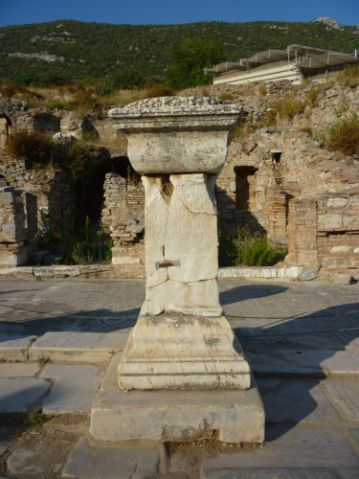
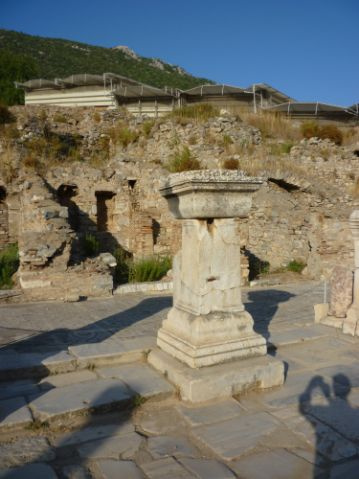
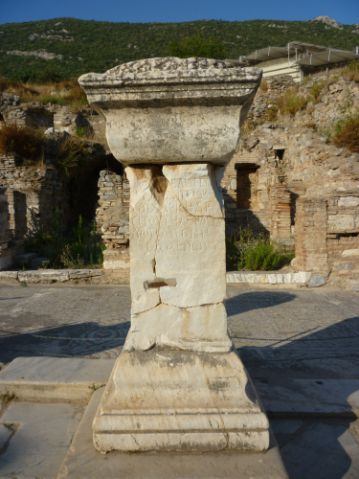
Base for statue of Probus, benefactor. Ephesus (Asia). Probably fifth century
Record details
Photographs
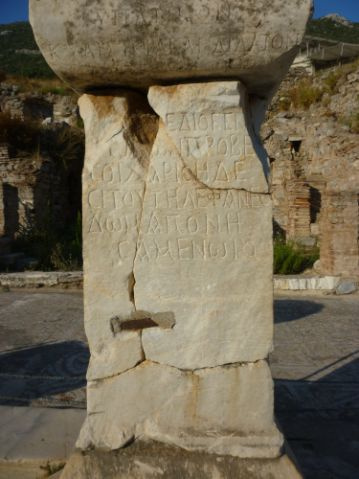
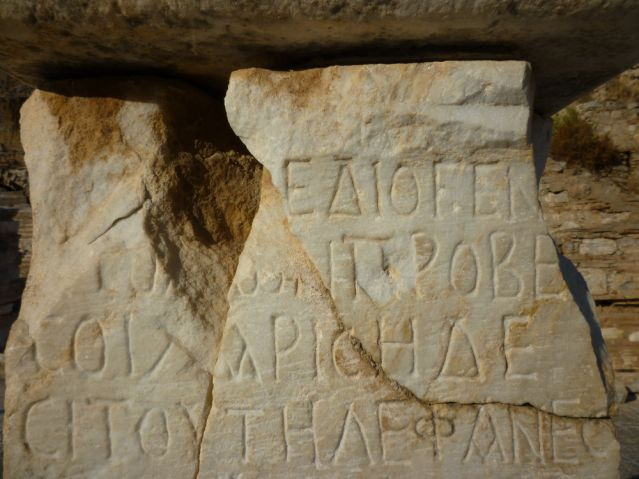
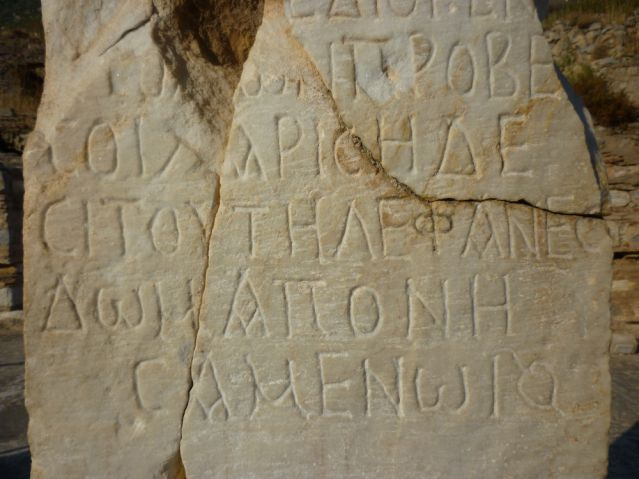
Inscription
[ἠνίδ]ε διογέν[ες] / μ̣όχ̣[θ]ων Πρόβε / σοι χάρις ἥδε /
σίτου τηλεφανὲς /(5) δῶμα πονησαμένωι.
Inscription translation
See here, Probus, sprung from Zeus, a thanks for your labours, for you who toiled for a house of food visible from afar.
Bibliography
- Engelmann, H. Knibbe, D. & R. Merkelbach, Die Inschriften von Ephesos Teil IV. Inschriften griechischer Städte aus Kleinasien, vol. 14, Bonn 1980, 167, no. 1309
Discussion
INSCRIPTION
Verse inscription of one elegiac distich laid out in five lines:
[ἠνίδ]ε διογέν[ες] / μ̣όχ̣[θ]ων Πρόβε / σοι χάρις ἥδε /
σίτου τηλεφανὲς / δῶμα πονησαμένωι. (ivy leaf)
'See here, Probus, sprung from Zeus, a thanks for your labours, for you who toiled for a house of food visible from afar. (ivy leaf)'
(Trans J. Lenaghan)
Letter height 5 cm.
DESCRIPTION
Composite reused white marble base. Shaft: H 80, W 53, D 45 cm; total: H 150, W 72, D 72 cm.
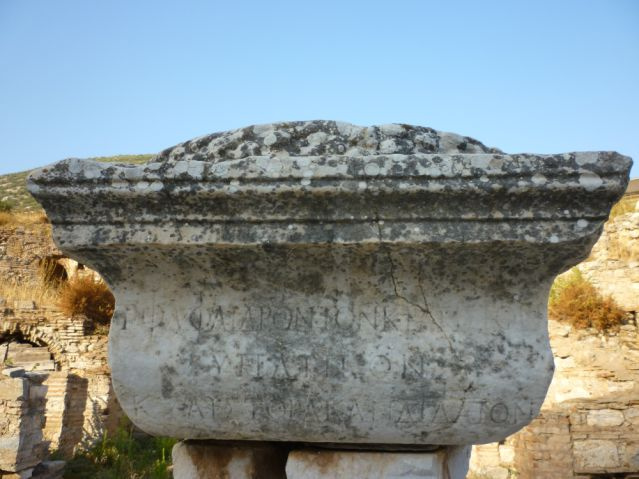
Reused composite base for bronze statue. Shaft broken in various pieces, and reassembled by its excavator, Miltner. Base moulding tall and simple, standing on a worked plinth. Crown moulding tall and simple with a laurel wreath on top. Cuttings on the top surface suggest that the statue for Probus was of marble; but only if the crown moulding belongs to this ensemble (which is not certain). The crown moulding bears an earlier inscription (Inschriften von Ephesos no. 677); as reassembled by Miltner, this faces the same way as our inscription, but is more likely to have been turned to the back.
PROVENANCE AND CURRENT LOCATION
The inscription was found on the Embolos in 1956, in front of the Stoa of the Alytarchs, near the base for Messalinus (LSA-730) (Auinger 2009). It is today set up close to its findspot.
HONORAND, AWARDER AND DATE
***ALEXANDER, THIS NEEDS TO BE IN THE DISCUSSION BIBLIOGRAPHY: U. Quatember - V. Scheibelreiter - A. Sokolicek, Die sog. Alytarchenstoa an der Kuretenstraße, in: S. Ladstätter (Hrsg.), Neue Forschungen zur Kuretenstraße von Ephesos. Akten des Symposiums für Hilke Thür vom 13. Dez. 2006 an der ÖAW. AForsch 15 (Wien 2009) 111-154.***
Probus, the honorand, is praised for having built a granary (σίτου ... δῶμα πονησαμένωι, lines 4-5). This reference to a very particular benefaction, and the absence of any of the usual motifs associated with high imperial office-holders (in particular the motif of justice), show that he is a local benefactor, otherwise unknown.
In the Greek East, verse inscriptions to local benefactors appear as early as around 200; in Late Antiquity, building activity was normally under the supervision of the provincial governor. However, our base has been dated to the 5th cent (Quatember - Scheibelreiter - Sokolicek 2009, 120) because the other bases set up in front of the Alytarch's stoa date from that period, when the stoa itself was renovated. An earlier date cannot be excluded, but it would be remarkable if the statue of a local man, who is otherwise unknown, would have survived serious renovations of this area.
Discussion references
- Auinger, J. 'Zum Umgang mit Statuen hoher Würdenträger in spätantiker und nachantiker Zeit entlang der Kuretenstrasse in Ephesos', Neue Forschungen zur Kuretenstrasse von Ephesos : Akten des Symposiums für Hilke Thür vom 13. Dezember 2006 an der Österreichischen Akademie der Wissenschaften, Vienna 2009, 30 (find location)
Cite: Last Statues of Antiquity, LSA-734 (A. Sokolicek).