
LSA-735
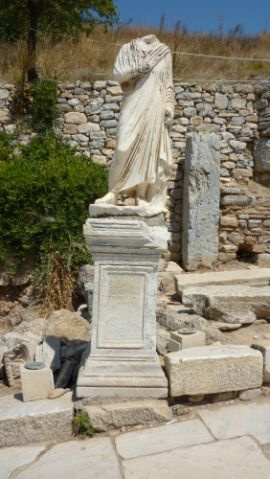
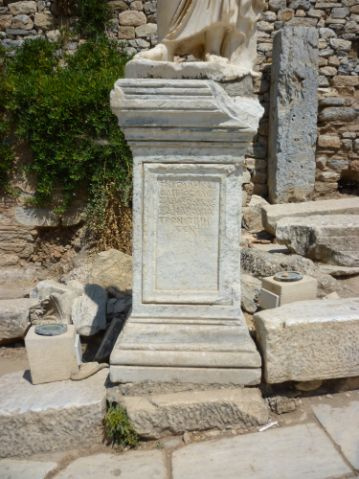
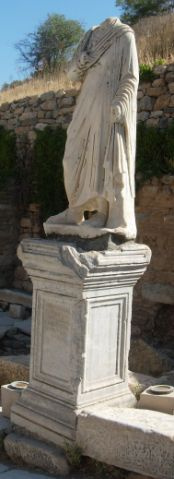
Base, with statue (LSA-736), of the doctor Alexander. Ephesus (Asia). Late fourth to fifth century, perhaps circa 380
Record details
Photographs
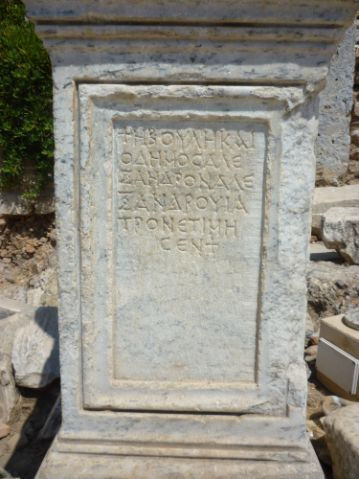
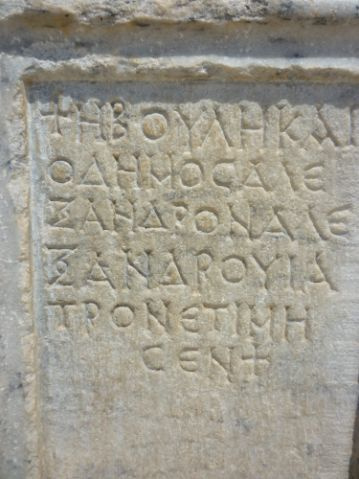
Inscription
ἡ βουλὴ καὶ / ὁ δῆμος Ἀλέ/ξανδρον Ἀλε/ξάνδρου ἰα/τρὸν ἐτίμη/σεν ☩.
Inscription translation
(cross) The council (boule) and people (demos) have honoured Alexander, the doctor, son of Alexander.(cross)
.
Bibliography
- Engelmann, H. Knibbe, D. & R. Merkelbach, Die Inschriften von Ephesos Teil IV. Inschriften griechischer Städte aus Kleinasien, vol. 14, Bonn 1980, 172, no. 1320
Discussion
INSCRIPTION
In six lines:
☩ ἡ βουλὴ καὶ / ὁ δῆμος Ἀλέ/ξανδρον Ἀλε/ξάνδρου ἰα/τρὸν ἐτίμη/σεν ☩.
'(cross) The council (boule) and people (demos) have honoured Alexander, the doctor, son of Alexander.(cross)'
Letter height 3 cm.
DESCRIPTION
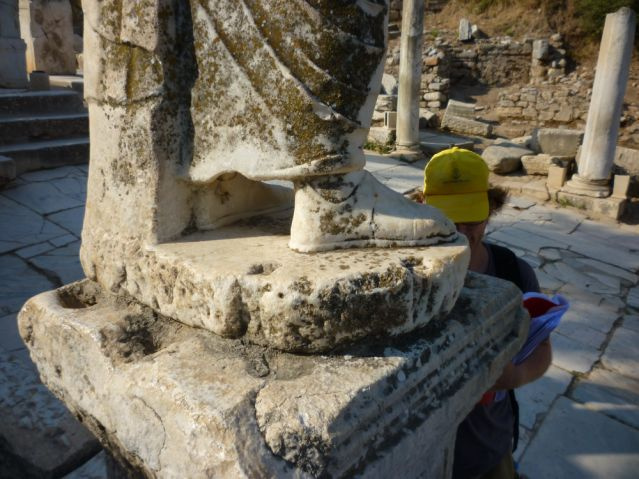
Monolithic rectangular base of white marble, with mouldings on all sides at top and bottom: H 135, W 70, D 72 cm. On the top face there are traces of the fixings for an earlier bronze statue. The top face is today largely obscured by modern concrete, with the statue that was found close by (LSA-736) set on top of it.
PROVENANCE AND CURRENT LOCATION
The base was found in situ by F. Miltner in 1956, together with the statue, at the eastern end of the Embolos, west of the Heracles gate. It is there today standing in situ.
HONORAND, AWARDER AND DATE
The honorand, the doctor Alexander, is not known from other evidence.
The awarder was the council and people of the city.
The Christian crosses that open and close our inscription date it securely to the late-antique period, probably no earlier than the later fourth century. Its findspot, apparently in situ, may enable us to narrow the dating to the period around 380. Our base stands at the eastern end of a row of nine bases on the north side of the Curetes Street, which bore eight statues of Nike (Victory) and a statue of the empress Flacilla (the latter datable to between 379 and 386, LSA-723). The Nike bases are high-imperial in date, but assembled and set up here in Late Antiquity (Roueché 2002). Our base is set up immediately adjacent to these bases, and may be roughly contemporary, though of course Alexander is a rather different figure to Flacilla or the Nikes.
The statue (LSA-736) found next to the base in 1956 is of a man wearing a himation, datable to the high-imperial period, but (with the head lightly reworked) this could well have served for our late-antique Alexander.
Discussion references
- Auinger, J. 'Zum Umgang mit Statuen hoher Würdenträger in spätantiker und nachantiker Zeit entlang der Kurenstrasse in Ephesos', Vienna 2009, 35-6, figs. 15 and 17
Cite: Last Statues of Antiquity, LSA-735 (A. Sokolicek).