
LSA-736
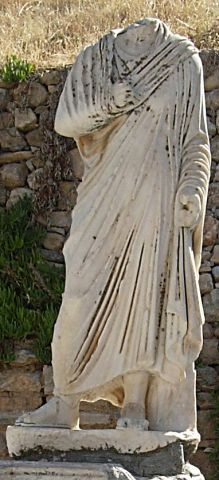
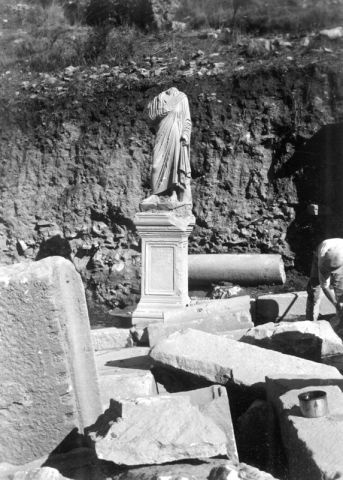
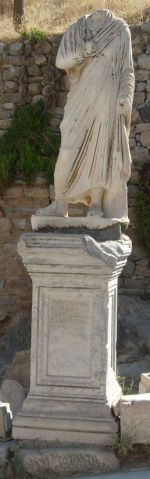
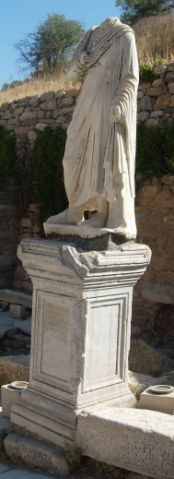
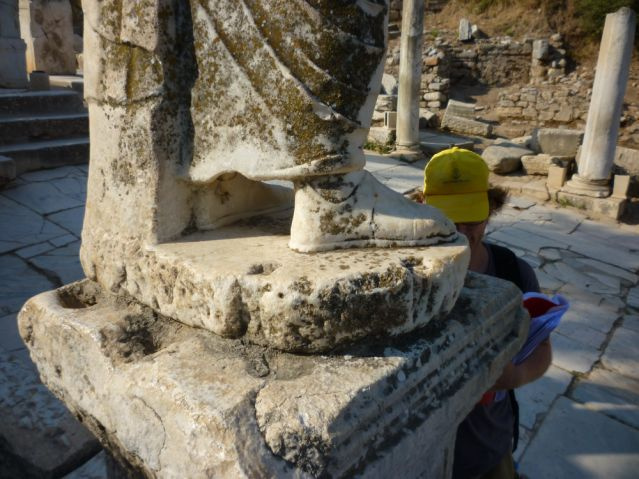
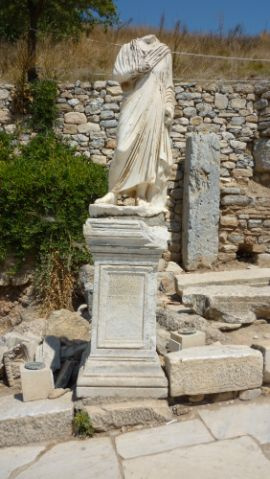
Himation statue re-used for doctor Alexander (see LSA-735). Ephesus. Second to fourth century.
Record details
Photographs
Bibliography
- Miltner, F. '22. Vorläufiger Bericht über die Ausgrabungen in Ephesos', Jahreshefte des Österreichischen Archäologischen Institutes in Wien 44, 243-314, Vienna 1959, 352, fig.191
Discussion
DESCRIPTION (Object):
Overlife-size statue. H: 192 cm. Coarse-grained, white to greyish marble.
Head and most of the fingers of both hands and attribute of the left hand broken off. Parts of the plinth are missing in front and on the back side. Some folds and the edges of the toes are damaged.
Drill used for the deep folds, in particular in the #Armschlinge# and the folds running from the right ankle to the left hip.
Whole front was polished, and the backside carefully flattened. Font of the plinth worked with the thooth-chisel, the other sides are rough chiseled.
PROVENANCE:
Embolos, north side at the east end in front of a stoa, found in 1957.
He was found near the base for a doctor Alexandros LSA-735, maybe above the demolition layer of the stoa. The tabernae in the backwall of the stoa were in use until the end of the sixth and beginning of the seventh century.
DESCRIPTION (Subject):
Statue of an elder man with deep wrinkles on his neck. Standing with weight over the left leg. A kubus shaped support beside his left foot. He is dressed in a tunica, which is seen in front of the neck, and a himation in a thight #Armschlinge#. Left arm is held along the side of the body, left hand holding maybe once a scroll. He is wearing sandals.
DATE:
Polaschek grouped some palliati around the statue of Alexandros in middle-antonine time, around 160-70. She compared the group with column-sarcophagi, which are dated by the architectural ornaments.
Discussion references
- Auinger, J. 'Zum Umgang mit Statuen hoher Würdenträger in spätantiker und nachantiker Zeit entlang der Kurenstrasse in Ephesos', Vienna 2009, 35-6, figs. 15-17
- Auinger, J. and M. Aurenhammer. 'Ephesische Skulptur am Ende der Antike', Byzanz – das Römerreich im Mittelalter. Teil 2, 2 Schauplätze, Mainz 2010, 22-23, fig. 29. 33
Cite: Last Statues of Antiquity, LSA-736 (J. Auinger).