
LSA-740
Base recording a statue set up by Aedesius, and one dedicated to him. Ephesus (Asia). Third to fourth century
Record details
Photographs
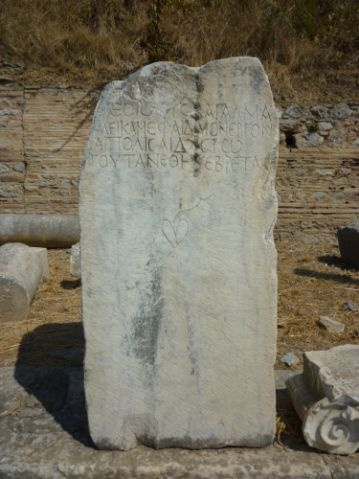
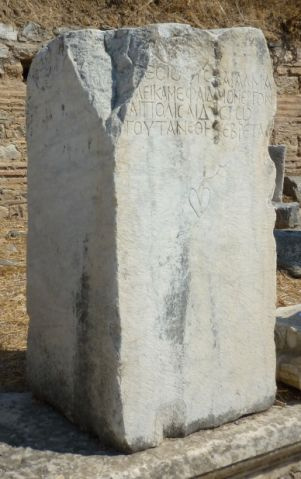
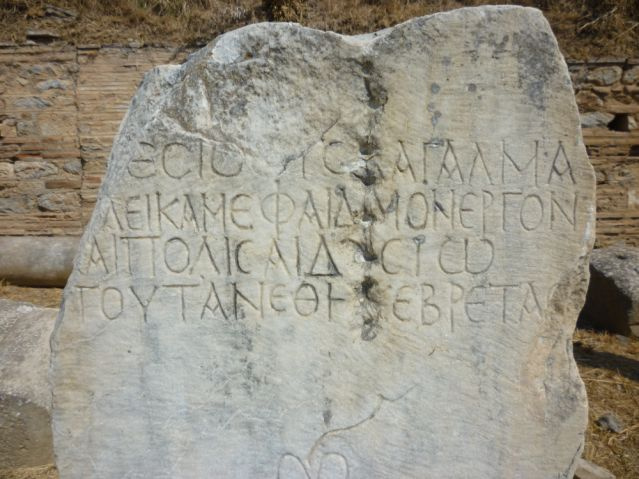
Inscription
[Aἰδ]έσιος τόδ’ἄγαλμα / [π]όλει κάμε φαίδ[ι]μον ἔργον· / καὶ πόλις Αἰδ[ε]σίῳ / τοῦτ’ ἀνέθηκε βρέτας (ivy leaf)
Inscription translation
Aedesius made this statue for the city, an astonishing work. And the city set up this image to Aedesius. (ivy leaf)
Bibliography
- Engelmann, H. Knibbe, D. & R. Merkelbach, Die Inschriften von Ephesos Teil IV. Inschriften griechischer Städte aus Kleinasien, vol. 14, Bonn 1980, 172, no. 1319
Discussion
INSCRIPTION
Verse inscription of one elegiac distich laid out in four lines:
[Aἰδ]έσιος τόδ’ἄγαλμα / [π]όλει κάμε φαίδ[ι]μον ἔργον· /
καὶ πόλις Αἰδ[ε]σίῳ / τοῦτ’ ἀνέθηκε βρέτας. (ivy leaf)
'Aedesius made this statue for the city, an astonishing work. And the city set up this image to Aedesius. (ivy leaf)'
Letter height 4 - 4.5 cm.
The inscription clearly refers to two statues, an ἄγαλμα and the portrait statue of Aidesius (see below, 'Honorand, Awarder and Date').
DESCRIPTION
White marble shaft from a composite base: H 117, W 58, D 58 cm.
The shaft is without decoration, and damaged at the top (it is missing the top left corner). In the centre of the top face, is a shallow square cutting, presumably for fixing a crown moulding above. Towards the top on the front face there is a row of drilled holes, cut into the inscription, presumably from a later phase preparatory to cutting up the block for re-use.
PROVENANCE AND CURRENT LOCATION
Found in 1905 by R. Heberdey on the northern side of the Marble Street. Today set up at its findspot.
HONORAND, AWARDER AND DATE
Aedesius, the honorand, is honoured for having created (or, perhaps more likely, financed) a statue for the city. He was identified by Foss 1979, 22 with the philosopher of that name, a pupil of Iamblichus the Elder, and founder of a Neoplatonist school at Pergamum in the 4th century. There is, however, no reference to intellectual brilliance in our inscription, as one would expect for a philosopher. It seems to us most likely that Aedesius was an otherwise unknown local man (he is very unlikely to have been an imperial office-holder, since none of the common motifs for office-holders appear in his inscription). Since the inscription refers to the beauty of the statue he provided, he may possibly have been the owner of a sculptor's workshop. References to sculptors are known from 4th century-inscriptions at Aphrodisias.
The inscription refers to two statues, one (the ἄγαλμα) that was made or provided by Aedesius himself, and one (the βρέτας), on top of our base, that was set up to him in gratitude. The statue that Aedesius gave to the city must have stood very close to our base, since the inscription refers to it as though it were present.
Our base was set up by the city of Ephesus (line 3).
Verse inscriptions to local notables are known in the Greek East from the early 3rd century onwards; our inscription could be as late as the 5th century, but is perhaps more likely to date from the 3rd or 4th centuries.
Cite: Last Statues of Antiquity, LSA-740 (A. Sokolicek and Ulrich Gehn).