
LSA-742
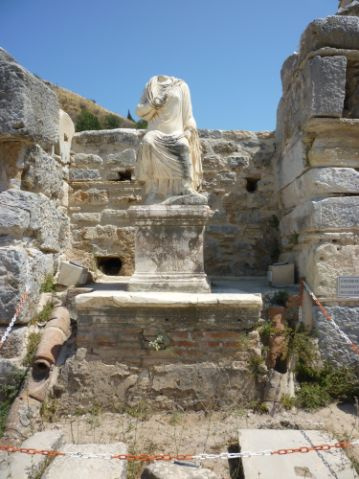
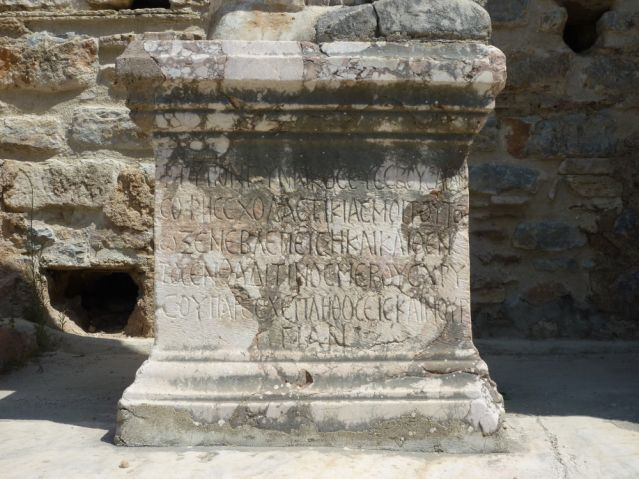
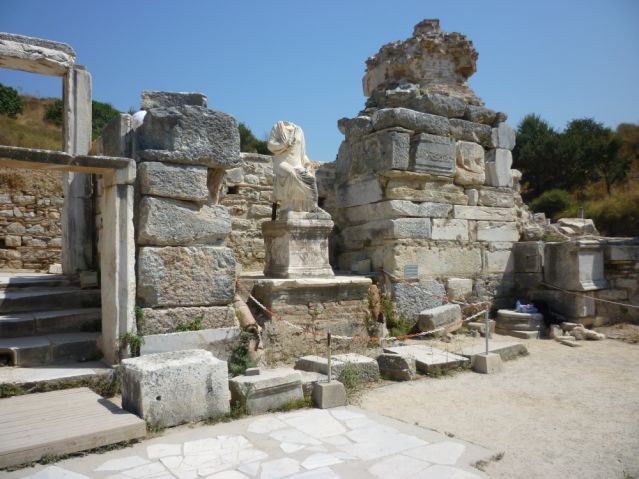
Base for seated statue of Scholasticia (LSA-741). Ephesus (Asia). Late fourth to fifth century
Record details
Photographs
Inscription
τύπον γυναικὸς εὐσεβοῦς λίαν / σοφῆς
Σχολαστικίας μοι τοῦτο(ν) /(3) ὦ ξένε βλέπεις
ἣ καὶ κλιθέν/τος ἐνθαδί τινος μέρους
χρυ/σοῦ παρέσχε πλῆθος εἰς καινου/γίαν.
Inscription translation
(cross) Stranger you see this statue of a very pious learned woman Scholasticia who, with some part here having fallen down, provided an amount of gold for the renovation.
Bibliography
- Wankel, H. et al., Die Inschriften von Ephesos II. Inschriften griechischer Städte aus Kleinasien vol. 12, Bonn 1979, 169, no. 453
Discussion
INSCRIPTION
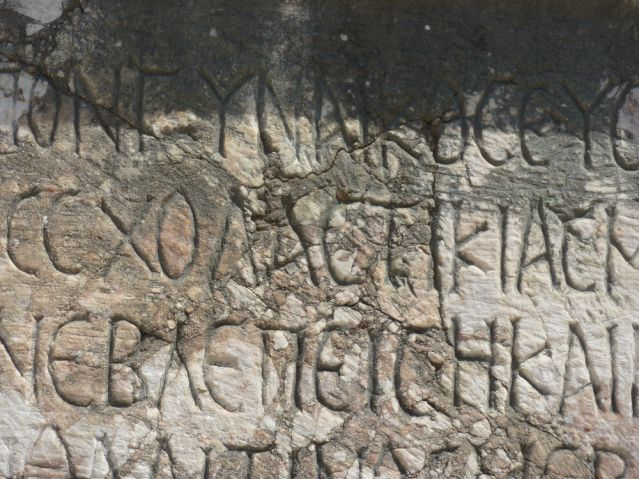
Verse inscription laid out in six lines
☩ τύπον γυναικὸς εὐσεβοῦς λίαν / σοφῆς
Σχολαστικίας μοι τοῦτο(ν) /(3) ὦ ξένε βλέπεις
ἣ καὶ κλιθέν/τος ἐνθαδί τινος μέρους
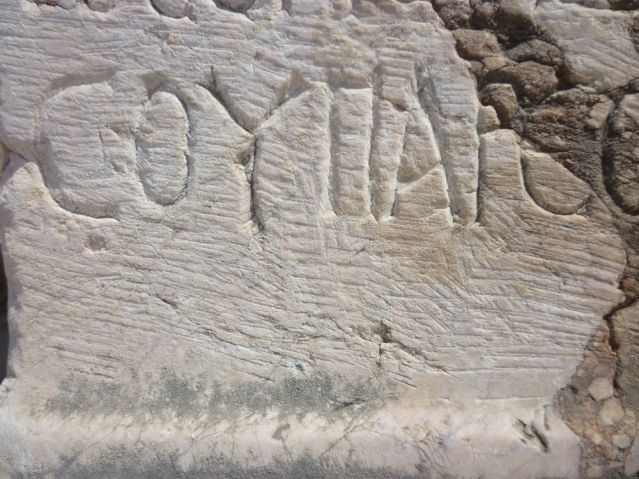
χρυ/σοῦ παρέσχε πλῆθος εἰς καινου/γίαν.
'(cross) Stranger you see this statue of a very pious learned woman, Scholasticia, who, with some part here having fallen down, provided an amount of gold for the renovation.' (Translation J. Lenaghan)
Letter height 5 cm.
DESCRIPTION
Base of marble with prominent red veins: H 88, W 86, D 87 cm.
Small, cube-shaped base with upper and lower mouldings. Upper moulding with beak-like acroteria in profile. The back is in a rough, quarry state. The front has a claw finish, typical of late antique bases in Ephesus. The right side is smooth, evidence probably of an earlier use. The top of the base is today obscured by modern concrete, with the statue of Scholasticia (LSA-741) placed upon it.
Both the form and the material of this base are exceptional for Ephesus, where there are no other such cube-shaped bases, and no other bases in coloured marble. Before being used as a statue base for Scholasticia, it was certainly an architectural element, such as a plinth for a column.
PROVENANCE AND CURRENT LOCATION
The base was found in the apse-hall of the 'Baths of Scholasticia', which now bear her name, where it remains in situ.
HONORAND, AWARDER AND DATE
Scholasticia, the honorand, is praised for her piety - securely Christian piety, as indicated by the cross that opens the inscription - her generosity, and her learning (PLRE II, 982 Scholasticia; Foss 1979, 70-1. 80. 96). She is otherwise unknown, but is an interesting figure since private benefactors are rare during Late Antiquity, and independent benefactions by women even rarer.
The awarder is not stated.
The Christian cross indicates a date not earlier than the later 4th century; Foss 1979 proposed a date in the 5th century on the basis of the letter forms.
Discussion references
- Foss, C., Ephesus after Antiquity, Cambridge 1979
- Martindale, J. R., The Prosopography of the Later Roman Empire. Vol. II A.D. 395-527, Cambridge 1980
Cite: Last Statues of Antiquity, LSA-742 (A. Sokolicek).