
LSA-744
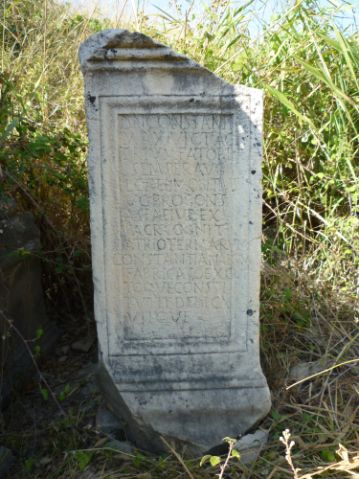
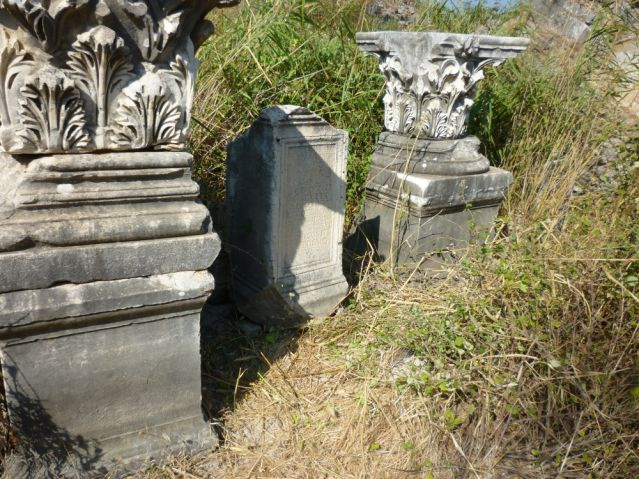
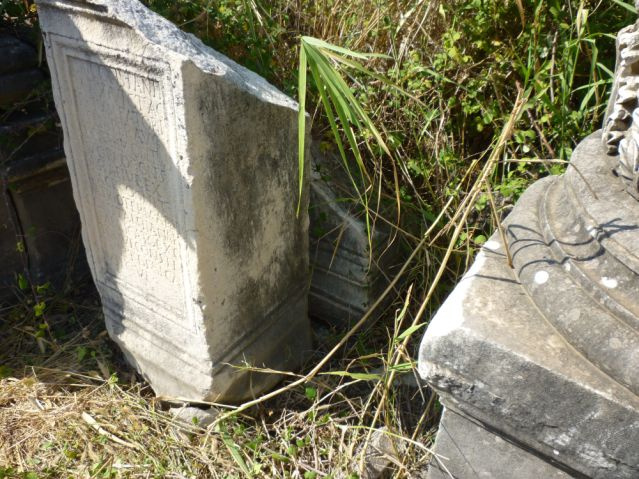
Base for statue of Constans, emperor. Ephesus (Asia). Mid-fourth century. 340-350
Record details
Photographs
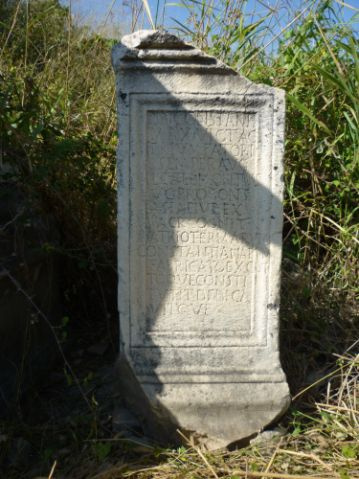
Inscription
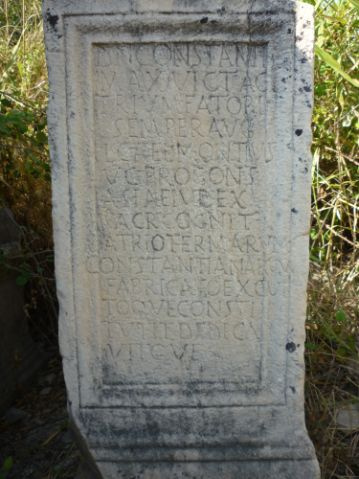
D(omino) n(ostro) Constanti / max(imo) vict(ori) ac / triumfatori / semper Aug(usto), /(5) L(ucius) Cael(ius) Montius, / v(ir) c(larissimus), procons(ul) / Asiae, iudex / sacr(arum) cognit(ionum), / atrio thermarum /(10) Constantianarum / fabricato excul/toque consti/tutit (sic) dedica/vitque.
Inscription translation
To our lord Constans, greatest victor and most triumphant, forever Augustus. Lucius Caelius Montius, of clarissimus rank, governor (proconsul) of Asia, judge in the imperial court of appeal, set up and dedicated [this] in the atrium of the Baths of Constantius, built and decorated [by him?] .
Bibliography
- Engelmann, H. Knibbe, D. & R. Merkelbach, Die Inschriften von Ephesos Teil IV. Inschriften griechischer Städte aus Kleinasien, vol. 14, Bonn 1980, no. 1314
Discussion
INSCRIPTION
In 14 lines:
D(omino) n(ostro) Constanti, / max(imo) vict(ori) ac / triumfatori, / semper Aug(usto), /(5) L(ucius) Cael(ius) Montius, / v(ir) c(larissimus), procons(ul) / Asiae, iudex / sacr(arum) cognit(ionum), / atrio thermarum /(10) Constantianarum / fabricato excul/toque consti/tutit (sic) dedica/vitque.
'To our lord Constans, greatest victor and most triumphant, forever Augustus. Lucius Caelius Montius, of clarissimus rank, governor (proconsul) of Asia, judge in the imperial court of appeal, set up and dedicated [this] in the atrium of the Baths of Constantius, built and decorated [by him?] .'
The words overlap the frame of the inscription at the right end in lines 5, 9 and 11; and at both ends in line 10, for the very long word 'Constantianarum'.
Letter height 5 cm.
DESCRIPTION
White marble base, with integral base and crown moulding: H 133, W 47, D 50 cm.
Though its full height is preserved, almost all of the top of the base is broken off, as is the bottom left corner. The inscription is carved within a moulded frame. The fact that the inscription overlaps its frame is evidence that our base is a reused piece.
PROVENANCE AND CURRENT LOCATION
The base was found during the excavations of 1897 by R. Heberdey in the debris of the Harbour Baths on the east side of the large entrance hall, and has been set up close to its findspot on the north side of the hall.
The building referred to in our inscription, the 'Baths of Constantius', where this base was set up, is now known as the 'Harbour Bath-Gymnasium'. It was built in the 1st century A.D., renovated by Pius Artorius Maximus at the end of the 3rd century (LSA-724), and renamed under Constantius. A very fragmentary inscription (LSA-2080), with part of the same wording as our inscription, suggests that Montius set up a second statue, presumably to Constans' co-emperor Constantius II, at the same time and in the same place as our dedication. The wording of our inscription is not explicit, but strongly implies that Montius built (in reality, probably repaired) the atrium of the baths.
HONORAND, AWARDER AND DATE
Constans, the honorand, was Augustus 337-50.
Lucius Caelius Montius, the awarder, was governor (proconsul) of Asia sometime in the period between 337 and 350 (PLRE I, 608, L. Caelius Montius; Robert 1948, 110-14). He set up bases to Constantius II (Augustus 337-61) and Constans in both Ephesus (our base, LSA-739, LSA-2079, LSA-2080) and Assos (LSA-291). He was himself honoured with statues in Klazomenai (LSA-286) and Tralles (LSA-521); he was probably the same man as the proconsul Montius Magnus to whom Libanius dedicated his Argumenta Demosthenis (PLRE I, 535-6, Magnus Montius 11). If so, his governorship of Asia must date to before the year 351, when Montius Magnus is recorded in the higher office of quaestor sacri palatii (a dating also supported by the dedications to Constans, since this emperor died in 350).
The fact that none of the several surviving imperial dedications set up by Lucius Caelius Montius are to the third son of Constantine I, Constantine II, strongly suggests that his governorship and his dedications date to the period after this emperor's death in 340. Our inscription can therefore be dated, with reasonable confidence, to the period 340-50.
FURTHER DISCUSSION
A very fragmentary inscription, found close by (LSA-2080), is almost certainly part of a base set up by Lucius Caelius Montius at the same time as our base to Constans, to his co-emperor Constantius II.
Discussion references
- Malcus, B. 'Die Prokonsuln von Asien von Diokletian bis Theodosius II', Opuscula Atheniensa, 7 (1967) 91-154, 102
- Robert, L., Epigrammes du Bas-Empire (Hellenica IV), Paris 1948, 110-14
Cite: Last Statues of Antiquity, LSA-744 (A. Sokolicek).