
LSA-750
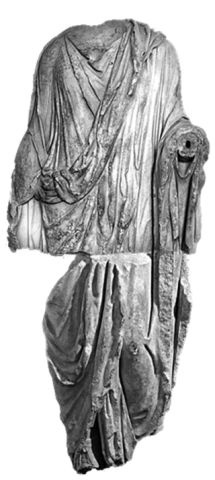
Togate portrait statue of emperor (see also LSA-196). Aphrodisias. Later fourth century.
Record details
Photographs
Bibliography
- Smith, R.R.R., S. Dillon, C.H. Hallett, J. Lenaghan, and J. Van Voorhis, Aphrodisias II: Roman Portrait Sculpture at Aphrodisias, Mainz 2006, 112-113, no. 4, pl. 11
Discussion
DESCRIPTION (Object)
Life-size statue, missing separately worked head H: c. 150, W: 58, D: 28 cm. Medium-grained white marble.
The statue is life-size for a child and was composed of three separately worked pieces: body, head, and left hand. It is currently preserved in four separate pieces. (1) the upper body preserved to the hips; (2) the right forearm and wrist; (3) the lower body from roughly the thighs to the ankles; (4) a fragment of the sinus on the outside and back of the right leg. None of the four pieces have been reattached in the modern era.
The statue is currently missing the separately worked head and the separately worked left wrist. Also missing are an area at the right hip; most of the sinus along the outside of the right leg; the front of the right foot; the lower edge of the lacinia, the left shin, ankle, and foot; and the plinth. The body has a highly visible rasp finish.
The statue was adapted to receive a new head. The socket for the head is small, shallow, and has a small cutting for a dowel which is still partially preserved.
PROVENANCE
The fragments were found scattered in and around the Tetrastoon and the medieval wall between the Tetrastoon and the stage building of the Theatre. The right arm and sinus fragment were found inside the Tetrastoon with the head which has been associated with LSA-196 . The upper body was found in the medieval wall probably in the stretch behind the centre of the stage building. The lower body was found inside the Theatre but well above floor level in an area full of re-used marbles.
DESCRIPTION (Subject)
The statue shows a slight, life-size figure of a boy dressed in a tunic, toga, and strapped “senatorial” footwear. The figure stood, as LSA-196, with its weight on the forward right leg. The left leg trailed behind. The extended left forearm probably held an attribute, such as a scroll. The right arm was lowered, and the missing forearm held away from the body. Since the statue is not capite velato, it should be mentally restored not with a phiale but making an open-handed gesture of address.
CONTEXT
The statue is one of two similar ,small, high-imperial, togate statues found at the Tetrastoon; see also LSA-196. Both statues were worked at a second moment to take another head, and one, late fourth century, imperial head was found (see againLSA-196). These statues and head seem to correspond to the two statue monuments set up by the governor Antonius Tatianus to the successive emperors Julian and Valens LSA-197 and LSA-223.
COMMENT
The two statues show that the man or body in charge of the creation of the monuments considered old togati figures to be the suitable choice for later fourth emperors and that they were concerned with aesthetic harmony; they wanted similar statues for similar honorands.
Cite: Last Statues of Antiquity, LSA-750 (J. Lenaghan).