
LSA-751
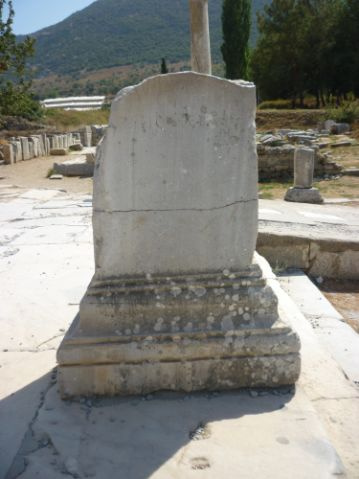
Fragmentary base for statue of unknown emperor. Ephesus (Asia). Late third to fourth century.
Record details
Photographs
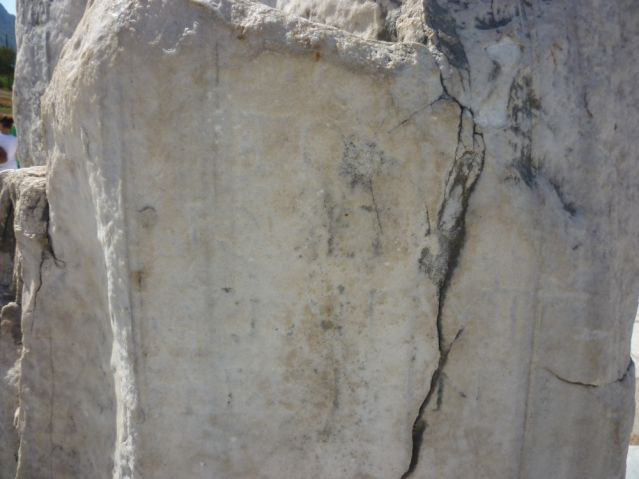
Inscription
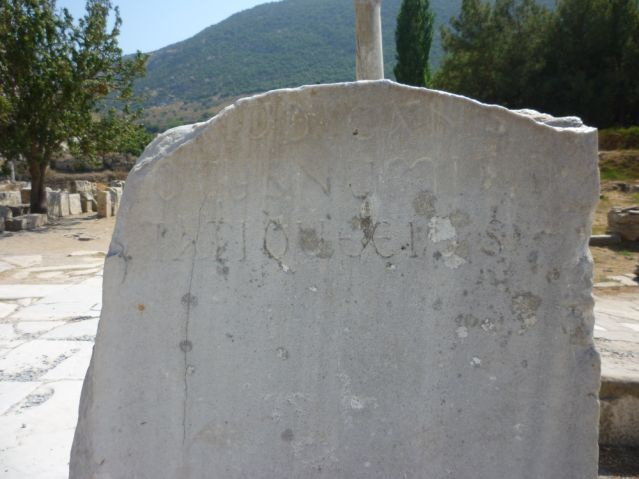
[— vice sacr]a iudicans / [— dev]otus numini / [mai]etatique (sic, for 'maiestatique')) eius
On the left face of the base:
[—]η̣[—] / [—]του δ[—] / [— ἀγω]νοθέτη[ν] τῆς [—] /
[—δ]ος καὶ ἑαυτο[ῦ] / [εὐ]εργέτην.
Inscription translation
' ... judge representing the emperor, devoted to his divine spirit and majesty, [set this up].'
'... for a giver of games (agonethete) ...twice...and his benefactor.'
Bibliography
- Engelmann, H. Knibbe, D. & R. Merkelbach, Die Inschriften von Ephesos Teil IV. Inschriften griechischer Städte aus Kleinasien, vol. 14, Bonn 1980, 171-2, no. 1318
Discussion
INSCRIPTION
In three surviving lines:
[— vice sacr]a iudicans / [— dev]otus numini / [mai]etatique (sic, for 'maiestatique')) eius
' ... judge representing the emperor, devoted to his divine spirit and majesty, [set this up].'
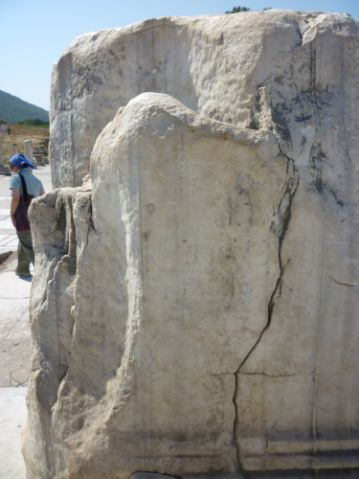
On the left face of the base is a Greek inscription in five partially surviving lines:
[—]η̣[—] / [—]του δ[—] / [— ἀγω]νοθέτη[ν] τῆς [—] /
[—δ]ος καὶ ἑαυτο[ῦ] / [εὐ]εργέτην.
'... for a giver of games (agonethete) ...twice...and his benefactor.'
(Translation J. Lenaghan)
Letter height of both inscriptions: 3 - 4 cm
DESCRIPTION (from )
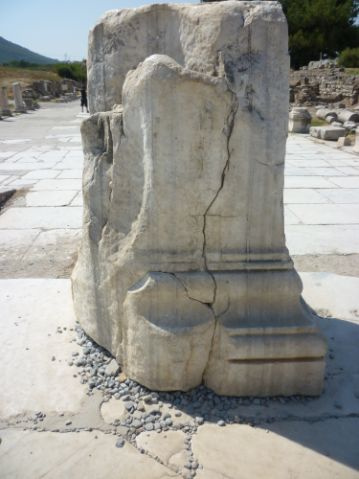
Lower half of a base of white marble, with integral base moulding and plinth: H 123, W 97, D 90 cm. Width of inscribed face: 65 cm. The Latin inscription is on the side facing the theatre, the Greek inscription, partially eroded, is on the left side.
The letter forms of the latter, and its greater state of erosion, suggest that it belongs to an earlier use of the base.
PROVENANCE AND CURRENT LOCATION
On the ramp in front of the Theatre, at the beginning of the Harbour Street, next to the foundations of the east gate(Benndorf, note sketchbook 1897). Currently set up close to its findspot.
HONORAND, AWARDER AND DATE
The name of the honorand and awarder are both lost, so this base cannot be dated with any precision. The surviving wording, however, shows that this was for a late-antique emperor. It is possible that it was for Arcadius (383-408), since nearby was found a fragmentary dedication to his colleague in the West, Honorius (LSA-711). The gate where it was found, at the entrance to the Arcadiane, may have been a monument to both emperors.
Discussion references
- Roueché, C., Aphrodisias in Late Antiquity (Journal of Roman Studies Monograph 5), London 1989
- Roueché, C. 'The Kuretenstrasse: the Imperial Presence in Late Antiquity', Neue Forschungen zur Kuretenstrasse von Ephesos : Akten des Symposiums für Hilke Thür vom 13. Dezember 2006 an der Österreichischen Akademie der Wissenschaften, Vienna 2009, 161
Cite: Last Statues of Antiquity, LSA-751 (A. Sokolicek).