
LSA-752
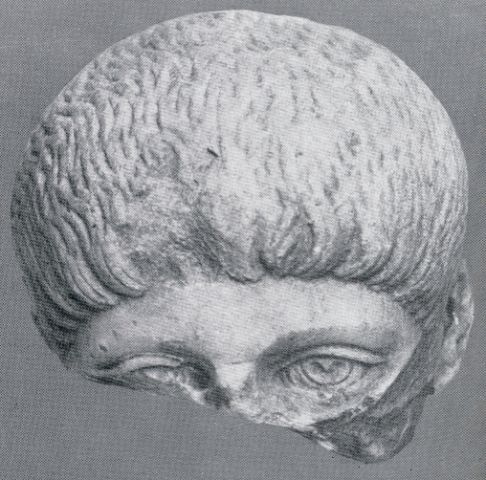
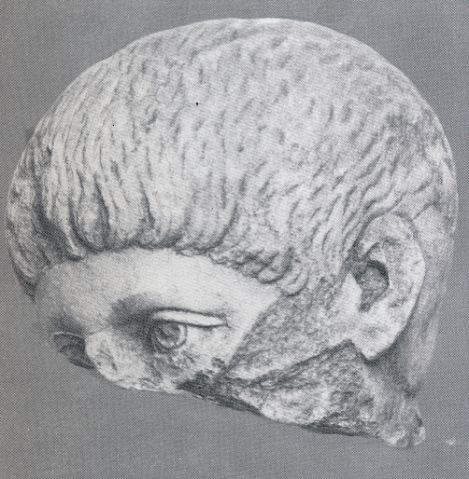
Fragmentary portrait head of boy, son of Constantine? From Agrigentum. Early fourth century.
Record details
Photographs
Bibliography
- Bonacasa, N., Ritratti greci e romani della Sicilia. Catalogo, Palermo 1964, 120, no. 156, pl. 72.1-2
Discussion
DESCRIPTION (Object)
Fragmentary over life-size head. H: 12 cm. White marble.
The fragment preserves most of the back left side, the top, and the brow and eyes. The head has been re-cut from an earlier portrait. The hair behind the left ear is a smooth, raised mass without representational detail. The left ear itself appears to be defined by a drill channel and to have a truncated upper shell. The eyebrows have however not been touch and retain the sharp but hairless edge of the earlier work.
The hair is rendered with short strokes of a flat chisel. The irises are engraved and greater than three-quarters of a circle. The outer edge of the canthi also seems engraved. The pupils are large, drilled U-shapes. The inner canthi are elongated.
PROVENANCE
From the Roman-hellenistic quarter of S. Nicola, Agrigento
DESCRIPTION (Subject)
The head portrays a young man with medium-length, combed-forward hair. The hair crosses the brow in a low arch. The locks consist of three to four strands. The ends of the locks mainly turn inwards. Only over the nose and inner corner of the left eye do the locks form respectively a small part and a pincer motif. Possibly there was another pincer motif over the inner corner of the right eyes.
The brow is low, broad, and smooth. The eyes are long and heavily marked.
DATE AND IDENTIFICATION
The technique and hairstyle of the portrait are close to LSA-596, LSA-753, and LSA-902. All of these portraits share a hairstyle in which the locks across the brow turn inwards and converge at the centre of the brow. All of these heads also show a young man without a diadem. Finally all are from Italy and have similarly rendered eyes.
All probably represent a prince of the Constantinian family. The more fully preserved examples clearly have a physiognomical resemblance to Constantine, and the portrait statue of Constantine II, LSA-559, wears a similar, if less specific, hairstyle. The lack of diadem makes the identification with Constantine’s older sons, Crispus or Constantine II more probable since their period of prominence preceded the promulgation of the imperial diadem.
Discussion references
- Calza, R., Iconografia Romana Imperiale. Da Carausio a Giuliano (287-363 d. C.), Rome 1972, 224-5, no. 137, pl. 76, 268 (not enough preserved for identification)
- Fittschen, K. and P. Zanker, Katalog der Porträts in den Capitolischen Museen und den anderen kommunalen Sammlungen der Stadt Rom, Band I, Mainz 1985, 156, n. 2 (similar to LSA-596)
- L'Orange, H. P., Das spätantike Herrscherbild von Diokletian bis zu den Konstantin-Söhnen, 284-361 n. Chr. Das Römische Herrscherbild. III. Abteilung ; Bd. 4 , Berlin 1984, 119 (young Constantine)
Cite: Last Statues of Antiquity, LSA-752 (J. Lenaghan).