
LSA-753
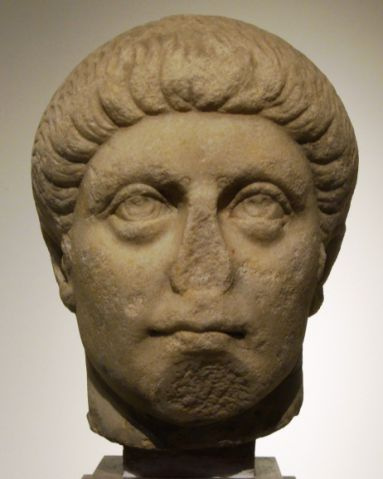
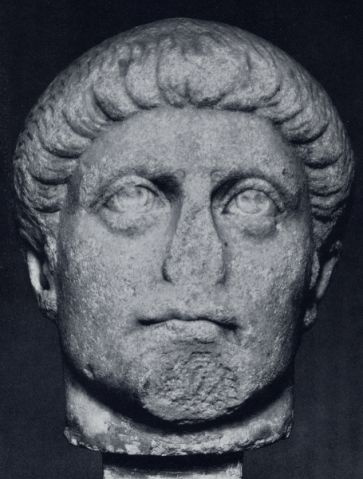
Re-worked portrait head of son of Constantine? From Italy? Early fourth century.
Record details
Photographs
Bibliography
- Heintze, H. von, Die antiken Porträts der landgräflich-hessischen Sammlungen in Schloss Fasanerie bei Fulda, Mainz am Rhein 1968, 81-2, 109, no. 54, pls. 90-91 and 137
Discussion
DESCRIPTION (Object)
Over life-size head. H: 26.9, H (of head): 25, H (of face): 18.4, W: 21.3 cm. Luni marble.
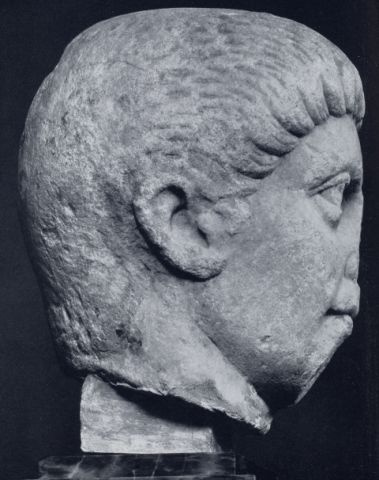
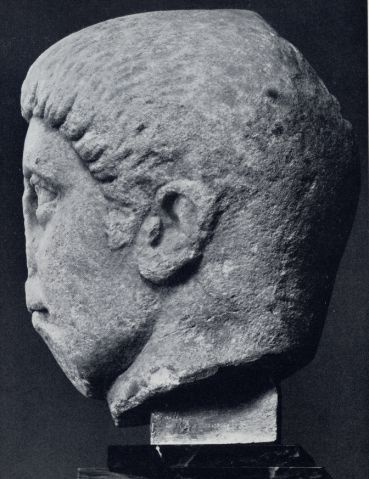
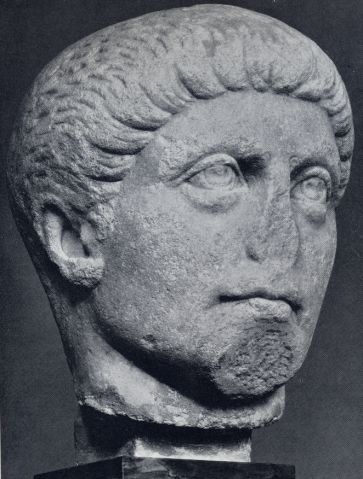
The head is broken through the upper neck. The chin and nose were both repaired in the modern era are now missing. The surface is weathered from long exposure to the elements in a garden.
The head has been re-cut from an earlier portrait. The top and back of the head have been taken back has been taken down and left without representational detail; the surface there shows claw chisel work and deeper point marks. Both ears have been truncated and have roughly carved areas directly behind them.
The irises are finely engraved and larger than semi-circular. They do not touch the bottom lid. The pupils are drilled out in a U-shape. The hair of the brow is rendered with a flat chisel.
PROVENANCE
The marble type suggests that the head was from Italy.
DESCRIPTION (Subject)
The head shows a clean-shaven young man who has medium-length, combed-forward hair. The hair crosses the brow in a low arch. The fringe features thick locks of generally three strands. The ends of these locks turn inwards and converge at a point over the nose. In front of each ear is a small sideburn.
The brow is unmarked and broad. The cheekbones are wide-set, and the cheeks are long and flat. The eyes are large and have a heavy bulge between beneath the lower lids. The mouth is broad, and the upper lip has a central dip. The jaw line is square, and the chin would have projected forcefully.
DATE AND IDENTIFICATION
The physiognomy of the portrait recalls that of Constantine, but the combed-inwards fringe converges above the nose without an emphatic vertical lock at the point of convergence. This differs from the well-known Constantine type (see l>558">LSA-558 and LSA-554. This difference and the lack of any indication of age suggest that the portrait represents a son of Constantine rather than Constantine (L’Orange). Crispus or Constantine II are the most likely candidates because the head does not wear a diadem and it has short hair on the nape of the neck, both of which are details of early Constantinian coin portraits. A comparison to the statue in Rome identified by its plinth as Constantine II (l>559">LSA-559) in inconclusive. The portraits are similar but not clearly based on the same type.
Other related portraits with a similar hairstyle include: LSA-556, LSA-596, and LSA-1064. A fragmentary head, found in Agrigento LSA-752, shows a finer and more complicated version of the same hairstyle.
Discussion references
- Demandt, A. and J. Engemann, (eds.), Konstantin der Grosse, Mainz 2007
, no. I.8.4 (K. Schade: son of Constantine) - Fittschen, K. and P. Zanker, Katalog der Porträts in den Capitolischen Museen und den anderen kommunalen Sammlungen der Stadt Rom, Band I, Mainz 1985, 156, fn. 1 (compares to LSA-596, son of Constantine)
- L'Orange, H. P., Das spätantike Herrscherbild von Diokletian bis zu den Konstantin-Söhnen, 284-361 n. Chr. Das Römische Herrscherbild. III. Abteilung ; Bd. 4 , Berlin 1984, 118-9 (Constantine ca. 324)
Cite: Last Statues of Antiquity, LSA-753 (J. Lenaghan).