
LSA-754
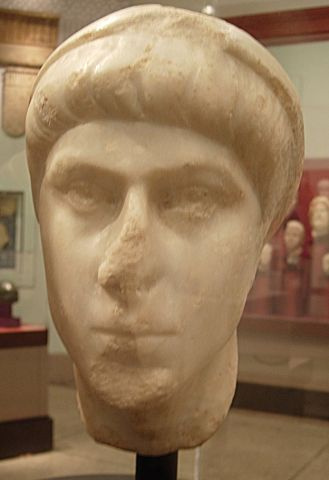
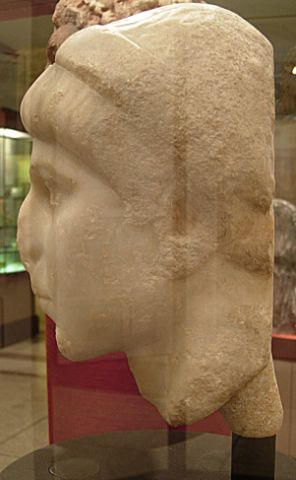
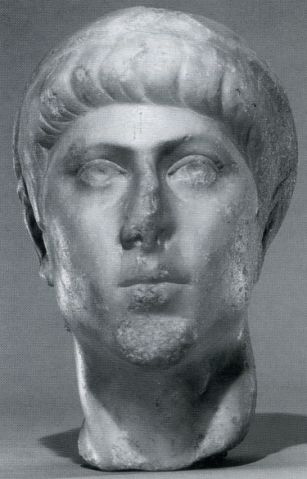
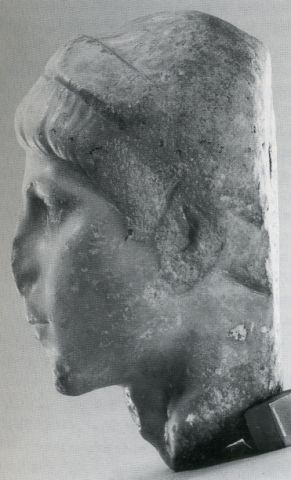
Portrait head of Theodosian prince. Batna (Syria). Late fourth to early fifth century.
Record details
Photographs
Bibliography
- Romano, I. Bald, Classical sculpture : catalogue of the Cypriot, Greek, and Roman stone sculpture in the University of Pennsylvania Museum of Archaeology and Anthropology, Philadelphia 2006, 228-30, no. 112
Discussion
DESCRIPTION (Object)
Life-size head, worked separately. H: 29, H (chin to crown): 24.5, W: 17, D: 17 cm. White marble.
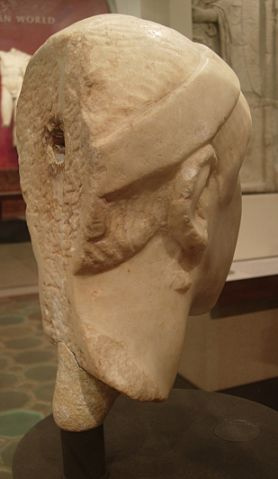
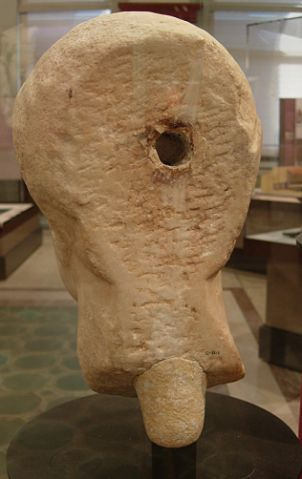
The back of the head and neck was removed in a vertical cut. There is a band of anathyrosis around a roughly picked area, and in the centre of the roughly picked area is a dowel hole. This probably indicates a repair. The tip of the nose is missing, and the left ear and adjacent area in the hair have lost their surface.
The hair beneath the broad band is rendered with a flat chisel. The pupils of the eyes are deeply-drilled and U-shaped. The inner corners of the eyes are also drilled. The flat band of the diadem was probably once decorated. The small projection beneath the right ear looks like a small strut and may be related to the hanging pearl ornament of the diadem.
The portrait has probably been re-cut from an earlier head. It lacks a tenon which would have been inserted into a socket on a statue; thus it was not originally made as a head for insertion. The right ear is high, stands off the face, and has a thick rim. The hollow of the left ear is too high. One wonders if the left ear was ever fully worked or if it had been removed when the head was re-carved.
PROVENANCE
From a pre-World War I excavation at ancient Batna. It was acquired by Oppenheim in 1924 and donated to Museum in Berlin. It was then lost during World War II and reappeared in Philadelphia.
DESCRIPTION (Subject)
The head shows a young man with a distinctive physiognomy, medium-length hair, and a broad flat headband. The band runs around the head just above the ears, and the end of tie seems to appear at the back of the head behind the right ear.
The hair is full and brushed forward. The fringe, which is articulated in large locks, falls low on the brow, and its ends turn uniformly to the proper left.
The face is long with prominent high cheek bones. There are no creases on either the brow or the cheeks. The eyes are small and closely-set. The nose is hooked. The mouth is broad and has slightly upturned corners and thin lips. The chin is pointed and recedes.
DATE AND IDENTIFICATION
The headband and the hairstyle indicate that an emperor is represented. The hairstyle of the emperor places him between the middle of the fourth century and the early fifth century. He has been identified as a son of Constantine (Calza, L’Orange), possibly Constantius II (most recently Bald-Romano). Coin portraits of Constantius II tend to show him with a long face and a hooked nose.
More convincingly, however, is Stichel’s argument. He compared the portrait to the statue from Aphrodisias LSA-163 which dates to 388-392 and represents either Arcadius or Valentinian II. Boths portraits have a similar fringe and facial structure. Thus he concluded the head from Batna represents a Theodosian figure. Meischner subsequently argued that it represented Arcadius.
Discussion references
- Calza, R., Iconografia Romana Imperiale. Da Carausio a Giuliano (287-363 d. C.), Rome 1972, 301-303, no. 210, pl.105,309 (ca. 340 son of Constantine)
- L'Orange, H. P., Das spätantike Herrscherbild von Diokletian bis zu den Konstantin-Söhnen, 284-361 n. Chr. Das Römische Herrscherbild. III. Abteilung ; Bd. 4 , Berlin 1984, 134, pl. 57b (Constantinian prince)
- Meischner, J. 'Studien zur spätantiken Kaiserikonographie', Jahrbuch des Deutschen Archäologischen Instituts 110, Berlin 1995, 433, 440-446, figs. 9, 13 (Arcadius)
- Stichel, R. H. W., Die römische Kaiserstatue am Ende der Antike, Roma 1982, 47-8, pl.9 (ca. 388, like Aphrodisian head)
Cite: Last Statues of Antiquity, LSA-754 (J. Lenaghan).