
LSA-759
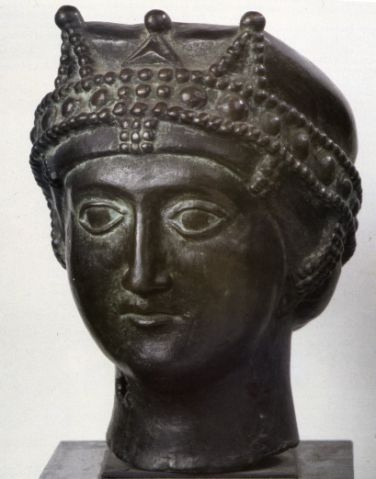
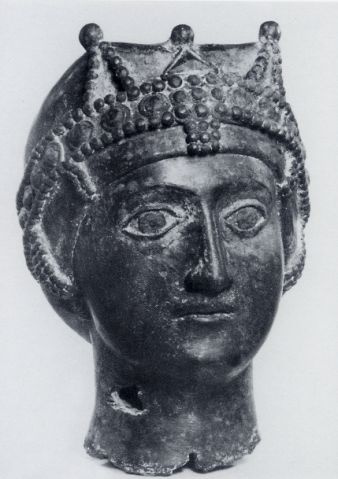
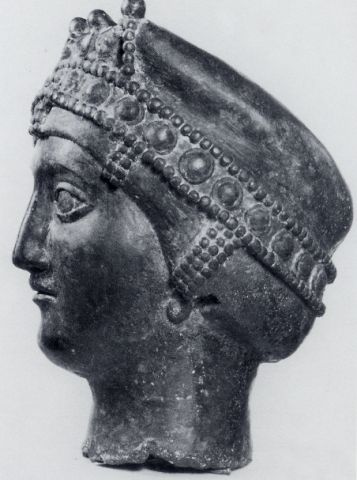
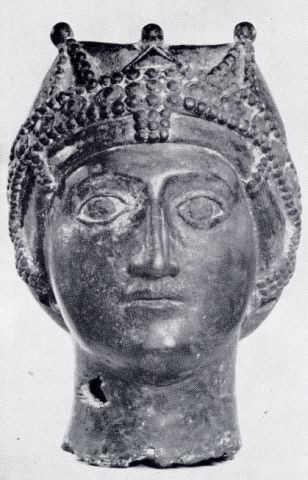
Bronze head of empress. Naissus (Dacia Mediterranea). Mid fifth to earlier sixth century.
Record details
Photographs
Bibliography
- Jevtovic, J. (ed.), Antički portret u Jugoslaviji : Narodni muzej, Beograd, Muzeji Makedonije, Skopje, Arheološki muzej, Zagreb, Arheološki muzej, Split, Narodni muzej, Ljubljana , Belgrade 1987, 248-9, no. 255
- Schade, K., Frauen in der Spätantike--Status und Repräsentation, Mainz 2003, 218-19, no. I 59, pl. 62
Discussion
DESCRIPTION (Object)
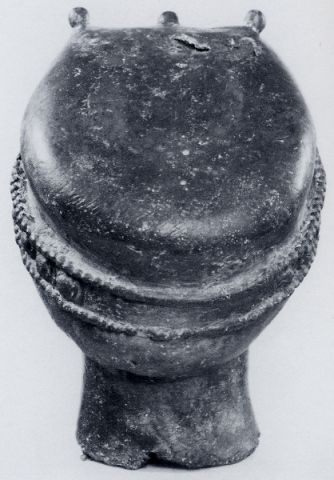
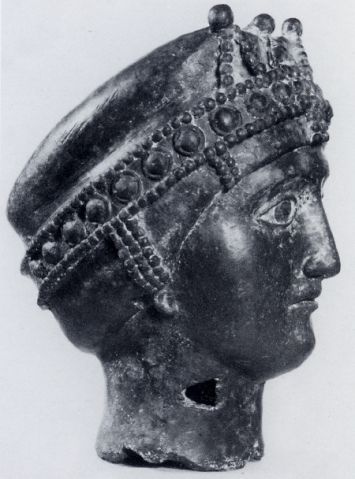
Female bronze head cut horizontally at the neck, H 29 cm. The rim of the neck is irregular, and at the right side of the neck there is an irregular hole. Behind the left ear, there is a small rectangular block out in the fillet covering the hair.
The iris is formed as a flat disc standing slightly proud.
The face has a rounded contour line, it is even and without marked modellings.
PROVENANCE AND CURRENT LOCATION
The head was discovered in 1958 in the location called Kulina (today an archaeological site) in the region of the municipality of Merošina in the Nišava District of Serbia; this is in the area of Naissus/ Niš from where the head was possibly looted. It is today in the Narodni Muzej in Niš, inv. no. 463/R.
DESCRIPTION (Subject)
The portrayed is a younger woman with a long slender nose and a small rounded chin. She is wearing a fillet which covers her entire hair and her ears, save small curls in front of the ears. On top of that fillet she is wearing an elaborate diadem embraided with large circular jewels or gems and seamed by pearls. Above the centre of the brow there is a square of nine larger pearls. Around the face, five vertical braids of pearls connect the diadem to the seam of the fillet. Above the brow three triangular coronations, each crowned by a large pearl, complete the diadem.
HONORAND AND DATE
The diadem identifies the portrayed as an empress. As Schade 2003, 219 points out, diadems of this type with the triangular coronations are first testified to on coins of Licinia Eudoxia (Augusta (West) 439 – c. 462), but appear in large scale sculpture only in the late 5th century. This and the sculptural style with the harmonizing lines lead Schade to a late 5th/ early 6th century date for our head. If so, the portrayed most likely would be Ariadne (wife of Zeno), Augusta 474-515, or Euphemia (wife of Justin I), Augusta 518-27; another female member of the imperial family, however, cannot be ruled out.
Discussion references
- Stichel, R. H. W., Die römische Kaiserstatue am Ende der Antike, Roma 1982, 63, pl. 32
- Stutzinger, D. (ed.), Spätantike und frühes Christentum. Ausstellung im Liebieghaus, Museum alter Plastik, Frankfurt am Main. 16. Dezember bis 11. März 1984, Frankfurt a.M. (1983), no. 76
Cite: Last Statues of Antiquity, LSA-759 (Ulrich Gehn).