
LSA-761
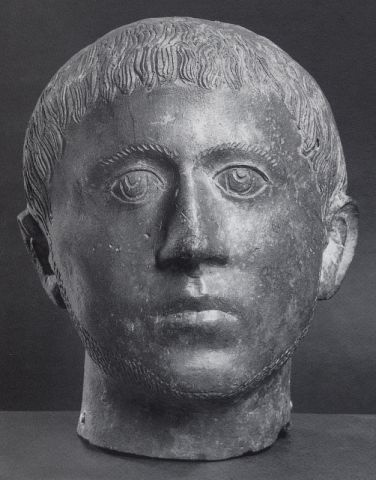
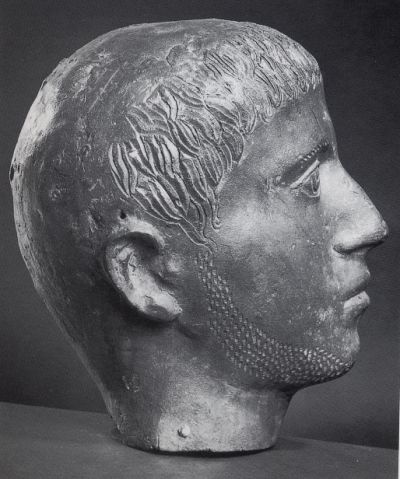
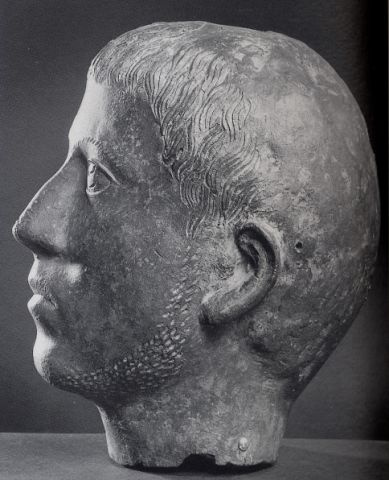
Bronze portrait head of young man with under the chin beard. From Aphrodisias? Later third century.
Record details
Photographs
Bibliography
- Inan, J. & E. Alföldi-Rosenbaum, Römische und frühbyzantinische Porträ̈tplastik aus der Türkei : neue Funde, Mainz 1979, 301-302, no. 299, pl. 212.1-3 (mid third century)
- Lahusen, G. and E. Formigli, Römische Bildnisse aus Bronze : Kunst und Technik, Munich 2001, 313, no. 194 (later third century)
Discussion
DESCRIPTION (Object)
Separately worked head. H: 23.8 cm. Bronze.
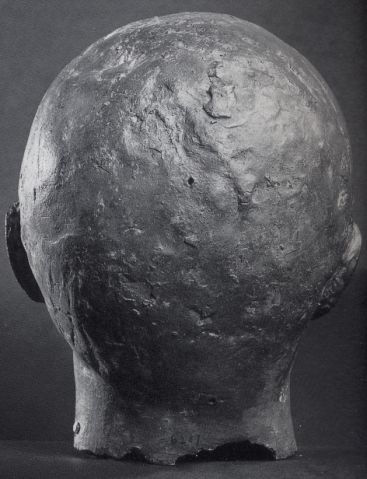
The head and neck were separately worked. On either side of the neck below the ears is a small raised boss. Above each ear and at the back of the head is a small hole.
The hair of the eyebrows and beard is rendered schematically. Behind the ears the hair is not rendered at all. The iris is an engraved ring which is about three-quarters of a circle. The pupil is also an engraved ring of about three-quarters of a circle.
PROVENANCE
Purchased on the art market in Izmir and said to have been found near Aphrodisias. It was in Germany and then in a private collection in Amsterdam. In 1932 it was given to the Allard Pierson Foundation and in 1934 became part of the Allard Pierson Museum.
DESCRIPTION (Subject)
The head, which was worked separately from its body, shows a young man between 15 and 25 years of age. He has short hair that falls forward onto his brow in an arch from ear to ear. Each individual lock ends in a point that is separate from and turns in a different direction to the adjacent locks. He also has a short beard which runs along the lower edge of the cheeks and under the chin.
The face has a full oval shape. The eyes are large and closely set; the eyebrows arch above them. The lips are thick, and the philtrum is crisply defined.
The lack of finish at the back of the head in conjunction with the ancient holes above each ear suggests that the young man might have been wearing headgear.
DATE AND HONORAND
Lahusen and Formigli note that the technique of the head is very similar to that of a bronze emperor, probably a Tetrarch, found at Adana, LSA-368 and belongs to the advanced second half of the third century. They suggest that a prince of the later third century is possible.
Snijder dentified it as Valerianus, son of Gallienus. K. Erim in Inan and Rosenbaum placed it in the middle of the third century and considered it to represent a non-imperial subject. In both cases, the under-chin beard was seen as a marker of the middle of the third century.
Cite: Last Statues of Antiquity, LSA-761 (J. Lenaghan).