
LSA-763
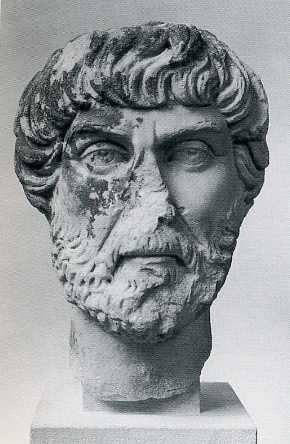
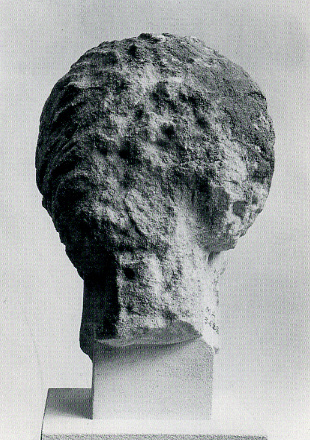
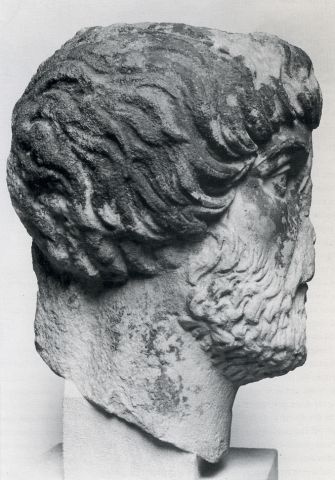
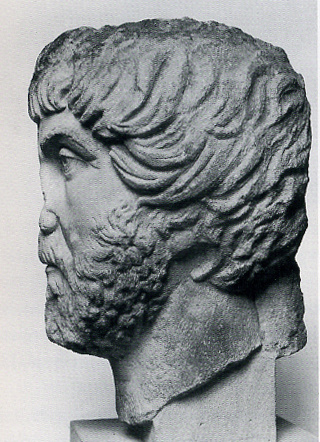
Portrait head with beard and full straight hair. From Antaradus (Syria). Later second to early third or late fourth to early fifth century.
Record details
Photographs
Bibliography
- de Kersauson, K., Les portraits romains II; de l’année de la guerre civile (68-69 après J-C) à la fin de l’Empire , Paris 1996, 532-3, no. 254 (Biosse Duplan, K.)
- Inan, J. & E. Alföldi-Rosenbaum, Römische und frühbyzantinische Porträ̈tplastik aus der Türkei : neue Funde, Mainz 1979, 277-8 no. 267 pl. 191
Discussion
DESCRIPTION (Object)
Portrait head of coarse grained marble broken at neck, H 30, W 20, D 21 cm. The nose is broken and the beard is chipped at the left side of the chin. In the back there is a support (‘Nackenbosse’, see below, ‘Provenance and Location’). The back side is worn and partly chipped off. The right side and the top are covered with pigments of iron (de Kersauson 1996).
The hair is a full fluffy mass, the lunular locks are falling irregularly. The strands have plastic volume even at the back; they are singled out with chisel work on the skull. Around the face the locks are separated with a drill and subdivided by incised lines. The full beard is arranged into short lunular locks, in the same technique as the hair; the drill is applied notably under the chin and at the right cheek while at the left cheek it is executed in chisel work.
The eyes are small; the iris is circumscribed by an incised line, the pupil is indicated by a lunular drill line.
Two long and sharp naso-labial folds separate the cheeks from the mouth.
PROVENANCE AND CURRENT LOCATION
The head is from Tortosa (Tartous/ Tartus) in northern Lebanon, the area of the ancient city of Antaradus (on provenance see Biosse Duplan 1972, 439 n. 17). Biosse Duplan 1972 thought it was worked in a Syrian workshop because she saw stylistic features indicating Palmyrene influence (repeated in de Kersauson 1996). Inan & Rosenbaum 1979 point out that there are few marble portraits known from ancient Syria, and that the neck support (‘Nackenbosse’, see, above, ‘Description (Object)’) is a characteristic feature notably of portraits from Asia Minor; this suggests that the head was imported from there.
The head is today in Paris, Musée du Louvre, inv. no. Ma 3625.
DESCRIPTION (Subject)
The portrayed is a mature man, though still in his full vigor. His full hair is brushed towards the face and falls deep into the brow; the ears are covered safe only the earlobes. The sharp folds around the mouth signal experience, the raised eyebrows alertness.
HONORAND AND DATE
The assessment of the head remains controversial.
Inan & Rosenbaum 1979 compared our head to an Antonine head from the same area, now in Antakya, which they thought was a free imitation of a philosopher’s portrait of the 4th century BC. They suggested that our head was possibly a copy of the Antakya head, both representing a sophist of the later 2nd century; critical on the identity is Danguillier 2001, 28.
Biosse Duplan (1972, repeated in de Kersauson 1996) compared the stylistic features of our head among others with two late antique portraits from Aphrodisias (so-called Elder Magistrate, LSA-169 and 'Younger Magistrate, LSA-170); she suggested that this was a portrait of a neo-platonic philosopher of the late 4th/ early 5th century.
Skupinska-Løvset 1999, in turn, suggested a date in the Antonine period.
In my view, the head in the Louvre shows none of the features of the late antique ‘holy men’ ascribed to him by Biosse Duplan. The comparison to heads like that of the ‘Elder Magistrate’ LSA-169 reveals striking stylistic and technical differences, notably in the rendering of the eyes and of the hair.
The rendering of hair and beard as a free falling fluffy mass on our head suggests a date in the later 2nd/ early 3rd century for our head.
The full beard and longish hair are indicative of the traditional virtues of paideia. Such virtues would grace any traditionalist notable.
Discussion references
- Biosse Duplan, K., Un portrait romain de la collection de Clercq, La Revue du Louvre et des Musées de France 6, 1972, 435-40
- Danguillier, C., Typologische Untersuchungen zur Dichter- und Denkerikonographie in römischen Darstellungen von der mittleren Kaiserzeit bis in die Spätantike, Oxford 2001, 27-8. 245 cat. no. 95
- Skupinska-Løvset, I., Portraiture in Roman Syria, ŁódŹ 1999, 87-8 pl. 10
Cite: Last Statues of Antiquity, LSA-763 (Ulrich Gehn).