
LSA-766
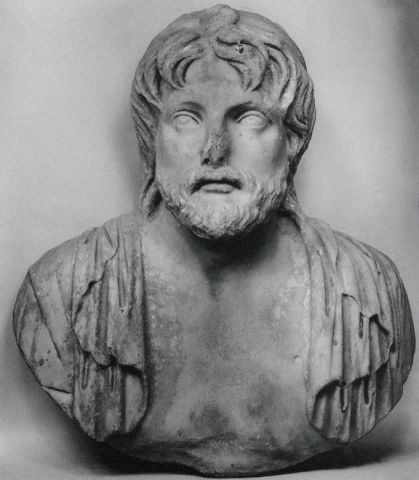
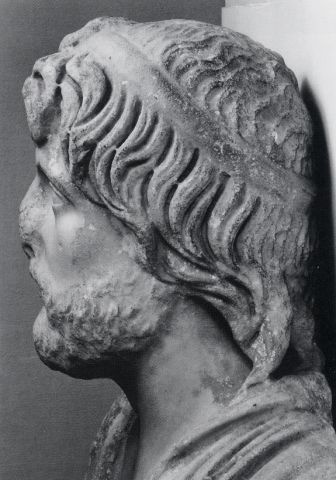
Shield portrait of long-haired, bearded man related to Bornova-Heidelberg type. From Rome or environs. Fourth or fifth century.
Record details
Photographs
Bibliography
- Fittschen, K., P. Zanker, and P. Cain, Katalog der Porträts in den Capitolischen Museen und den anderen kommunalen Sammlungen der Stadt Rom. Band II. Die männliche Privatporträts, Berlin 2010, 129-131, no. 129, pls. 160-161 (5th c.?)
Discussion
DESCRIPTION (Object)
Shield portrait. H: 51, H (chin to crown): 24, Diam (inner rim of shield): c. 48 cm. Marble.
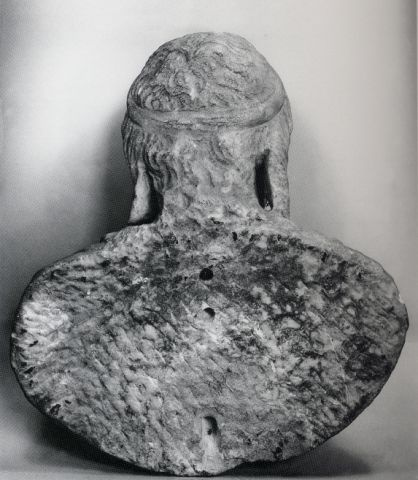
The bust was worked separately from its tondo frame. The back is roughly picked and has three holes for dowels to attach it to the frame. The nose is chipped.
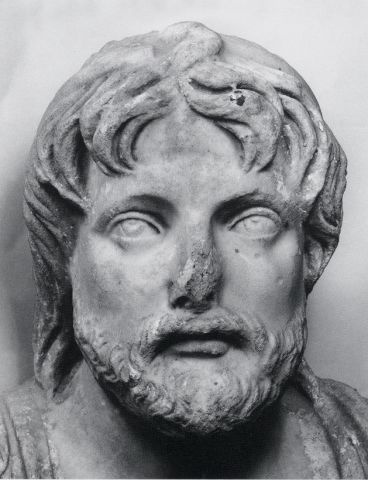
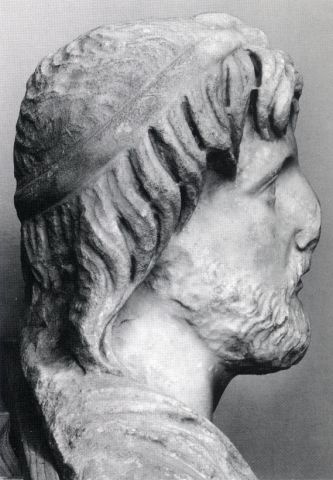
The irises are engraved and semi-circular. The pupils also seem to be engraved semi-circular lines. The irises are not rendered. The hair over the brow and around the ears is rendered with drill channels some of which preserve marble bridges. The hair above the fillet and behind the ears is not drilled; above the nape of the neck it is not fully finished.
PROVENANCE
Probably Rome or its environs.
DESCRIPTION (Subject)
The portrait bust shows a man who turns to his right. He is long-haired and wears a flat fillet and a himation over a bare chest.
The man has long, centrally parted hair that frames the brow in a symmetrical manner. Over the centre of the brow, at the parting, a single lock is brushed backwards over the fillet. At the sides of the face, the hair falls naturally down and back and covers the ears completely. It reaches to the shoulders. The beard and moustache are full but not long.
The face is bland. The brow is tall with a slight downward sloping crease. The cheekbones are prominent and widely-spaced. The eyes are also widely spaced. The root of the nose is not deep. The lower lip is full.
The himation falls over both shoulders in curving folds which are almost exactly symmetrical. Of the bare chest only the lower edge of the pectorals seems to be modelled.
HONORAND
The portrait seems to follow the same model, ‘Heidelberg-Bornova’ (LSA-236 and LSA-2442) . This version differs from the other two in that it is less heavily-bearded and has locks which frame the central parting vertically as opposed to being pushed to the sides of the brow. Nonetheless the fillet, the hair to the shoulders, the central part, and the lock brushed over the fillet are all elements of the same model. All three examples are furthermore in the format of shield portraits. Probably the original model was intended to represent a thinker of the earliest period of the Greek world.
DATE
The portrait is difficult to date because of its lack of contemporary fashion. Fittschen, Zanker, and Cain had initially posited a Severan or Gallienic date. On reflection they opted for a later date, possibly in the fifth century, because of the popularity of the shield format in that period (see, for example, LSA-206), because of the use of the running drill in that period (again see, for example, LSA-206 or LSA-210) and because of the unusual symmetric arrangement of the himation over both shoulders (once again LSA-206 and LSA-207).
A bust of Menader, LSA-2110,which was worked separately for a shield, shares the same structure and much of the same technique (though the eyes are marked differently). It too comes from Rome.
Cite: Last Statues of Antiquity, LSA-766 (J. Lenaghan).