
LSA-767
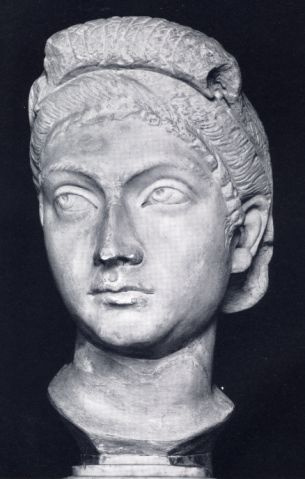
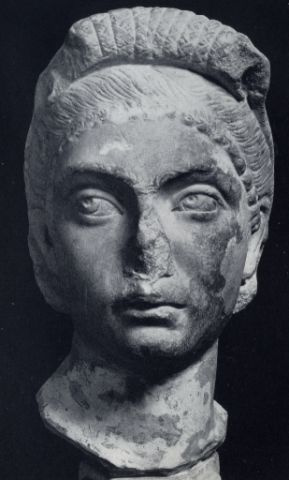
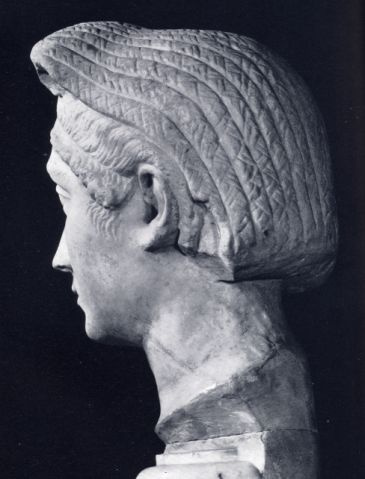
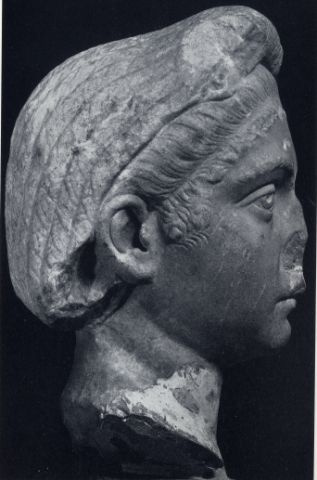
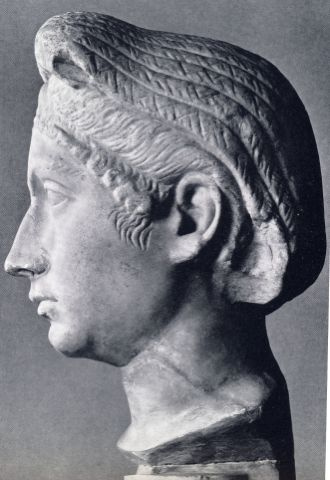
Portrait head of woman with crown braid. From West? Late third to early fourth century.
Record details
Photographs
Bibliography
- Heintze, H. von, Die antiken Porträts der landgräflich-hessischen Sammlungen in Schloss Fasanerie bei Fulda, Mainz am Rhein 1968, 79, 109, no. 53, pls. 88-9, 135a, 136a
Discussion
DESCRIPTION (Object)
Over life-size head for insertion (?). H: 28, W: 17.8 cm. H (of head): 24.5 cm. Carrara marble
The nose has been restored. The front right corner of the rolled plait is chipped as is the back left loop behind the ear. The bottom of the central braid, at the back of the neck, is either unfinished or worked back in order to fit it against the drapery of a statue.
The hair and eyebrows are carefully defined with fine flat chisel work. The large roll is drilled out. The eyeballs feature a bean-shaped pupil made by two or three drill holes. The irises are semi-circular engraved lines made with a flat chisel. The inner corner of the right eye features a large engraved line to demarcate the edge of the canthus. In the the left eye it is unusual. The line of the upper lid does not continue to the canthus; it ends at the iris and between the iris and the inner corner is a small raised band
PROVENANCE
Unknown.
DESCRIPTION (Subject)
The portrait head depicts a woman who turns to her right. She has an oval face and wears a variation the late third century, central braid hairstyle.
The face is oval. The projecting rounded chin emphasizes the loose skin between the chin and neck. The brow is tall, and the eyebrows arch. The hair of the eyebrows continues onto the nose. The inner canthi of the eyes are pointed and set below the eyes. The lips are full and shapely.
The hair directly over the brow is combed forward in short curled locks. Behind this fringe, the hair is brushed backwards in s-shaped locks which tuck around the ears. It is then pulled up the back of the head in more than 10 braids which form almost a helmet. The plait of 10 braids is broad and rolls underneath itself over the brow. Short loose locks have been engraved into the cheek in front of each ear.
DATE
The large central braid that reaches the brow is depicted on imperial portraits first with Ulpia Severina (270-275). The fashion continues into the early fourth century. Here, the central braid is broad and is reminiscent of a melon-frisur in back view. It has been combined with a short curly fringe and a series S-shaped waves between the fringe and the plait. A similar variation can be seen in two heads from Rome (l>1592">LSA-1592 and l>993">LSA-993 ). The helmet-like aspect and the complexity of the frontal arrangement would seem to post-date the simpler versions of the hairstyle shown on the coins of Severina.
The repetitive linear pattern of the hair which is so carefully engraved with a flat chisel also suggests a later rather than earlier date. The overlapping directions of the hair at the centre of the brow (here just to the left of centre) is a detail that repeats in the so-called Fausta portrait (l>573">LSA-573 ) in the Louvre. The bold marking of the canthi seems almost to foreshadow eyeballs that use concentric flat chisel lines to delineate the irises.
Discussion references
- Bergmann, M., Studien zum römischen Porträt des 3. Jahrhunderts n. Chr., Bonn 1977, 191, pls. 55.5 and 56.5 (late third century)
- Demandt, A. and J. Engemann, (eds.), Konstantin der Grosse, Mainz 2007
, no. I.15.25 (K. Schade: late third century)
Cite: Last Statues of Antiquity, LSA-767.