
LSA-768
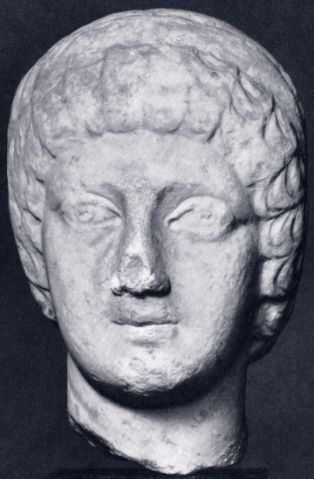
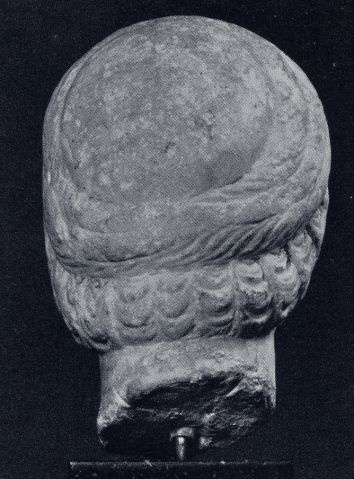
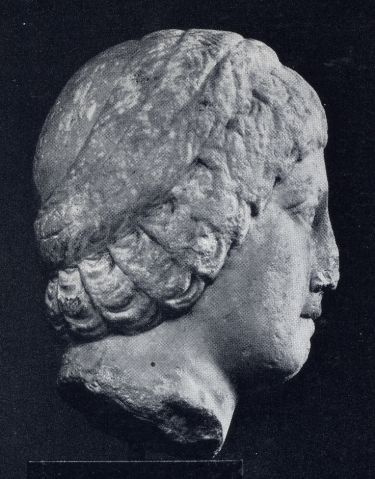
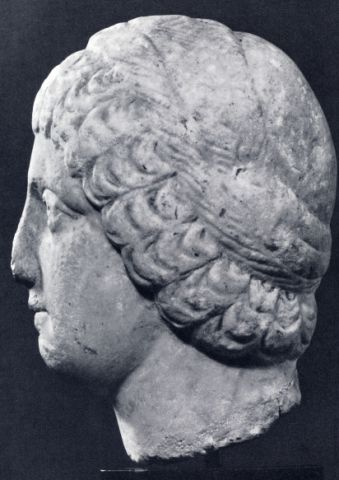
Portrait head of woman with crimped locks and encircling braids. From Italy. Early fourth century.
Record details
Photographs
Bibliography
- Heintze, H. von, Die antiken Porträts der landgräflich-hessischen Sammlungen in Schloss Fasanerie bei Fulda, Mainz am Rhein 1968, 82-3, 109-10, no. 55, pls. 92-3, 140
Discussion
DESCRIPTION (Object)
Under life-size head. H: 20.5, W: 13.5 cm. White large-grained marble (von Heintze: Carrara).
The head is broken through the base of the neck. The tip of the nose is missing, and the brow and chin are battered. The surface is water-worn.
The separately worked lateral areas of hair have led Felletti-Maj (followed by Bergmann) to suggest that the head was originally an ideal head which was re-used for a female portrait in the fourth century. The original head simply lacked an appropriate quantity of hair around the ears.
Most of the hair has been rendered carefully with drills (around the face) and flat chisels (in the braids). The top of the head is smooth. The repetition of the rendering creates an inorganic sense of pattern. The irises are almost circular, and the flat U-shaped pupils are set low within the irises. The left eye has a deep drill hole at the inner canthus.
PROVENANCE
This head was in the Villa Ada -Savoia at the Villa Polissena in Rome until 1953. This large park in Rome was made originally by the Pallavicini family in the 1700s. It belonged to the royal family of Savoia between 1872-1878 and 1904-1946; in 1951 it was expropriated by the city of Rome and made public. The park is next to the ancient via Salaria and extends, for example, over the catacombs of Priscilla.
DESCRIPTION (Subject)
The head shows a woman of indeterminate age who turns to her right. She wears an encircling-braid hairstyle. The hairstyle consists of three different sections. Around the face and above the nape are a series of crimped looping locks. These conceal the ears completely. Above this are three bands of hair which are wound around the head like a diadem. Their surface is indicated with diagonal lines. These braids cross over each other at the back of the head. Above them at the top of the head is a smooth area without representational detail.
The face is a full oval with regular features and no wrinkles. The mouth is short from side to side but has full, slightly open lips.
DATE
The hairstyle is usually placed in the Tetrarchic and Constantinian period. It is generally similar to that worn by portraits identified as Helena (see LSA-965 and LSA-966). This particular portrait is based on the same model as LSA-964.
Discussion references
- Schade, K., Frauen in der Spätantike--Status und Repräsentation, Mainz 2003, 172, no. I.7, pl. 26
- von Heintze, H. ‘Ein spätantikes Mädchenportät in Bonn. Zur stilitischen Entwicklung des Frauenbildnisses im 4. und 5. Jahrhundert’, Jahrbuch für Antike und Christentum 14, Münster 1971, 74, no. III 7, pl. 10c (325-330)
Cite: Last Statues of Antiquity, LSA-768 (J. Lenaghan).