
LSA-769
Re-cut portrait head with long engraved beard and accentuated irises. Unknown provenance. Fourth century.
Record details
Photographs
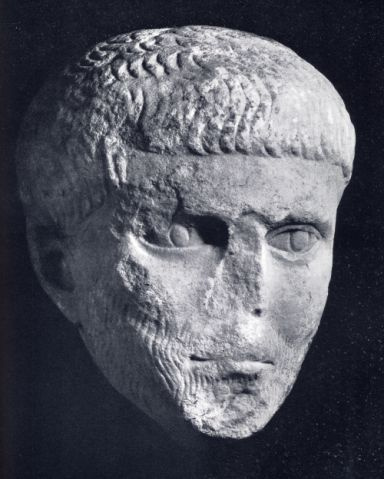
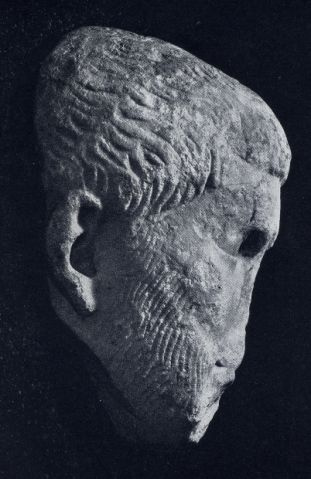
Bibliography
- Heintze, H. von, Die antiken Porträts der landgräflich-hessischen Sammlungen in Schloss Fasanerie bei Fulda, Mainz am Rhein 1968, 110, no. 58, pl. 99 and 140c (fifth century)
Discussion
DESCRI PTION (Object)
Over life-size head. H: 26.6, W: 20.2, D: 11.2 cm. White marble.
The head is broken beneath the chin and vertical from the crown down immediately behind the right ear. Von Heintze notes that the head is from a relief. The right eyebrow, nose, and chin are broken off.
The hair (head and beard) is rendered entirely with a flat chisel. The irises are indicated by large engraved circles. The portrait has been worked out of an earlier head. The original portrait was clean-shaven and had longer hair and unmarked eyes.
PROVENANCE
Unknown.
DESCRIPTION (Subject)
The head represents a man with wavy, combed-forward hair. The fringe falls in a straight line across the brow; the ends of the locks turn to the proper left. At the right corner is a triangular indentation which serves as an awkward transition from brow to side hair. The beard and moustache are made of wavy, sometimes long, hairs which are aligned vertically.
The face is without wrinkles. The forehead is flat and broad. The cheek bones project. The eyes are emphatically marked. The lower lip is full and pouting.
DATE
The head has been re-worked probably from a Julio-Claudian portrait. The honorand of the second portrait wears a fashion (combed forward hairstyle and beard) which was typical of the fourth century. The portraits of C. Caelius Saturninus signo Dogmatius (LSA-903), dated c. 335, and of Virius Audentius Aemilianus (LSA-46), dated c. 375, provide comparable examples of the style. The hair and beard of LSA-46 are worked similarly. However, this technical similarity relates more to the capability of the sculptor than to the chronological moment.
Other related re-worked portraits include LSA-1056 from Africa which has both similar eyes and similar hair, a portrait from Corinth LSA-66 and one from Olympia LSA-2493 . These examples testify to geographic range of this mode of re-carving in the fourth century.
Discussion references
- Blanck, H., Wiederverwendung alter Statuen als Ehrendenkmäler bei Griechen und Römern, Rome 1969, 61, no. A 38, pl. 27
Cite: Last Statues of Antiquity, LSA-769 (J. Lenaghan).