
LSA-776
Base for statue of the senator Valerius Severus, prefect of Rome. Gortyna (Creta). 382
Record details
Photographs
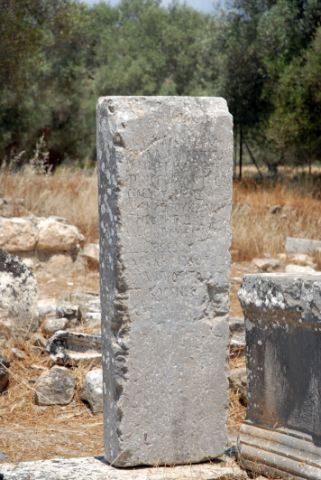
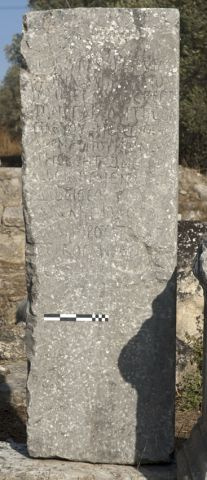
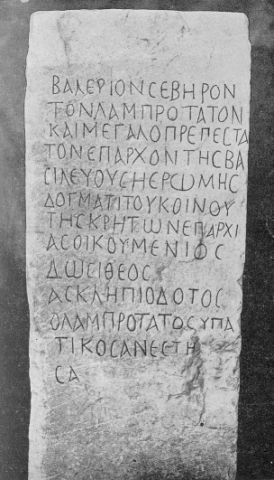
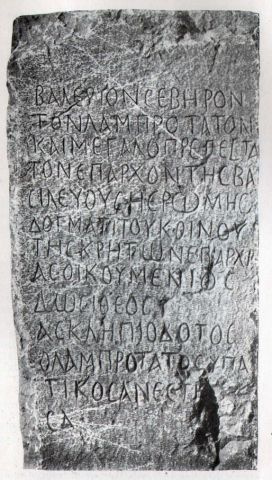
Inscription
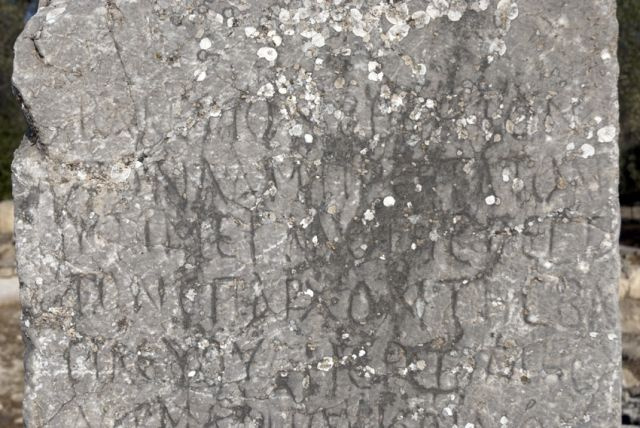
Βαλέριον Σεβῆρον, / τὸν λαμπρότατον / καὶ μεγαλοπρεπέστα/τον ἔπαρχον τῆς βα/σιλευούσης Ῥώμης, /(6) δόγματι τοῦ κοινοῦ / τῆς Κρητῶν ἐπαρχί/ας, Οἰκουμένιος / Δωσίθεος /(10) Ἀσκληπιόδοτος / ὁ λαμπρότατος ὑπα/τικὸς ἀνέστησα (sic).
Inscription translation
Oecumenius Dositheus Asclepiodotus, the governor (consularis) of clarissimus rank set (this) up (to) the senator Valerius Severus the most magnificent prefect of imperial Rome, by decree of the assembly of the province of the Cretans.
Bibliography
- Guarducci, M., Inscriptiones Creticae. Vol 4. Tituli Gortynii, Roma 1950, p. 345-6 no. 315
Discussion
INSCRIPTION
In twelve lines:
Βαλέριον Σεβῆρον, / τὸν λαμπρότατον / καὶ μεγαλοπρεπέστα/τον ἔπαρχον τῆς βα/σιλευούσης Ῥώμης, /(6) δόγματι τοῦ κοινοῦ / τῆς Κρητῶν ἐπαρχί/ας, Οἰκουμένιος / Δωσίθεος /(10) Ἀσκληπιόδοτος / ὁ λαμπρότατος ὑπα/τικὸς ἀνέστησα (sic).
'Oecumenius Dositheus Asclepiodotus, the governor (consularis) of clarissimus rank set (this) up (to) the senator Valerius Severus the most magnificent prefect of imperial Rome, by decree of the assembly of the province of the Cretans'.
Letter height 3-4 cm.
DESCRIPTION (from Guarducci 1950, De Tommaso 2000, and the published photo)
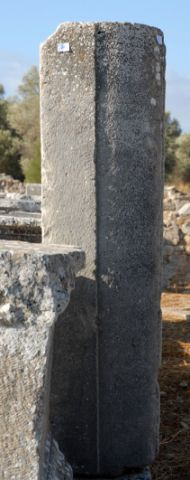
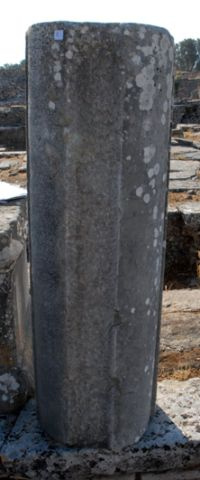
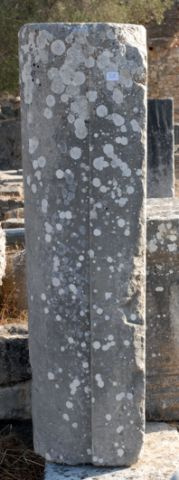
Tall semi-columnar base of grey local marble, with the inscription carved on the plain (back-)side of the semi column. Height 139 cm, width 48 cm, depth 37 cm. Slightly broken on top front and left side; chipped at right margin. Inscribed surface finished with a claw. Several cracks, especially on the right side. On the convex side there is a vertical groove 12 cm x 3 cm.
PROVENANCE/ LOCATION
Found in the praetorium. Today preserved in its western part.
HONORAND, AWARDER, AND DATE
Valerius Severus, urban prefect of Rome (ἔπαρχον τῆς βασιλευούσης Ῥώμης, lines 4-5), is recorded in this office in 382 (PLRE I, 837 Valerius Severus 29). He is called λαμπρότατος in our inscription, although his office would have given him the highest senatorial rank of illustris - ἰλλούστριος. The other senators in this group from Gortyn (see below, 'Further Discussion') are similarily described, probably because the term is being used loosely to denote the rank of senator. The second epithet, μεγαλοπρεπέστατος, is unspecific but occasionally used for very high ranking officials. Its use here (and on LSA-780) predates the earliest use (in 403 for a Consul) recorded by Hornickel (O. Hornickel, Ehren- und Rangpraedikate in den Papyrusurkunden: ein Beitrag zum roemischen und byzantinischen Titelwesen (Giessen 1930) p. 29).
The awarder, the governor (consularis) Oecumenius Dositheus Asclepiodotus, whose governorship is reliably datable to 382-3, is commemorated in no less than eleven honorific inscriptions in Crete (PLRE I, 115 Oecumenius Dositheus Asclepiodotus 2). He dedicated statue bases to Gratian, Valentinian II, and Theodosius I (LSA-472, LSA-770, LSA-950, though his name is missing on this latter) which were set up, together with his own statue (LSA-774), in front of the new praetorium built by him in Gortyn. He was also honoured with a statue in Olus (LSA-792). Our base belongs to a set of ten statue bases for leading members of the urban Roman aristocracy in Gortyn (LSA-773, LSA-775, LSA-776, LSA-777, LSA-778, LSA-779, LSA-780, LSA-781, LSA-782, LSA-783), on seven of which Asclepiodotus' name as awarder appears ( LSA-775, LSA-776, LSA-777, LSA-778, LSA-779, LSA-780, LSA-781).
What is known of Severus' career and Asclepiodotus' governorship dates this inscription with reasonable precision to 382.
FURTHER DISCUSSION
The semicircular base for Valerius Severus resembles in form and material the bases dedicated to Gratian, Valentinian II and Theodosius I by the governor (consularis) of Crete Asclepiodotus (LSA-472, LSA-770, LSA-950) and the base dedicated to that very governor by members of the local elite LSA-774). Our base however differs from these in that its inscription is on the flat face of the semi-column (as opposed to the convex face of the other four). This latter property our base shares only with a sixth base of the same shape, dedicated to Probianus ( LSA-780). All six bases perhaps once decorated the monumental entrance to the praetorium of Gortyn, newly built by the governor Asclepiodotus (De Tommaso 2000, 387), although it is very hard to imagine how a semi-column was used with its plain flat face displayed to the viewer.
Discussion references
- De Tommaso, G., Il Settore B: La Basilica del Pretorio. Fase B6 = Fase costruttiva IX (ultimo venticinquennio del IV sec. d.C.), Gortina V.1. Lo Scavo del Pretorio (1989-1995) - Vol. V. 1* - , 337-48, Padova 2000, 343 no. B2. 1
- De Tommaso, G., Nota su alcune Iscrizioni del Pretorio di Dositeo, Gortina V.1. Lo Scavo del Pretorio (1989-1995) - Vol. V. 1* - , 384-8, Padova 2000, 387
- Guarducci, M., Le iscrizioni del pretorio di Gortina, Rivista del R. Istituto d'Archeologia e Storia dell'Arte I, 143-184, Roma 1929, pp. 163-4 no. 12
- Jones, A. H. M. et al., The Prosopography of the Later Roman Empire. Vol. I 260-395, Cambridge et al. 1971 (1975)
Cite: Last Statues of Antiquity, LSA-776 (Francesca Bigi - Ignazio Tantillo - Ulrich Gehn).