
LSA-785
Base for statue of Marcellinus, probably praetorian prefect. Gortyna (Creta). Probably first half of the fourth century
Record details
Photographs
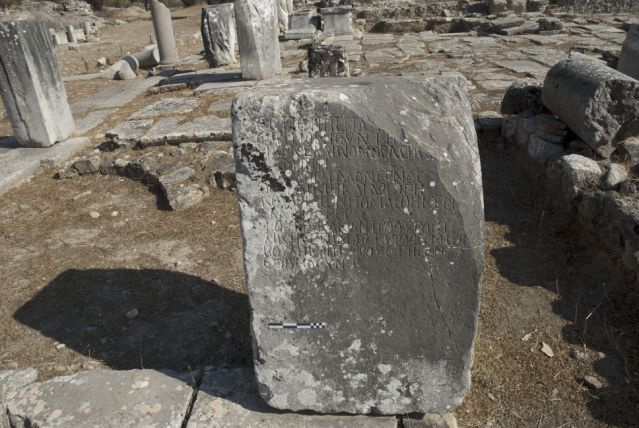
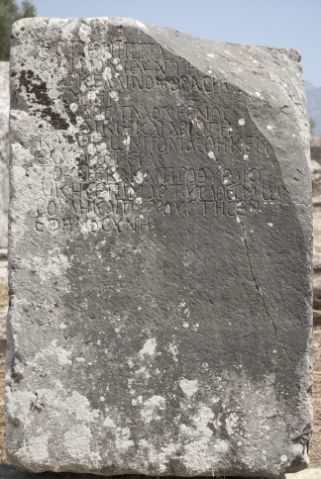
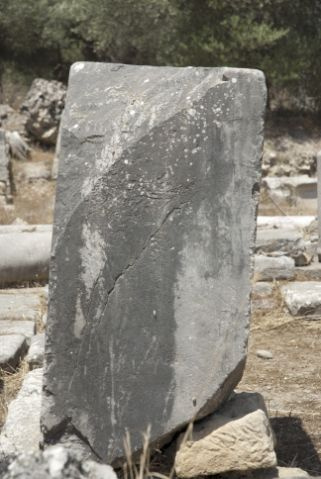
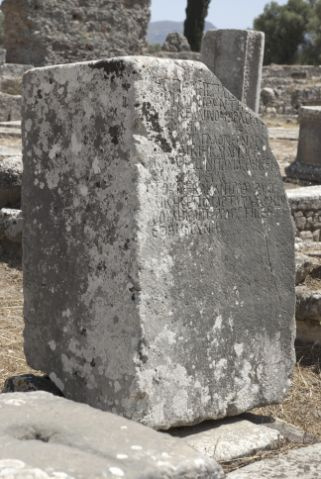
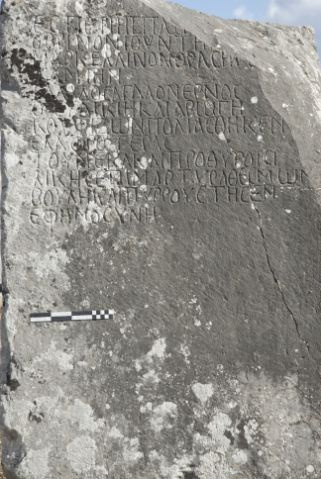
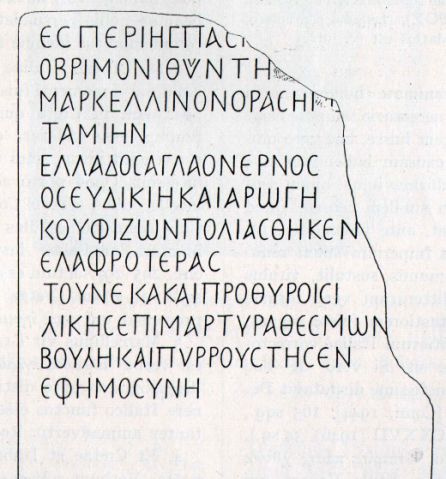
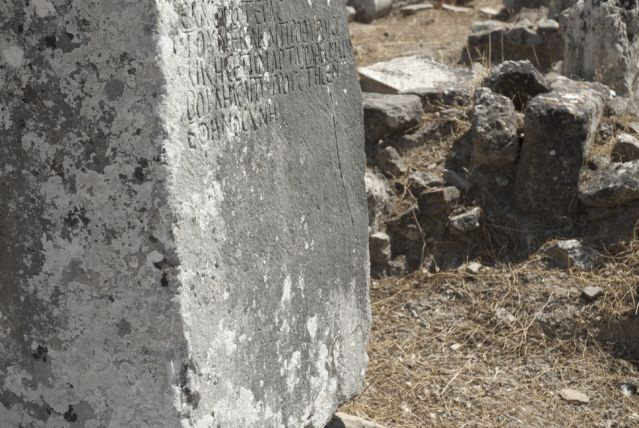
Inscription
Ἑσπερίης πάση̣[ς χθονὸς] / ὄβριμον ἰθυντῆ[ρα] / Μαρκελλῖνον ὁρᾶς ἠδ̣ε̣ [--] / ταμίην /(5) Ἑλλάδος ἀγλαὸν ἔρνος / ὃς εὐδίκῃ καὶ ἀρωγῇ / κουφίζων, πόλιας θῆκεν / ἐλαφροτέρας / τοὔνεκα καὶ προθύροισιν /(10) Δίκης ἐπιμάρτυρα θεσμῶν / βουλὴ καὶ Πύρρου στῆσεν / ἐφημοσύνη.
Inscription translation
You see the mighty ruler of the whole western land, Marcellinus, the treasurer of ..., the shining child of Hellas (Greece), who relieving them with justice and support made the cities lighter. Because of this the council and the behest of Pyrrhus set (this) up (to him), witness to the laws, by the front doors of Dike.
Bibliography
- Guarducci, M., Inscriptiones Creticae. Vol 4. Tituli Gortynii, Roma 1950, pp. 349-50 no. 323
Discussion
INSCRIPTION
Verse inscription of three elegiac distichs laid out in twelve lines:
Ἑσπερίης πάση̣[ς χθονὸς] / ὄβριμον ἰθυντῆ[ρα] /
Μαρκελλῖνον ὁρᾶς ἠδ̣ε̣ [--] / ταμίην /
(5) Ἑλλάδος ἀγλαὸν ἔρνος / ὃς εὐδίκῃ καὶ ἀρωγῇ /
κουφίζων, πόλιας θῆκεν / ἐλαφροτέρας /
τοὔνεκα καὶ προθύροισιν / (10) Δίκης ἐπιμάρτυρα θεσμῶν /
βουλὴ καὶ Πύρρου στῆσεν / ἐφημοσύνη.
'You see the mighty ruler of the whole western land, Marcellinus, the treasurer of ..., the shining child of Hellas (Greece), who relieving them with justice and support made the cities lighter. Because of this the council and the behest of Pyrrhus set (this) up (to him), witness to the laws, by the front doors of Dike'.
Letter height 3.5-4 cm.
The inscription celebrates the justice and support with which Marcellinus aided the cities of Crete. The third distich alludes to the statue set up in, or in front of, the praetorium of Gortyn (προθύροισιν Δίκης - 'by the front doors of Dike' (the goddess of Justice), i. e. the praetorium).
The ends of lines 1-3 are lost. We reproduce the inscription here with the completions proposed by Robert 1948. While the completions in lines 1 and 2 are uncontroversial, the completion in line 3 (part of the second line of the first distich) has been central in any interpretation and dating of the inscription. Guarducci 1950 read and completed lines 3 and 4 as Μαρκελλῖνον ὁρᾶς ἡγε̣[μόνος] / ταμίην - 'you see Marcellinus, the quaestor of the governor'. Consequently, she believed that Marcellinus was a quaestor of the governor of Crete (and Cyrene), later becoming a corrector totius Italiae ( line 1-2: Ἑσπερίης πάσης χθονὸς ὄβριμον ἰθυντῆρα'). This led her to an (early) 3rd-century date for the inscription. We follow Robert's reading, completion and dating, and see the inscription as typical of a set of late-antique honorific verse inscriptions erected in the Greek East (Robert 1948; see also below, 'Honorand, Awarder, and Date').
DESCRIPTION (from Guarducci 1950 and Guarducci 1929)
Large and tall rectangular base of grey local marble, H 117, W 80, D 59 cm (measurements are taken from Guarducci 1950). The base was later - in 382/3 - reused for Anicius Bassus whose honorific inscription is engraved on the opposite side (LSA-775).
PROVENANCE AND CURRENT LOCATION
Found in the praetorium of Gortyn, where (from the wording of the inscription) it was set up. It is today standing on site in Gortyna.
HONORAND, AWARDER AND DATE
This base was re-used for the statue of Anicius Bassus (LSA-775) set up by the governor Dositheus Oecumenius Asclepiodotus in 382/3. The group of statues dedicated by that governor are related to his reconstruction of the praetorium, possibly after the earthquake of 365. It seems reasonable therefore that this first-use inscription predates that earthquake.
Marcellinus is styled a 'child of Hellas', hence must have been a Greek by birth. He executed justice, a safe indicator that he was a high ranking state official with juridical duties, a provincial governor, a vicar, or a praetorian prefect. He was probably praetorian prefect over Italy, Illyricum, and Africa, since he is described as ruling 'the whole Western land' (line 1-2: Ἑσπερίης πάσης χθονὸς ὄβριμον ἰθυντῆρα). Crete, as part of the diocese of Macedonia, fell within this praetorian prefecture. Antonius Marcellinus, praetorian prefect of Italy, Illyricum and Africa in 340-1 (and consul in 341) could perhaps be our man (see PLRE I, 545 Marcellinus 5, and PLRE I, 548-9 Antonius Marcellinus 16).
The 4th line of verse, referring to relief of the cities, would be very appropriate for a praetorian prefect, since it was these men (not the provincial governors) who set the tax burden for individual provinces. In the 2nd line of verse, ταμίης does not denote the office of quaestor, as Guarducci proposed. Rather it is a word, perhaps best translated as 'treasurer', that appears repeatedly in late-antique honorific epigrams to describe the wisdom, rhetorical skills, or knowledge of law of the person honoured (see, for instance, LSA-137 (Athens, for the praetorian prefect Herculius), and LSA-786 (Gortyna, for the governor Pyrrhus). See also Robert 1948, 91).
The awarder was a member of a prominent Cretan family (PLRE I, 756 Pyrrhus 2 and 3; and LSA-786).
Discussion references
- Guarducci, M., Le iscrizioni del pretorio di Gortina, Rivista del R. Istituto d'Archeologia e Storia dell'Arte I, 143-184, Roma 1929, pp. 151-3 no. 4
- Robert, L., Epigrammes du Bas-Empire (Hellenica IV), Paris 1948, 89-91
Cite: Last Statues of Antiquity, LSA-785 (Francesca Bigi - Ignazio Tantillo - Ulrich Gehn).