
LSA-790
Base for statue (subject unstated), re-erected by Naeratius Cerealis, consul. Rome. 358
Record details
Photographs
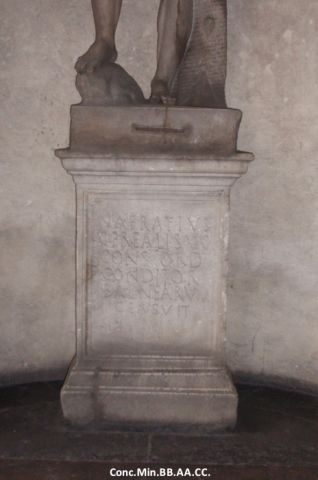
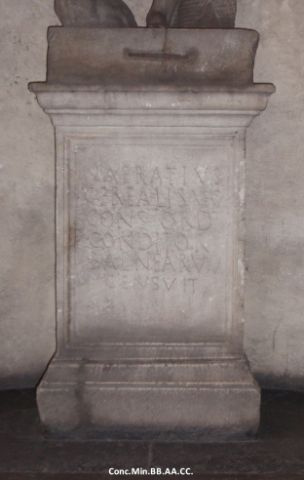
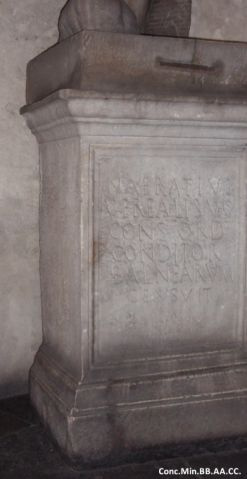
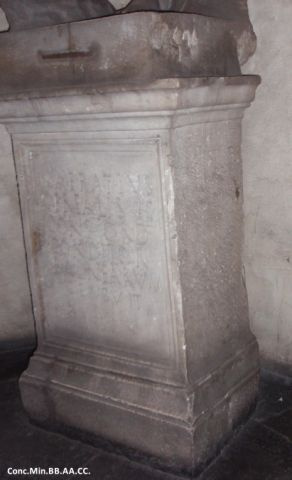
Inscription
Naeratius / Cerealis, v(ir) c(larissimus), / cons(ul) ord(inarius), / conditor / balnearum / censuit.
Inscription translation
Naeratius Cerealis, of clarissimus rank, consul ordinarius, founder of baths, decreed (the erection of this statue).
Bibliography
- Corpus Inscriptionum Latinarum; , VI, 1744c=31916b (+p. 4749-50)
Discussion
INSCRIPTION
In 6 lines:
Naeratius / Cerealis, v(ir) c(larissimus), / cons(ul) ord(inarius), / conditor / balnearum / censuit.
'Naeratius Cerealis, of clarissimus rank, consul ordinarius, founder of baths, decreed (the erection of this statue).'
Letters are fairly regular in size. Lines are not straight, descending towards the right. This is one of a series of bases with the same text, recording the setting up of statues in the baths founded by Naeratius Cerealis. The wording of the inscriptions does not specify the subject of the statues. It is not clear whether these were statues of Cerealis himself, or (more probably) statues dedicated for the embellishment of his baths.
DESCRIPTION
Well preserved white marble base with mouldings top and bottom on all sides. 120 x 82 x 57 cm. The epigraphic field, set within a frame, is rough with clear traces of the erasure of an earlier inscription. The left and right sides are also rough, and it is possible that earlier inscriptions or decoration on the sides were also erased. An unrelated marble statue with plinth has been placed on top of the base, making it impossible to examine the original surface. The base has its back against a wall, and it is also hidden.
PROVENANCE AND CURRENT LOCATION
The base was discovered on the Esquiline, in the area of Villa Montalto Negroni, near Santa Maria Maggiore (CIL). Other inscriptions relating to the same family come from the same area (see below), and the Liber Pontificalis (46.3) mentions a domus Palmati in the fifth century life of bishop Xystus III (Ed. Duchesne, p. 233), equipped with a bakery and baths. It probably referred to a domestic building with an adjoining thermal complex open to the public, donated to the church by Naeratius Palmatus, son of Cerealis. The house and the baths of Naeratius Cerealis were excavated in the 1870s, on the corner of the modern Via Farini and Via Cavour, together with another base celebrating Cerealis (Lanciani 2000, 374; Lanciani 1988, 45-46; see LSA-1455 for the base), confirming the provenance of this series of bases (see also Lanciani 1990, pl. 17).
The base is now in the entrance portico from Corso Vittorio Emanuelle into Palazzo Massimo alle Colonne. The Massimo family had acquired villa Montalto in the 19th century, from where they must have moved our base.
HONORAND, AWARDER AND DATE
The dedication celebrates Naeratius Cerealis, founder of baths in the year of his consulship (358). Cerealis was a member of a powerful family, prefect of the city in 352-3 and consul in 358 (PLRE I, 197-199 Cerealis 2; Chastagnol 1962, 135-139). Cerealis had strong connections in the court, and his wealth was famous in Rome. The foundation of a lavishly decorated bathing complex in Rome, next to his house, was a remarkable demonstration of his prestige and wealth.
Cerealis was also responsible for the setting up of LSA-790, LSA-1447, LSA-1448, LSA-1449, LSA-1450, LSA-1451, LSA-1452, LSA-1453 and LSA-1454. Although not all of these were found in situ, they certainly came from the same baths founded by our awarder.
Discussion references
- Chastagnol, A., Les fastes de la Préfecture de Rome au Bas-Empire, Paris 1962
- Jones, A. H. M. et al., The Prosopography of the Later Roman Empire. Vol. I 260-395, Cambridge et al. 1971 (1975), pp. 197-199 (Cerealis 2)
- Lanciani, R., Forma Urbis Romae, Rome 1990, pl. 17
- Lanciani, R., Notes from Rome, London 1988
- Lanciani, R., Storia degli scavi di Roma e notizie intorno le collezioni romane di antichità, vol. 6 (1700-1878), Rome 2000
Cite: Last Statues of Antiquity, LSA-790 (Carlos Machado).