
LSA-792
Fragment of base for statue of Oecumenius Dositheus Asclepiodotus, governor of Creta. Olous (Creta). 379-384
Record details
Photographs
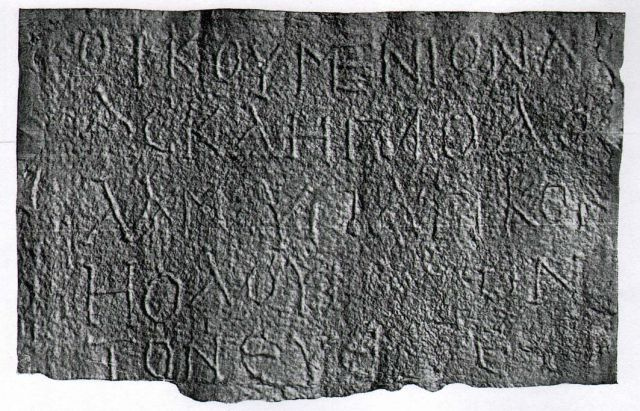
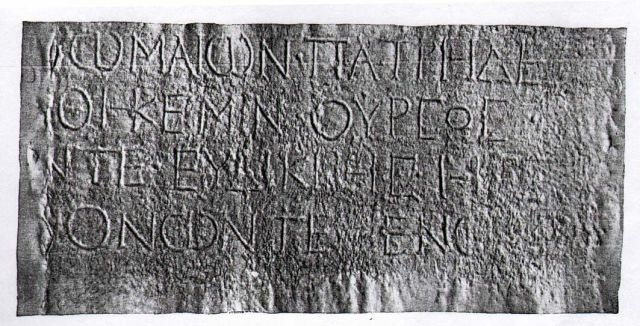
Inscription
Οἰκουμένιον Δωσίθεον / Ἀσκληπιόδοτο[ν τὸ]ν / λαμ(πρότατον) ὑπατικὸν / ἡ Ὀλουντίων βουλὴ / τὸν εὐεργέτην.
Inscription translation
The council of the Olunthians (set this up to) Oecumenius Dositheus Asclepiodotus, the governor (consularis) of clarissmus rank, the benefactor.
Bibliography
- Guarducci, M. , Inscriptiones Creticae. Vol. I. Tituli Cretae mediae praeter Gortynos, Rome 1935, pp. 256-7 no. 13 A
Discussion
INSCRIPTION
In five lines:
Οἰκουμένιον Δωσίθεον / Ἀσκληπιόδοτο[ν τὸ]ν / λαμ(πρότατον) ὑπατικὸν / ἡ Ὀλουντίων βουλὴ / τὸν εὐεργέτην.
'The council of the Olunthians (set this up to) Oecumenius Dositheus Asclepiodotus, the governor (consularis) of clarissmus rank, the benefactor'.
Letter height: 2-3 cm.
Guarducci published this inscription together with another one, on a second fragment from the same findspot. She argued that the two inscriptions were engraved on the opposite large sides of a single base (in lateribus maioribus adversis inscripta). We think that some serious doubts against Guarduccis argument have to be risen; we document the second inscription (LSA-1161) for the discussion here:
Νίκῃ Ῥωμαίων πάτρῃ δὲ / ἀνέθηκέ μιν Οὖρσος / νηόν τε Εὐδικίης ἡγεμόνων τε [γ]ένος.
'Ursus set him up to Victory, the fatherland of the Romans, (him who is a) temple of justice, from a family of governors'.
Guarducci believed that this inscription on the back side of the dedication to Oecumenius Dositheus Asclepiodotus nonetheless formed part of the same honorific monument. Against this speaks not only the fact that the two inscriptions are on opposite sides; moreover the scriptures of the two texts differ significantly. In the Asclepiodotus-inscription, the epsilon is sometimes rounded, sometimes straight; the sigma is always rounded. In the Ursus-inscription these letters are always straight. The alpha in the Asclepiodotus-inscription has an angular bar, in the Ursus-inscription it is straight. Generally, the lettering of the Ursus-inscription is more regular and better lined. It should be noted, that the properties of the Asclepiodotus-inscription outlined here reocurr throughoutly on the inscriptions from Gortyna attributable to that governor (LSA-472, LSA-770, LSA-773, LSA-774, LSA-775, LSA-776, LSA-777, LSA-778, LSA-779, LSA-780, LSA-781, LSA-782, LSA-783,LSA-950).
The prose inscription to Oecumenius Dositheus Asclepiodotus displays the name, rank and title of the honorand and refers to the decree of the city council. In its 'western-style' sobriety, this inscription is equivalent to the rest of the inscriptions known from Creta connected with that governor (LSA-472, LSA-770, LSA-774, LSA-950 (outer front of the praetorium in Gortyna); LSA-775, LSA-776, LSA-777, LSA-778, LSA-779, LSA-780, LSA-781 (dedications to urban Roman aristocrats set up in the praetorium of Gortyna by Asclepiodotus).
While it is all but unusual that individuals take charge for the execution of a decree taken by an assembly, it would be unparalleled that such an individual would not appear united with and related to that assembly in the honorific inscription. The local detachment of the two inscriptions as well as the remarkable change in style from prose to verse, together with the significant diversities in the scriptures, speak in favour of two diverse honours.
DESCRIPTION (from Guarducci 1935 and Guarducci 1929)
Part of a statue base of white marble. Guarducci argued that the surviving part of the base was composed of two fragments, the present one and the fragment bearing the Ursus-inscription(LSA-1161). From her documentation it only elucidates that both fragments are of the same material; nothing is said about wether they are adjoining. The two inscriptions therefore could either document a re-use of a statue base, or they might refer to two singular bases.
PROVENANCE/ LOCATION
The fragment was found on the isthmus called 'Poros' which links modern Elounda with the Peninsula of Kolokitha. The ancient city of Olous is sunken in the sea between Elounda and Kolokitha. According to Guarducci 1935, the fragment was brought to the nearby island of Spinalonga.
HONORAND, AWARDER, AND DATE
The honorand, the governor (consularis) Oecumenius Dositheus Asclepiodotus, whose governorship is reliably datable to 382-3, is commemorated in no less than eleven honorific inscriptions in Crete (PLRE I, 115 Oecumenius Dositheus Asclepiodotus 2). He dedicated statue bases to Gratian, Valentinian II, and Theodosius I (LSA-472, LSA-770, LSA-950, though his name is missing on this latter) which were set up, together with his own statue (LSA-774), in front of the new praetorium built by him in Gortyn. He was also honoured with a statue in Olus (LSA-792). Our base belongs to a set of ten statue bases for leading members of the urban Roman aristocracy in Gortyn (LSA-773, LSA-775, LSA-776, LSA-777, LSA-778, LSA-779, LSA-780, LSA-781, LSA-782, LSA-783), on seven of which Asclepiodotus' name as awarder appears ( LSA-775, LSA-776, LSA-777, LSA-778, LSA-779, LSA-780, LSA-781).
Discussion references
- Guarducci, M., Le iscrizioni del pretorio di Gortina, Rivista del R. Istituto d'Archeologia e Storia dell'Arte I, 143-184, Roma 1929, 169-70
- Robert, L., Epigrammes du Bas-Empire (Hellenica IV), Paris 1948
Cite: Last Statues of Antiquity, LSA-792 (Ulrich Gehn).