
LSA-794
Base for bronze statue of Polycharmus, governor of Achaea. Olympia (Achaea). Fourth century
Record details
Photographs
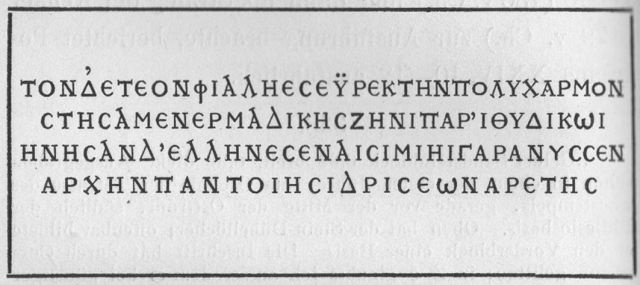
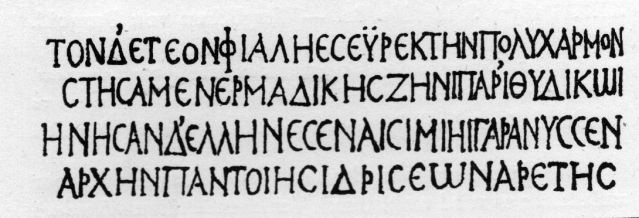
Inscription
τὸνδ’ ἐτεὸν Φιαλῆες ἐϋρ(ρ)έκτην Πολύχαρμον / στήσαμεν ἕρμα δίκης Ζηνὶ παρ’ ἰθυδίκῳ. / ἤνησαν δ’ Ἕλληνες· ἐν αἰσιμίῃ γὰρ ἄνυσσεν / ἀρχήν, παντοίης ἴδρις ἐὼν ἀρετῆς.
Inscription translation
We, the Phigalians set (this) up (to) Polycharmus, the true benefactor, as a herm of Dike (i. e. as an image of Justice) near justice-speaking Zeus. The Greeks agreed: for he finished his rule happily, being skillful in every virtue.
Bibliography
- Dittenberger, W. & K. Purgold, Die Inschriften von Olympia (Olympia Textband V), Berlin 1896, no. 481
- Rizakis, A. D., Roman Peloponnese 1. Roman personal names in their social context (Achaia, Arcadia, Argolis, Korinthia and Eleia), Athens and Paris 2001, 513 Eleia no. 300
Discussion
INSCRIPTION
Verse inscription of two elegiac distichs laid out in four lines:
τὸν δ’ ἐτεὸν Φιαλῆες ἐϋρ(ρ)έκτην Πολύχαρμον
στήσαμεν ἕρμα δίκης Ζηνὶ παρ’ ἰθυδίκῳ.
ἤνησαν δ’ Ἕλληνες· ἐν αἰσιμίῃ γὰρ ἄνυσσεν
ἀρχήν, παντοίης ἴδρις ἐὼν ἀρετῆς.
'We, the Phigalians set (this) up to Polycharmus, the true benefactor, as a herm of Dike (i. e. as an image of Justice) near justice-speaking Zeus. The Greeks agreed: for he finished his rule happily, being skillful in every virtue'.
The epigram praises the justice and other virtues of the office-holder Polycharmus. For the very rare word ἐϋρ(ρ)έκτην, see Robert 1948, 20 n. 6. Dike is a daughter of Zeus and Themis, and a goddess of Justice.
Letter height not recorded.
DESCRIPTION (from Dittenberger and Purgold 1896, and Dittenberger 1880)
Statue base of Pentelic marble. Height 48 cm, width 96 cm, depth 54 cm. It is clear from the descriptions that it has been used twice. The original base was set vertically (as usual), with mouldings top and bottom around three sides (simple at the bottom, double at the top). When re-used for the present inscription, the base was set horizontally on its original back, the statue placed on the original front face, and the inscription carved into the original right side. There are imprints for a bronze statue associated with this re-use; the statue was standing with its weight over its right leg.
PROVENANCE AND CURRENT LOCATION
The base was found in 1880 'in a late wall' (Dittenberger & Purgold), south of the sixth of the Zanes-bases, that is north-east of the temple of Zeus between the Metroon and the entrance of the stadium, at the foot of the terrace of the Treasuries. The inscription states that the statue was set up in the vicinity of the temple of Zeus (Ζηνὶ παρ’ ἰθυδίκῳ).
HONORAND, AWARDER AND DATE
Polycharmus, who is known only from this inscription (PLRE I, 711 Polycharmus), is honoured for his justice, and the location of his monument draws an implicit comparison with Zeus, the model of a heavenly judge. The office (arche) he held was not local, since 'the Greeks agreed to the erection of the statue'. The motifs and form of the epigram suggest that he was a high ranking late-antique state official, very probably a governor (proconsul) of Achaea (cf. Robert 1948, 20).
Phigalia was a city of the Peloponnese south of Olympia. The Phigalians presumably chose to honour Polycharmus at Olympia (http://www.trismegistos.org/place/1495), rather than in their own city, because of its greater prestige, and perhaps because of its pagan religious aura.
The dedication cannot be dated precisely. The only evidence for dating is the verse form, with its allusive references, typical of late-antique statue dedications in the East (Robert 1948). These verse dedications appear to be applied to high-ranking state officials only after 300. We therefore assume this as a terminus post quem, although the documentation of honorific statuary in Olympia is already almost non-existant as early as in the later 3rd century (Goette & Hitzl 1987, 286-8; LSA-2493). It is unlikely that a dedication at Olympia was later than around 400.
Discussion references
- Dittenberger, W., Inschriften aus Olympia, Archäologische Zeitung 38, 1881, 52-62, 54 no. 340
- Goette, H.R. and K. Hitzl, 'Zwei umgearbeitete Porträtköpfe in Olympia', Mitteilungen des deutschen archäologischen Instituts. Athenische Abteilung 102, Berlin 1987, pp. 286-8
- Jones, A. H. M. et al., The Prosopography of the Later Roman Empire. Vol. I 260-395, Cambridge et al. 1971 (1975), 711 Polycharmus
- Robert, L., Inscriptions de l'Antiquité et du Bas-Empire a Corinthe, Revue des Études grecques 79, 1966, 733-770, 20
Cite: Last Statues of Antiquity, LSA-794 (Ulrich Gehn).