
LSA-795
Base for bronze statue, probably of Cervonius, governor of Achaea. From Thespiae (Achaea). Mid fourth century
Record details
Photographs
Inscription
Ἄνδρα φίλον Μούσαισι καὶ ἀ[ν]τιθ̣έ̣ῳ̣ [βασιλῆϊ]
Ἑλλάδος ἄνθυπατον Κε̣ρ̣β̣ώνιον [ἔνθαδ’ ἀδέλφοι]
Θεσπιάδης τε καὶ Εὐστέφιος Μουσ[ῶν παρὰ ναὸν]
στῆσαν Περμεσσοίο πέλας ζαθέου [θ̣’ Ἑλικῶνος].
Inscription translation
Here the brothers Thespiades and Eustephius set (this) up (to) a man dear to the Muses and the godlike emperor, the governor (proconsul) of Greece Cervonius by the temple of the (?) Muses, near (the river) Permessus and the very sacred Helicon.
Bibliography
- Inscriptiones Graecae, VII 1855
- Supplementum Epigraphicum Graecum, , XV, 323
Discussion
INSCRIPTION
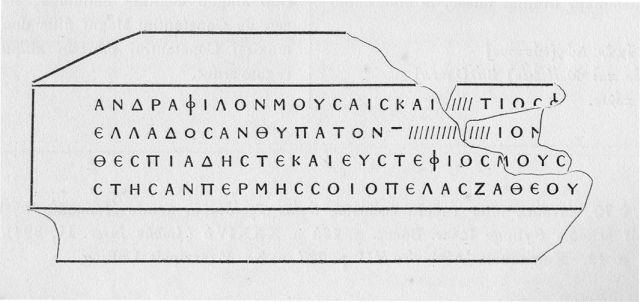
Verse inscription of four hexameters laid out in four lines, each line containing one verse:
Ἄνδρα φίλον Μούσαισι καὶ ἀ[ν]τιθ̣έ̣ῳ̣ [βασιλῆϊ]
Ἑλλάδος ἄνθυπατον Κε̣ρ̣β̣ώνιον [ἔνθαδ’ ἀδέλφοι]
Θεσπιάδης τε καὶ Εὐστέφιος Μουσ[ῶν παρὰ ναὸν]
στῆσαν Περμεσσοίο πέλας ζαθέου [θ̣’ Ἑλικῶνος].
'Here the brothers Thespiades and Eustephius set (this) up (to) a man dear to the Muses and the godlike emperor, the governor (proconsul) of Greece Cervonius by the temple of the (?) Muses, near (the river) Permessus and the very sacred Helicon'.
The inscription in two elegiac distichs praises a governor of Achaea for his education (intimacy with the Muses). In the literature it appears in three different versions. We reproduce the version given in SEG XV, which restores the name of the honorand. This reading is based on a proposal by Peek 1955 who saw the base in the Museum in Thebes and was able to decipher the name of the governor.
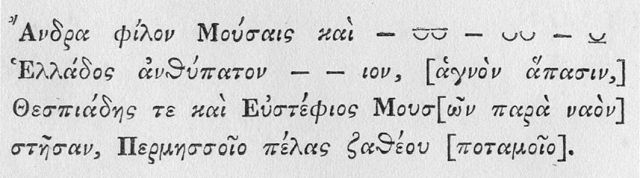
The inscription was only partially completed by Dittenberger in 1892 for IG VII; Dittenberger proposed in line 4 Περμεσσοίο πέλας ζαθέου [ποταμοῖο] (' ... set up ... close to the holy river Permessos').
Letter height not recorded.
Preuner 1920, followed by Robert 1948, 29, proposed the following version, with far fewer completions than Peek's, including no reading of the honorand's name:
ἄνδρα φίλον μούσαις καὶ [------]
Ἑλλάδος ἄνθυπατον [--]ιον [---]
Θεσπιάδης τε καὶ Εὐστέφιος Μουσ[ῶν παρὰ ναὸν]
στῆσαν Περμεσσοίο πέλας ζαθέου [τ’ Ἑλικῶνος]
'Thespiades and Eustephius set (this) up to ...ius a man intimate with the Muses, the governor (anthupatos) of Greece by the temple of the Muses close to the Permessos and the very sacred Helicon'
DESCRIPTION (from IG VII)
Block of white marble once part of a statue base. Height 24 cm, width 30 cm, depth 36 cm. Towards the left edge of the top there is a clamp hole to connect this block with another one. On the top face there are imprints for feet; the statue therefore must have been of bronze.
PROVENANCE AND CURRENT LOCATION
Found in the ruins of the church of Hagia Triada in the valley of the river Permessos by Mount Helicon, the area where in Antiquity the holy grove of the Muses was located. Now in the Museum in Thebes.
HONORAND, AWARDER AND DATE
If the governor (anthupatos, proconsul) of Achaea here honoured is correctly identifed as Cervonius, he is known from a speech by Himerius delivered to him in Athens. This speech must be earlier than the one delivered to the proconsul Scylacius not much later than 343 (Groag 1946; for Scylacius: PLRE I, 811 Scylacius 1). From the middle of the 4th century onwards, the erection of bronze statues required imperial permission, which is often mentioned in the relevant inscriptions (Premerstein 1912). The absence here of any reference to permission therefore supports a date for this base in the first half of the 4th century. The terminus post quem for the base is provided by the re-elevation of the governorship of Achaea to proconsular rank, probably in 324 (Groag 1946, 22).
A late-antique date is additionally supported by the allusive and literary verse form.
One of the awarders, Thespiades, probably reappears as the dedicator of another statue in Thespiae (LSA-796); there he is styled 'twice gymnasiarch'.
ACKNOWLEDGEMENTS
We are grateful to Erkki Sironen for help with the translation of this inscription.
Discussion references
- Peek, W., ΠΕΙΡΑΤΑ ΤΕΧΝΗΣ. Grundsätzliches und Kritisches zu neuen Büchern über Griechische Epigramme, Wissenschaftliche Zeitschrift der Martin-Luther Universität Halle-Wittenberg IV, 216-236, Halle (Saale) 1955, 217
- Premerstein, A. v., 'Griechisch-Römisches aus Arkadien', Jahreshefte des Österreichischen Archäologischen Instituts 15, 197 - 218, Wien 1912, 216
- Preuner, E., Honestos, Hermes, 1920, 388-426, 404 n. 2
- Robert, L., Epigrammes du Bas-Empire (Hellenica IV), Paris 1948
Cite: Last Statues of Antiquity, LSA-795 (Ulrich Gehn).