
LSA-8
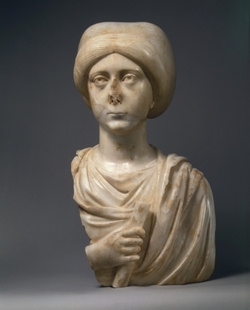
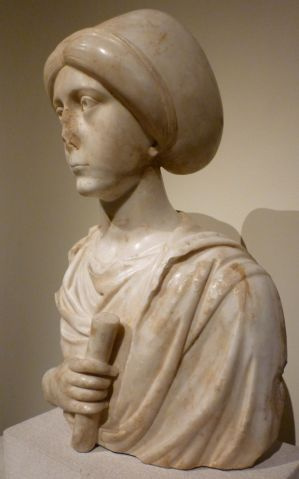
Bust of woman with headdress and scroll. Constantinople? (now Metropolitan Museum). Late fourth to early fifth century.
Record details
Photographs
Bibliography
- Inan, J. & E. Alföldi-Rosenbaum, Römische und frühbyzantinische Porträ̈tplastik aus der Türkei : neue Funde, Mainz 1979, 335-6, no. 335, pl. 268
- Schade, K., Frauen in der Spätantike--Status und Repräsentation, Mainz 2003, 208-10, no. I 49, pl. 56
- Weitzmann, K. (ed.), Age of spirituality : late antique and early Christian art, third to seventh century : catalogue of the exhibition at the Metropolitan Museum of Art, November 19, 1977, through February 12, 1978, New York 1979, 292-5, no. 272 (AD 500-525)
Discussion
DESCRIPTION (Object)
Life-size bust. H: 53, W (at shoulders): 27.5, D: 22.2 cm. H (chin to crown): 22, W (of head): 18 cm. Fine-grained white marble.
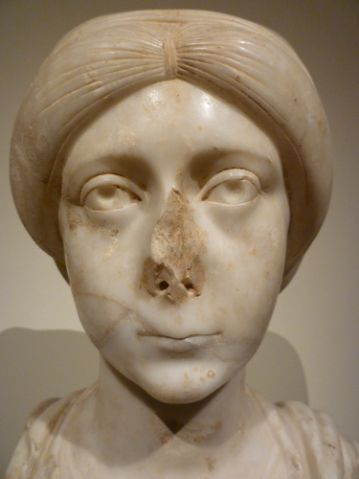
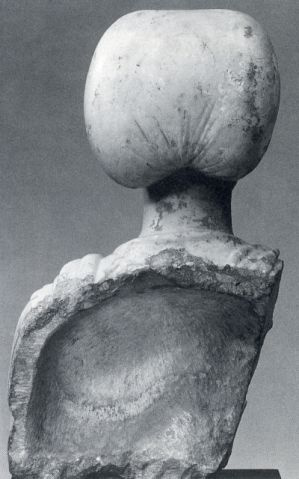
The head is broken through the lower face but the two fragments fit together seamlessly. The lower edge of the bust (from below the scroll) is sawn as is a line from the right shoulder down. The outer right shoulder and the right arm are missing. The nose has broken off.
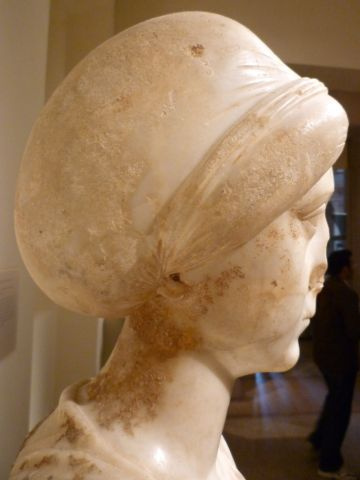
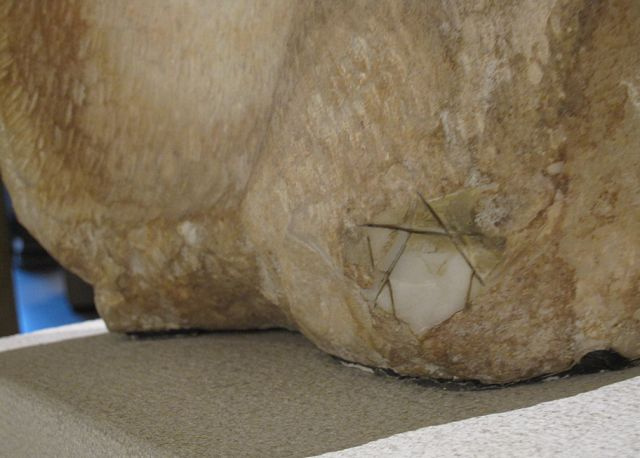
The head and bust were made in one piece. The back is hollowed out, and the surface preserves the regular markings of a claw chisel. Although there is no proper spine, the back surface does swell near the lower centre. There is a marble flaw in the bottom of this 'spine.' There is a 3 cm hole in the bottom surface for a dowel.
The inner eye is rendered as a deep round depression. The surface is finely polished. Details of the hair, eyelids, and mouth are precisely cut with flat chisels.
PROVENANCE
Purchased in 1966 by the Metropolitan Museum of Art. Allegedly found in Istanbul.
DESCRIPTION (Subject)
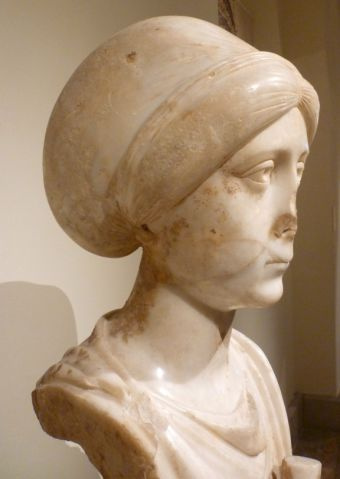
The bust wears a heavy outer garment (himation, palla) over an inner one (chiton, tunic). One end of the outer garment is pulled tightly around the left shoulder. It then passes around the back of the neck and comes forward at the right side, falling loosely around the right shoulder. It crosses the body and is draped over the left shoulder again. The inner garment is blousy and has a loose neck line which sags heavily at the centre. Both garments appear to be made of a similar thick material.
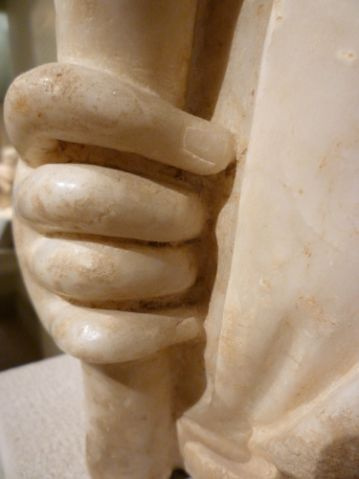
The right hand holds a scroll at the centre of the chest. The hand is attenuated, and the fingers are without naturalistic modelling.
The neck lacks any turn, and so the head faces forward. The face has broadly-spaced cheekbones, full cheeks, and a small protruding chin. The mouth is thin-lipped and pursed. The eyes are set under eyebrows which droop slightly. They are finely shaped with pointed inner canthi and upper lids which continue beyond the outer corners of the eyes. The hole for the pupil must once have been filled with coloured glass or a stone.
The hair is completely covered by a bonnet which leaves only the ear lobes visible. A band of cloth is tied around the bonnet and runs around the head over the brow. It creates creases in the bonnet over the centre of the brow and above the nape. A tie or lace runs vertically over a section of the bonnet over the brow. This creates another series of radiating creases in the bonnet. The shape of the bonnet seems to reflect the hairstyle beneath it, possibly a roll of hair framing the face and then two thick braids at the back.
HONORAND
The woman honoured has her hair completely covered and holds a scroll. These are both characteristics of a good wife, modest and attentive to household affairs (rather than intellectually and artistically inclined), and can be seen in funerary depictions.
DATE
The date is controversial. The head-covering appears in tomb imagery in the late fourth century. The use of inset irises in the eyes is a technical detail that appears frequently in Western portraits in the fifth century; see, for example, the ‘Ariadne’ portraits from Rome, LSA-755, LSA-756, and LSA-757. The physiognomy seems to Schade to pre-date the cubic forms of the Empress Ariadne of the mid fifth century. Yet, the high quality seems to Rosenbaum to justify a Justinianic date.
Discussion references
- Alföldi-Rosenbaum, E. 'Bemerkungen zur Porträtbüste einer jungen Dame justinianischer Zeit im Metropolitan Museum', Jahrbuch für Antike und Christentum 15, Münster 1972, 175-8 (refutes von Heintze)
- Heintze, H. von ‘Ein spätantikes Mädchenportät in Bonn. Zur stilitischen Entwicklung des Frauenbildnisses im 4. und 5. Jahrhundert’, Jahrbuch für Antike und Christentum 14, Münster 1971, 90, fn. 104 (doubts antiquity of bust)
- Meischner, J., Bildnisse der Spätantike : 193-500 : Problemfelder : die Privatporträts , Berlin 2001, 113, figs. 323-4 (Theodosian)
Cite: Last Statues of Antiquity, LSA-8 (J. Lenaghan).