
LSA-801
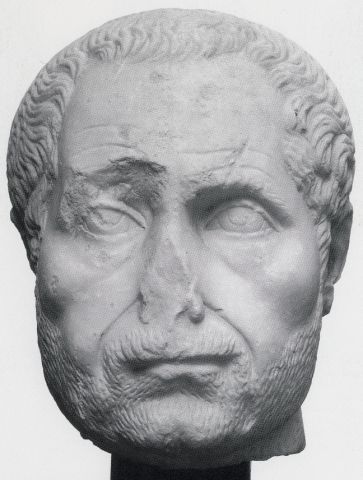
Portrait head of man with hair combed forward and smoothly finished back. From Asia Minor? Fourth century.
Record details
Photographs
Bibliography
- Johansen, F. , Catalogue of the Roman Portraits III; Ny Carlsberg Glyptotek, (Copenhagen 1995), 146-7, no. 62 (c. 300)
- Poulsen, V., Les portraits romains II, Copenhagen 1974, 181, no. 186 cat. 749a, pls. 302-303
Discussion
DESCRIPTION (Object)
Over life-size head. H: 25 cm White marble.
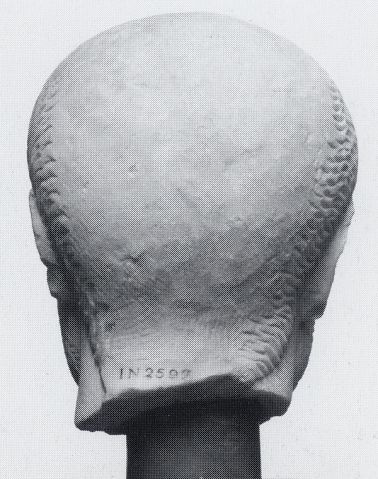
The head is broken through the top of the neck. It probably came from a statue since the perimeter of the hair pattern continues low onto the nape almost as if it were a neck support. The tip of the nose is missing, and there is a chip in the right eyebrow.
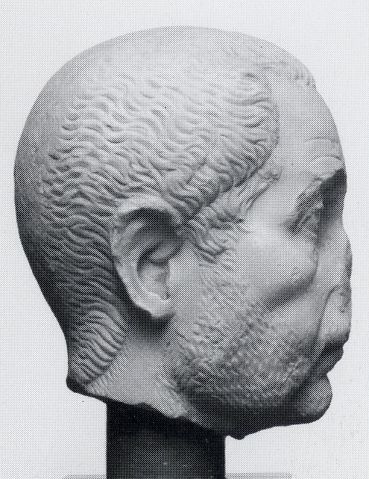
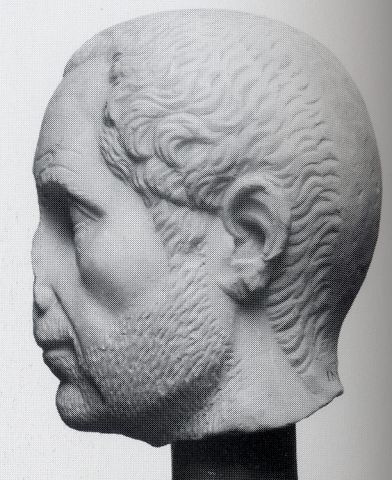
The hair on the head is defined with careful undulating lines of a flat chisel work. These emerge at the front and sides of the head from a smooth flat surface follows the contour of the head. The hair on the face has been less carefully indicated with a small strokes of the flat chisel. Small strokes of the flat chisel are also visible on the neck below the raised area of the hair.
The eyes have been roughly marked. A semi-circular line of the flat chisel, which does not touch the bottom lid, indicates the iris of each eye. The inner canthi are also marked by a curving line of a flat chisel.
The head has been re-worked from an earlier head. The beard and eyes are incompetently rendered in comparison with the hair of the head. The upper lip is lost under a roughly carved moustache. The naso-labial folds are deeply inserted and narrow drill channels. There is a division on both sides of the head between the hair of the sideburns and that of the head.
PROVENANCE
Purchased from a Greek art dealer. Johansen, however, writes that this does not necessarily mean from Greece. The particular form of the uncarved hair at the back of the head and nape is a technical detail which can be seen almost identically on a second-century portrait of young man in a toga from Aphrodisias (R.R.R. Smith, Aphrodisias II, no. 4). The head might come from Asia Minor.
DESCRIPTION (Subject)
The head shows a mature man with a short, mainly brushed- forward hairstyle, a moustache, and a short beard. The hair over the brow is naturalistically rendered and recedes slightly at the corners of the brow. At the temples the hair grows downwards or is brushed backwards; this contrasts to the forward movement of the rest of the hair.
The face is broad with a tall brow that is lined and with large projecting cheekbones. The naso-labial folds form a ‘parenthesis’ around the mouth, and lines running from the inner corners of the eyes to the cheeks accentuate the cheekbones. The mouth rises on the proper left which gives the sitter a wry expression.
DATE
The fashion style of combed forward hair and short beard suggest a date in the late third or earlier fourth century. The portrait of Caius Caelius Saturninus signo Dogmatius shows a similar style and can be dated securely to 324-337 (LSA-903 and LSA-1266).
Heads showing a generally similar style and technique include LSA-73 from Corinth, LSA-124 from Athens, LSA-418 from Sparta, and LSA-1707 from Miletus.
Discussion references
- L'Orange, H. P., Studien zur Geschichte des spätantiken Porträts, Oslo 1933, 124, no. 57, fig.106.
- Meischner, J., Bildnisse der Spätantike : 193-500 : Problemfelder : die Privatporträts , Berlin 2001, 173 (under 270-285) and 176 (under 282-293)
Cite: Last Statues of Antiquity, LSA-801 (J. Lenaghan).