
LSA-803
Three fragments of base for statue, probably of Flavius Valerius Diogenianus, apparently imperial official. Samos (Insulae). Late third to earlier fourth century (?)
Record details
Photographs
Inscription
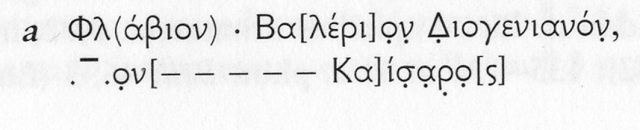
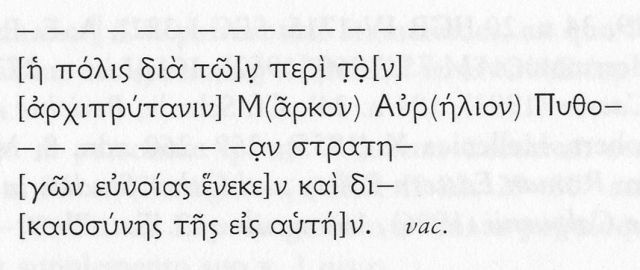
Φλ(άβιον) Βα[λέρι]ο̣ν̣ Δ̣ιογενιανόν̣ / τ̣̣ο̣ν [---------Κα]ίσ̣α̣ρ̣ο̣[ς[ / --------------- / [ἡ πόλις διὰ τῶ]ν̣ περὶ τ̣ο̣]ν] /(5) [ἀρχιπρύτανιν] Μ(ᾶρκον) Αὐρ(ήλιον) Πυθο- / ----------α̣ν στρατη- / [γῶν εὐνοίας ἕνεκε]ν καὶ δι- / [καιοσύνης τῆς εἰς αὑτή]ν.
Inscription translation
The city (set this up to) Flavius Valerius Diogenianus, the (---) of the emperor, because of his benevolence and justice towards her. The college of the four praetors, especially the Archiprytanis (= highest local magistrate) Marcus Aurelius Pytho(---), took charge
Bibliography
- Inscriptiones Graecae, XII, 6, 1, 386
Discussion
INSCRIPTION
In eight lines:
Φλ(άβιον) Βα[λέρι]ο̣ν̣ Δ̣ιογενιανόν̣ / τ̣̣ο̣ν [---------Κα]ίσ̣α̣ρ̣ο̣[ς[ / --------------- / [ἡ πόλις διὰ τῶ]ν̣ περὶ τ̣ο̣]ν] /(5) [ἀρχιπρύτανιν] Μ(ᾶρκον) Αὐρ(ήλιον) Πυθο- / ----------α̣ν στρατη- / [γῶν εὐνοίας ἕνεκε]ν καὶ δι- / [καιοσύνης τῆς εἰς αὑτή]ν.
'The city (set this up to) Flavius Valerius Diogenianus, the (---) of the emperor, because of his benevolence and justice towards her. The college of the four praetors, especially the Archiprytanis (= highest local magistrate) Marcus Aurelius Pytho(---), took charge'
DESCRIPTION (from Herrmann 1960)
Three fragments of a large white marble base. Fragment A preserves part of the left edge; the conjoining fragments B and C preserve part of the right edge. The upper edge is preserved, the lower part of the base is broken. Above the first line of this inscription, the erased line (c. 20 cm long) of an earlier inscription is visible but not legible.
PROVENANCE/ LOCATION
Fragment A was found in 1953 in the village of Kolonna; fragment B in 1912 in the sanctuary of Hera; fragment C also in 1912 in the Byzantine church. All the fragments are now in the lapidarium of the sanctuary of Hera, inv. nos. J 289 (frgmt. A), M 155 (frgmt. B), M 199 (frgmt. C).
HONORAND, AWARDER AND DATE
Flavius Valerius Diogenianus, named in the first line, is probably the honorand, although the condition of the inscription does not make this certain (Herrmann 1960, 147): the last letter in the first line is not clearly legible, but appears to be an 'n' (hence accusative, for the honorand) rather than an 's' (nominative, for the awarder). Diogenianus is otherwise not known and has no PLRE-entry. Line 2 indicates that he was entrusted with an office by an emperor.
In Samos a college of four praetors (strategoi, στρατηγοί) was responsible for the erection of honorific monuments. A fifth magistrate, the Archiprytanis, presided over this college (Herrmann 1960, 125 n. 198).
Herrmann 1960, the first editor of the inscription, dated it 'to the 3rd century or later' without further justification. IG XII, 6, 1 in 2000 gives a date in the 4th century, likewise without justification. These late dates are presumably based on the letter forms. Whereas the use of prose and the wording of the inscription are traditional and do not in themselves indicate a late-antique date, the praise of the honorand's justice which is a major feature of late antique honorific inscriptions, is an indicator of late antique date. Likewise, the honorand's name, containing a nomen (Valerius) born by all emperors of the tetrarchy, and another one (Flavius) referring to the second Flavian (Constantinian) dynasty, strongly points to a date in the late 3rd or earlier 4th century.
Discussion references
- Herrmann, P., Die Inschriften römischer Zeit aus dem Heraion von Samos, Athenische Mitteilungen 75, 1960, 68 - 183, 147-8 no. 42
Cite: Last Statues of Antiquity, LSA-803 (Ulrich Gehn).