
LSA-804
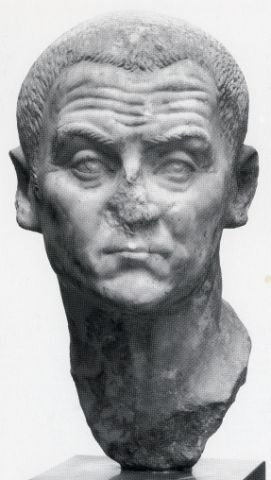
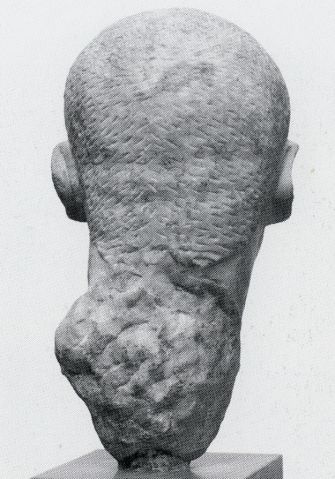
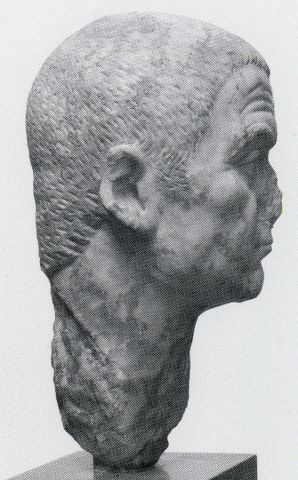
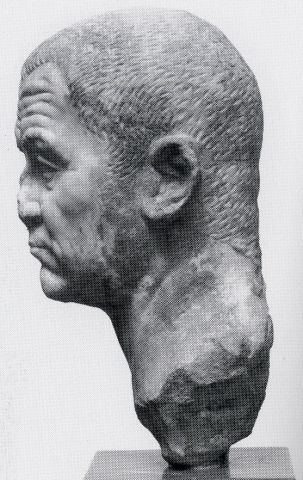
Portrait head of clean-shaven elderly man, worked separately. From Rome. Late third century.
Record details
Photographs
Bibliography
- Curtius, L. 'Portraet der Tetrarchenzeit', Journal of Hellenic Studies 71, London 1951, 48-57, pls. 23-24, figs. 1-3
- Johansen, F. , Catalogue of the Roman Portraits III; Ny Carlsberg Glyptotek, (Copenhagen 1995), 164-5, no. 71
Discussion
DESCRIPTION (Object)
Over life-size head, worked separately. H: 38, H (chin to hair): 18.5 cm. White marble (Curtius: probably Pentelic).
The head was probably worked separately from its statue. The back of the neck is roughly picked. The nose is missing, and there is a chip in the chest at the front proper left.
The hair is indicated with many, short strokes of the flat chisel. The irises are finely engraved and do not touch the lower lids. The pupils are circular.
The head has been re-cut from an earlier portrait. There are indications of longer more three-dimensional locks on the left side of the nape. The neck is too thick for the head. There is excess material behind the ears which protrude. The facial features seem to recede from the plane of the forehead.
PROVENANCE
From Rome, formerly in the collection of L. Curtius
DESCRIPTION (Subject)
The head shows a clean-shaven elder man. He turns forcefully to his left. There are creases on the left side of the neck and two vertical lines run through the centre of the neck.
He has short-cropped hair which comes forward in a peak at the centre of the brow, extends far down the nape, and has two sideburns in front of the ears.
The brow is heavily creased, traversed by five or six curving furrows. The eyebrows are prominent and have a flaring arch. The eyes themselves are small. The nose is hooked and the chin projects. The mouth is tight-lipped. Most strikingly, the skin has been rendered great care. It wrinkles at the corners of the eyes, sags below the eyes and around the mouth.
DATE
The portrait wears a clean-shaven fashion style, has emphatic eyebrows, and has a markedly aged and carefully-wrought physiognomy. But it is the short-cropped hair rendered with the flat chisel which has led most all scholars to place it at the end of the third century or beginning of the fourth. The head has been compared to LSA-852 , which however does not represent Diocletian and which does not have a fixed date. Other examples of older men with clean-shaven faces, which possibly date to this period, include: LSA-2128, LSA-2146, and LSA-2508.
The head was probably originally a Julio-Claudian portrait given the outline of the hair and the locks visible on the nape.
Discussion references
- L'Orange, H. P., Das spätantike Herrscherbild von Diokletian bis zu den Konstantin-Söhnen, 284-361 n. Chr. Das Römische Herrscherbild. III. Abteilung ; Bd. 4 , Berlin 1984, 97 (Diocletian)
- Meischner, J., Bildnisse der Spätantike : 193-500 : Problemfelder : die Privatporträts , Berlin 2001, 65 (under 283-293)
Cite: Last Statues of Antiquity, LSA-804 (J. Lenaghan).