
LSA-805
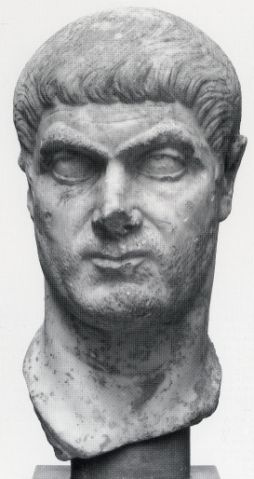
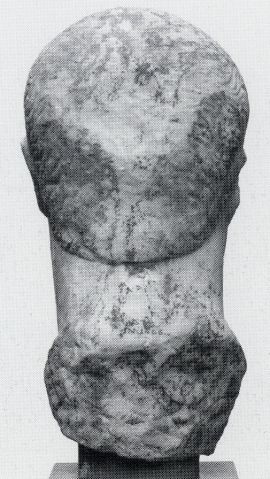
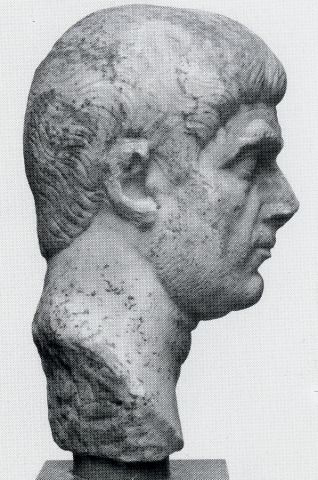
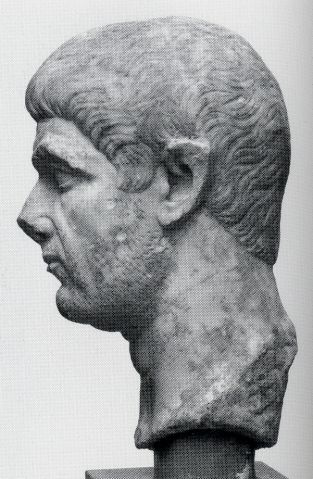
Portrait head, separately worked, of man with short hair, stubble beard, and arching brows. From Italy. Fourth century.
Record details
Photographs
Bibliography
- Johansen, F. , Catalogue of the Roman Portraits III; Ny Carlsberg Glyptotek, (Copenhagen 1995), 166-7, no. 72
Discussion
DESCRIPTION (Object)
Over life-size head, worked separately. H: 40 cm. White marble.
The head was worked separately from its statue. The underside of the tenon is roughly picked. The area around the left clavicle, the tip of the nose, and the upper edges of the ears are missing.
The hair, except at the back, is indicated by curving lines of a flat chisel. At the back the flat surface is devoid of representational detail. The eye markings appear to be large semi-circular hollows made with a drill that are placed directly beneath the upper lids. The eyebrows and beard are rendered with fine lines of small chisel.
PROVENANCE
From the collection of Martinetti.
DESCRIPTION (Subject)
The head shows a mature man with a rectangular face and a short fringe. He turns to his right. The neck is creased and flabby. The sterno-cleido mastoids are indicated near the base of the neck.
The hair is brushed forward and all the ends over the brow turn to the proper left. There is a small opening between the locks over the right eye. At the nape the hair is cut short, and in front of the ears are short side-burns which fall downwards in a direction almost perpendicular to that of the hair of the fringe.
The brow is low and lightly creased. The flaring eyebrows project in high relief and meet at the bridge of the nose which is deeply set. The nose springs sharply out from the bridge. The mouth is small and the upper lip thin and lopsided so as to seem almost sneering. The chin is broad, round, and receding. The naso-labial folds are indicated; there are creases at the corners of the mouth; and loose skin hangs beneath the chin. The upper lip, cheeks, and chin are covered with light hair.
DATE
The brushed-forward hairstyle plus curving fringe are generally said by scholars to depend upon the images of Constantine (see LSA-558). The shape of the face, loose skin around the chin and neck, and the flaring eyebrows are also reminiscent of the portrait type assigned to Valentinian or Valens (see LSA-582 ). A date in the mid-fourth century seems most probable to this author.
Discussion references
- Bergmann, M. 'V.Poulsen. Les Portraits Romains II', Gnomon 53, Berlin 1981, 189, no. 196 (Constantinian)
- L'Orange, H. P., Studien zur Geschichte des spätantiken Porträts, Oslo 1933, 53, 130, no. 74, figs. 142 and 144
- Meischner, J., Bildnisse der Spätantike : 193-500 : Problemfelder : die Privatporträts , Berlin 2001, 95-6, 103, fig. 254 (under 324-337)
- Stutzinger, D. (ed.), Spätantike und frühes Christentum. Ausstellung im Liebieghaus, Museum alter Plastik, Frankfurt am Main. 16. Dezember bis 11. März 1984, Frankfurt a.M. (1983), 425-6, no. 39 (Tetrarchic)
Cite: Last Statues of Antiquity, LSA-805 (J. Lenaghan).