
LSA-808
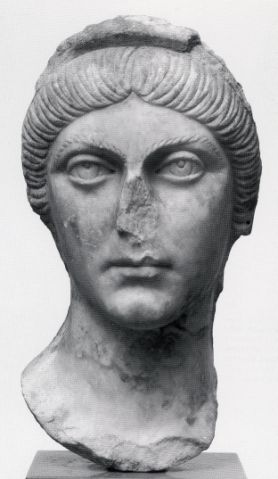
Portrait head for insertion of woman with head cloth and long face. From Italy. Fourth century.
Record details
Photographs
Bibliography
- Johansen, F. , Catalogue of the Roman Portraits III; Ny Carlsberg Glyptotek, (Copenhagen 1995), 174-5, no. 76
Discussion
DESCRIPTION (Object)
Over life-size head, worked separately. H: 35 cm. White marble.
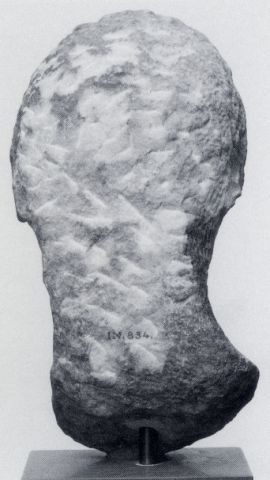
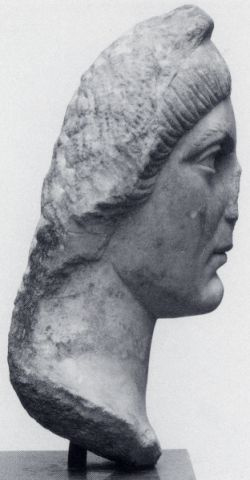
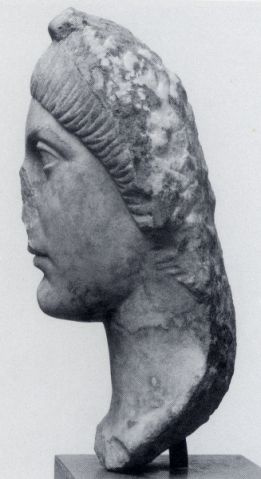
The head is preserved with its neck and the area immediately around the base of the neck. The back of the neck and head and the sides of the head are all roughly picked. The head was clearly intended to be inserted into a statue with drapery pulled over the head. The underside of the neck is flat. That is, it is without a true tenon and thus may not have originally made to be a head for insertion. The tip of the nose is missing. Schade writes that the hole in the left ear was for the addition of an earring.
The hair is rendered with crisply-cut, parallel lines of a flat chisel. The irises are engraved and larger than semi-circular. The pupils are also engraved and are almost circular.
PROVENANCE
It was purchased in Rome in 1890.
DESCRIPTION (Subject)
The head shows a woman who turns to her right. Her head was originally veiled; an edge of the veil which was worked with the head is preserved at the front of the head. Her hair is parted in the centre and brushed up and back off the face. It covers the ears.
The hair is parted in the centre and pulled to both sides, covering the ears. At the back the hair is divided into two sections which begin each behind an ear and cross over each other above the centre of the nape. They are then pulled around the head and form a band behind the crown.
The face is almost oval, though it is slightly wider across the cheekbones. The eyebrows are high flaring arches. The nose seems to have projected. The mouth is short from side to side but has full lips. The chin, whose upper border is defined by a curving line below the mouth, is deep and projecting.
DATE AND HONORAND
The head is usually placed in the second half of the fourth century. In facial structure and hairstyle, it finds closest parallel in LSA-574, which, though it is a portrait of an empress, cannot be dated securely. The treatment of the brow hair recalls the portrait of a Valentinian Emperor, LSA-578, also in Copenhagen and also purchased in the same years in Rome. The treatment of the eyes and eyebrows is very similar to another imperial portrait from Rome, LSA-558, which has been variously identified as Gratian, Valentinian II, Arcadius, and Honorius.
Discussion references
- Meischner, J., Bildnisse der Spätantike : 193-500 : Problemfelder : die Privatporträts , Berlin 2001, 180 (under 337-364)
- Schade, K., Frauen in der Spätantike--Status und Repräsentation, Mainz 2003, 186, no. I 25, pl. 39 (second half of 4th century)
- Sydow, W. von, Zur Kunstgeschichte des spätantike Porträts im 4. Jahrhundert. n. Chr, Bonn 1969, 88-91, pl. 3.2 (390-400)
- von Heintze, H. ‘Ein spätantikes Mädchenportät in Bonn. Zur stilitischen Entwicklung des Frauenbildnisses im 4. und 5. Jahrhundert’, Jahrbuch für Antike und Christentum 14, Münster 1971, 76, no. IV 2, pl. 12a and c (mid fourth century)
Cite: Last Statues of Antiquity, LSA-808 (J. Lenaghan).