
LSA-809
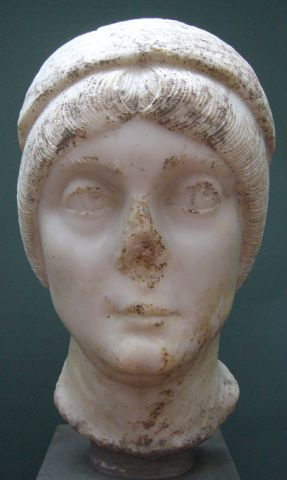
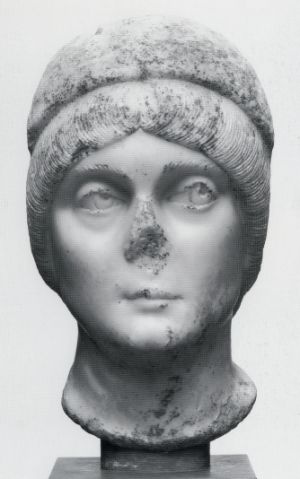
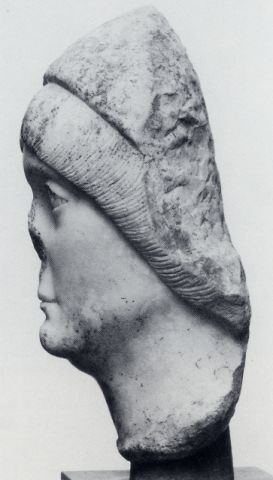
Portrait head for insertion of woman with head cloth and polished face. From Italy. Late fourth century to early fifth century.
Record details
Photographs
Bibliography
- Johansen, F. , Catalogue of the Roman Portraits III; Ny Carlsberg Glyptotek, (Copenhagen 1995), 180-81, no. 79 (late fourth to fifth c.)
Discussion
DESCRIPTION (Object)
Over life-size head, worked separately. H: 35 cm. White marble.
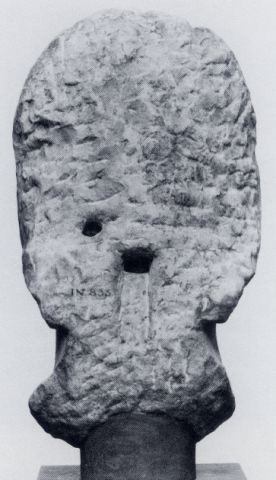
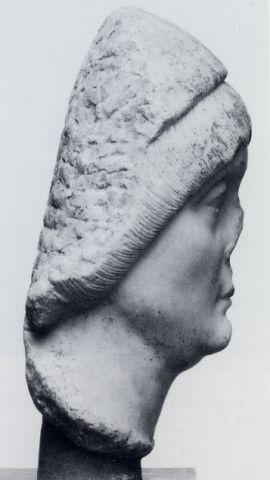
The head is preserved with its neck and the area immediately around the base of the neck. The back of the neck and head and areas of the sides of the head are roughly picked. In addition, there is a clamp hole in the back at approximately the height of the nape. The underside of the neck is flat. That is, it is without a true tenon and was not originally made to be a head for insertion. Most of the nose is missing.
The hair is rendered with delicately-cut, parallel lines of a fine chisel. The irises are engraved, and the pupils are drilled out and circular. The surface of the face is polished. The recessed plane of the face suggests that the portrait has been reworked from an earlier head.
PROVENANCE
It was purchased in Rome in 1888.
DESCRIPTION (Subject)
The head shows a mature woman who turns to her left. The face is finely polished and framed by carefully rendered hair. The back of her head and hair is either covered or simply without representational detail.
The hair is parted at the centre of the brow and brushed up and back off the face. The hair around the face rests on the outer corners of the eyebrows and covers the ears. A few centimetres above this is another section of hair or a cloth. It has a uniform curving edge and is on a higher plane than the hair itself.
The face is oval and set back. The brow is low, and the eyebrows are straight and fine. The cheek bones project. The eyes have heavy upper lids and pointed inner canthi. The mouth is small with fine lips. The chin is short and projecting with loose skin beneath it.
DATE
The fine rendering of the hair and the careful modelling of the face combined with stylized features find general parallels in the portraits of the Theodosian emperors; see, for example, LSA-337.
The clothing or treatment of the hair is not clear. It resembles best a portrait purchased on the art market and now in Berlin, LSA-983. A portrait of woman, now in Florence, LSA-974, is also a useful comparison. It shows a crimped hairstyle around the brow but has a similar turban effect above the brow hair, and it has a similar facial structure. Both of these examples suggest that the portrait under discussion may not have been wearing a bonnet but that the hair was not fully executed. LSA-406 provides yet another example in which distinctions between hair and cloth covering are difficult.
Discussion references
- Meischner, J., Bildnisse der Spätantike : 193-500 : Problemfelder : die Privatporträts , Berlin 2001, 122, figs. 361-2 (under 430-455)
- Schade, K., Frauen in der Spätantike--Status und Repräsentation, Mainz 2003, 203, no. I 44, pl. 52 (c. 400)
- von Heintze, H. ‘Ein spätantikes Mädchenportät in Bonn. Zur stilitischen Entwicklung des Frauenbildnisses im 4. und 5. Jahrhundert’, Jahrbuch für Antike und Christentum 14, Münster 1971, 76, no. IV 1, pl. 11d (mid fourth century)
Cite: Last Statues of Antiquity, LSA-809.