
LSA-81
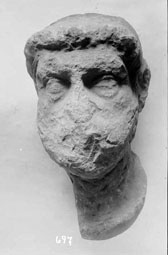
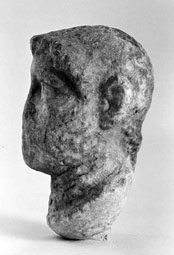
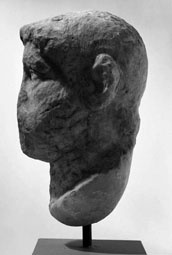
Unfinished portrait head of bearded man (in process of being re-worked). Corinth (Achaea). Late fourth to fifth century.
Record details
Photographs
Bibliography
- de Grazia, C. E., American School of Classical Studies at Athens, "Excavations of the American School of Classical Studies at Corinth:
The Roman Portrait Sculpture," Ph.D. Dissertation
, Columbia University, 1973, pp. 226-7 no. 55 pl. 72 - Vanderpool, C., Roman Portraiture, Williams, C. K. II & N. Bookidis, Corinth, the centenary, 1896-1996: Corinth XX, 369-384, Princeton 2003, p. 375 n. 33 fig. 22.7
Discussion
DESCRIPTION (Object)
Fine-grained white marble, H (overall) 38.5 (chin to crown) 26.5, W 20.5, D 22 cm. Worked for insertion, a portion of the right side of the neck is broken off. Nose and chin are broken off; hairline, eyebrows, cheeks, and mouth are chipped off; the entire surface is badly worn.
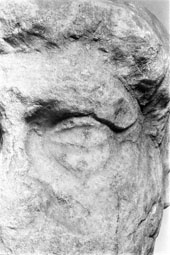
Hair and beard are only blocked out; traces of the re-working process are visible notably at the ear, and around the eyes which were enlarged during that process. The eyes are not (yet?) marked.
PROVENANCE/ LOCATION
The head was found 1904 in the west agora, between the two sets of West shops, set into the head socket of the himation statue Corinth museum inv. no. S-696. The head is oversized for the statue and does not originally belong to it; Johnson 1931, 198 argued that ‘it was probably placed there after Corinth had become a ruined site’. It is now in the Corinth museum, inv. No. S-697.
DESCRIPTION (Subject)
Portrait of a male with heavy jaw bones, wearing a trimmed full beard; the head is slightly turning to the right. The hair loops into a moderate wreath around the face, the ears are not covered. Comparable fashion hairstyles feature on the portraits of high imperial state officials on the obelisk-base in Constantinople (390/2), and on portrait statues of high imperial officials in the (early) 5th century (LSA-150) (see below, ‘Date’).
DATE
The hairstyle was compared to fashion styles of the Hadrianic period by Johnson 1931; L’Orange 1933 dated it to the 2nd half of the 5th century, followed by De Grazia 1973, Sturgeon 2003, and Vanderpool 2003.
The moderate wreath hairstyle with ears uncovered features on the portraits of high imperial state officials on the obelisk-base in Constantinople (390/2), and on portrait statues of high imperial officials in the (early) 5th century (LSA-150) (see above, ‘Description (Subject)’); in our view a date in the late 4th or early 5th century is favourable.
Discussion references
- Johnson, F. P., Sculpture, 1896-1923: Corinth IX, 1, Cambridge, Mass. 1931, pp. 88-9 no. 170
- L'Orange, H. P., Studien zur Geschichte des spätantiken Porträts, Oslo 1933, p. 89
- Sturgeon, M. C., Sculpture at Corinth, 1896 - 1996, Williams II, C. K. & N. Bookidis (eds.), Corinth. The centenary, 1896 - 1996 (Corinth XX), 351-68, Princeton 2003, p. 362 n. 42
Cite: Last Statues of Antiquity, LSA-81 (Amelia Brown/ Ulrich Gehn).