
LSA-810
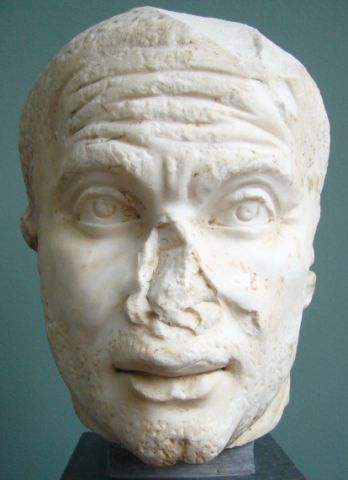
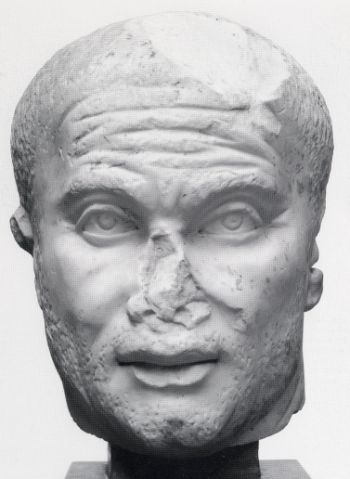
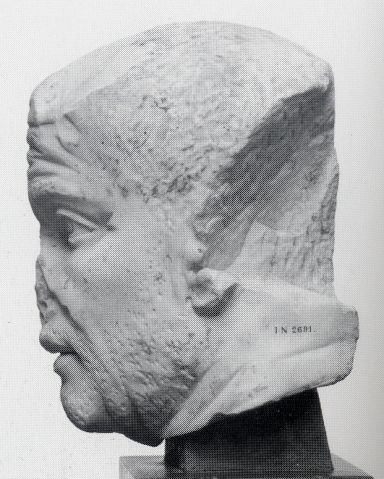
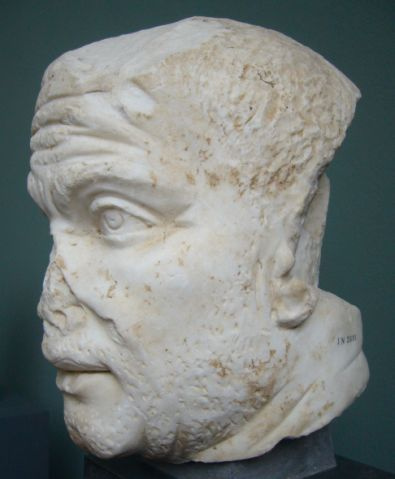
Portrait head of man with hooked nose and deeply creased forehead, Constantius I? From Italy. Late third to early fourth century.
Record details
Photographs
Bibliography
- Johansen, F. , Catalogue of the Roman Portraits III; Ny Carlsberg Glyptotek, (Copenhagen 1995), 184-5, no. 81
Discussion
DESCRIPTION (Object)
Over life-size head. H: 30 cm. White marble.
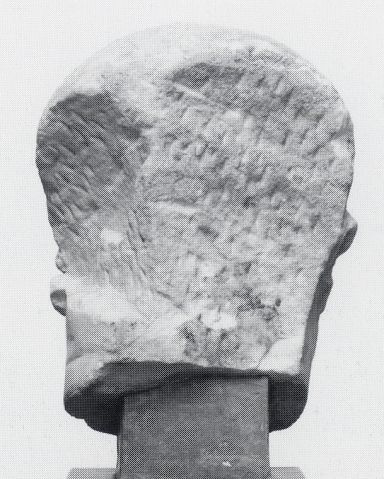
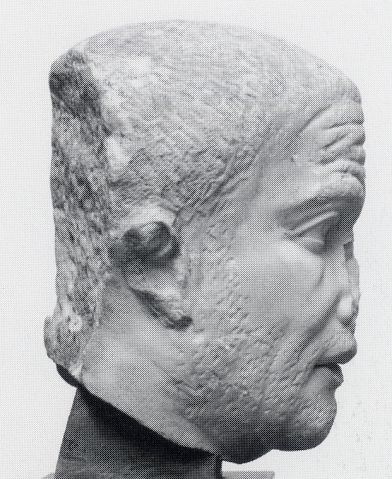
The head is broken through the upper part of the neck. The back left and right of the head broke off separately and are missing. Both break surfaces have large pick marks. The front of the brow and the nose are missing.
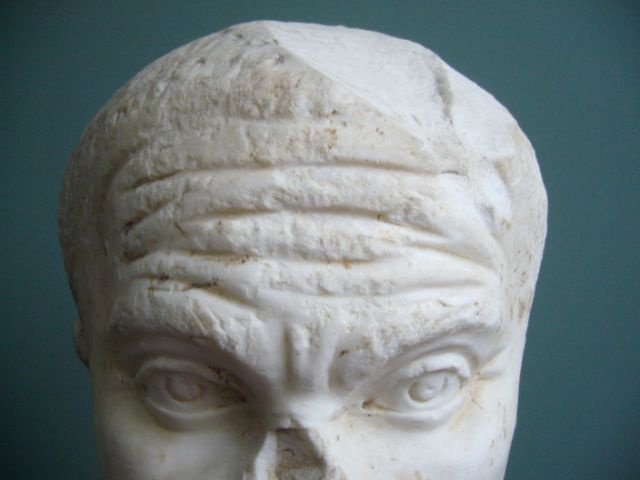
The hair of the head and the beard is rendered with a small chisel. The irises of the eyes are marked with engraved semi-circles; the pupils by a small point of a chisel. A drill channel separates the lips. The deeply-cut creases on the forehead indicate that this head has been re-cut from another.
PROVENANCE
Purchased in Rome from an art dealer in 1924.
DESCRIPTION (Subject)
The head depicts a mature man with short hair and a stubble beard. He has a distinctive physiognomy and turns to his left.
The short hair clings to the skull. The short moustache and beard are engraved into the skin of the face.
The brow is traversed by a series of deep creases, most of which slope downwards. In addition, two vertical creases rise from the root of the nose. The high cheekbones pull the skin taut. The nose has a deeply indented root and was probably hooked. The nostrils are tucked tightly back into the cheeks. The full-lipped mouth is slightly open. The chin is deep and projecting. The skin hangs loosely beneath it. There are three diagonal creases visible on each profile around the mouth and chin; those of the naso-labial folds, those descending from the corner of the mouth; and another set which descends from the middle of the mandible.
The neck is creased on the left side because he turns in that direction. There is also a horizontal crease at the nape of the neck below the hairline.
IDENTIFICATION AND DATE
The technique, fashion, and physiognomy of this portrait relate it closely to several other heads which were found in the area of Rome. These are two portraits from Ostia, LSA-848 and LSA-1055, and to examples of a
type (‘Berlin-Copenhagen’) which has been identified as Constantius I (LSA-806and LSA-855).
The head can be dated confidently to the Tetrarchic period. A specific identification however is at the moment impossible. Even the relationship to the portrait type of Constantius I is not entirely clear. It seems probable however that all of these heads were re-cut and loose versions of one model.
Discussion references
- Calza, R., Iconografia Romana Imperiale. Da Carausio a Giuliano (287-363 d. C.), Rome 1972, 97-8, pls. 9, 25 and 10, 26
- L'Orange, H. P., Das spätantike Herrscherbild von Diokletian bis zu den Konstantin-Söhnen, 284-361 n. Chr. Das Römische Herrscherbild. III. Abteilung ; Bd. 4 , Berlin 1984, 97 (Diocletian)
- L'Orange, H. P., Studien zur Geschichte des spätantiken Porträts, Oslo 1933, 30, 114-5, no. 25, figs. 66 and 69
- Meischner, J., Bildnisse der Spätantike : 193-500 : Problemfelder : die Privatporträts , Berlin 2001, 65, fig. 193 (Constantius Chlorus)
- Sydow, W. von, Zur Kunstgeschichte des spätantike Porträts im 4. Jahrhundert. n. Chr, Bonn 1969, 17-18 (probably Constantius I)
Cite: Last Statues of Antiquity, LSA-810 (J. Lenaghan).