
LSA-811
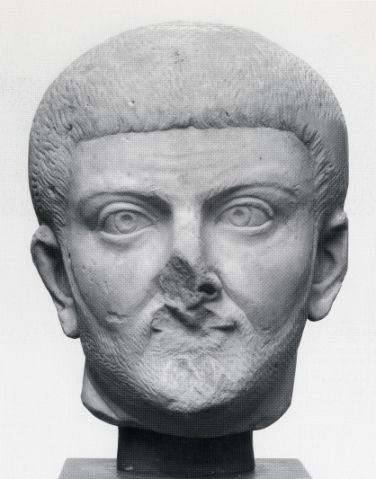
Re-cut head of Tetrarch? From Rome or its environs. Early fourth century.
Record details
Photographs
Bibliography
- Johansen, F. , Catalogue of the Roman Portraits III; Ny Carlsberg Glyptotek, (Copenhagen 1995), 186-7, no. 82
Discussion
DESCRIPTION (Object)
Over life-size head. H: 27 cm. White marble.
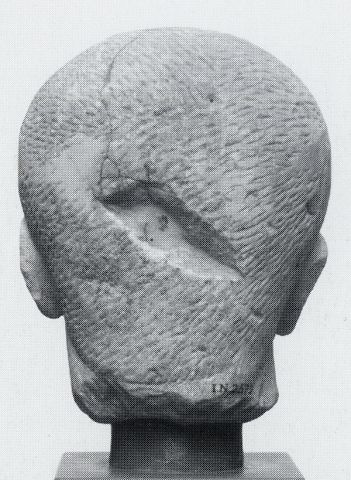
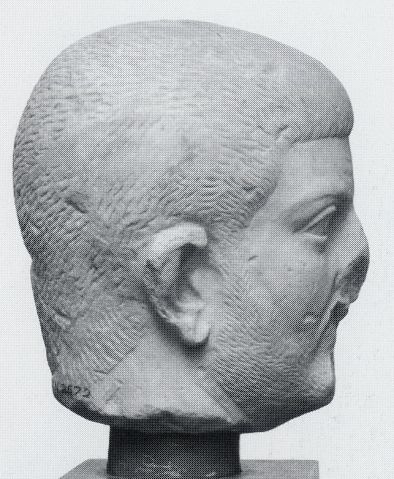
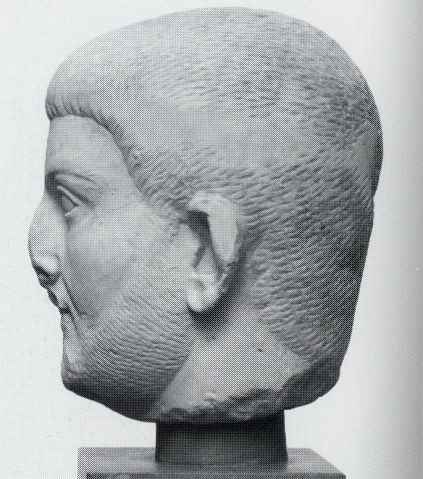
The head is broken through the top of the neck. There is a hole (break or deliberately made?) at the back of the head. The ears, mouth, and tip of the nose are chipped. The head once had an iron ring through the crown of the head.
The hair and beard are uniformly rendered with fine lines of a flat chisel. The engraved irises are circular; the pupils are round drill holes.
The portrait has been re-cut from an earlier head. The earlier portrait had fuller hair, which has been removed, and was probably clean-shaven since the beard and moustache have been engraved onto the surface. New eyebrows have been defined with the chisel.
PROVENANCE:
Purchased in 1910 from a Roman engineer.
DESCRIPTION:
The head shows a man with full but short hair and with a full but short beard. The hair is brushed forward and falls in very small locks over the brow. Above the nose there is a small part in the fringe. The hair continues low onto the nape of the neck. The edge of the beard and moustache is separated from the cheek by an engraved line. The beard ends precisely at the juncture of the neck and jaw.
The face is triangular in shape. The brow is broad and has two creases. The eyebrows have a low arch and with thick hairs. The nose was probably hooked.
DATE AND COMMENTARY
The brushed-forward fashion and short but full beard this head in the early fourth century. It wears a fashion that is similar to the portrait type generally accepted as Maxentius, (see LSA-896) and to the well-dated, c. 335, portrait of C. Caelius Saturninus signo Dogmatius (LSA-903).
The original portrait seems almost surely to have represented a Julio-Claudian man. The shape of the face and central part recalls the portrait type of Caligula.
Discussion references
- L'Orange, H. P., Studien zur Geschichte des spätantiken Porträts, Oslo 1933, 27, 113, no. 18
- Meischner, J., Bildnisse der Spätantike : 193-500 : Problemfelder : die Privatporträts , Berlin 2001, 178 (under 305-324)
Cite: Last Statues of Antiquity, LSA-811 (J. Lenaghan).