
LSA-815
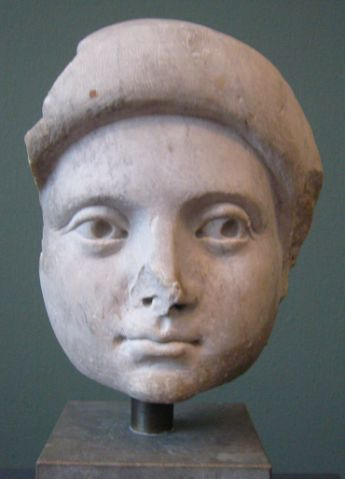
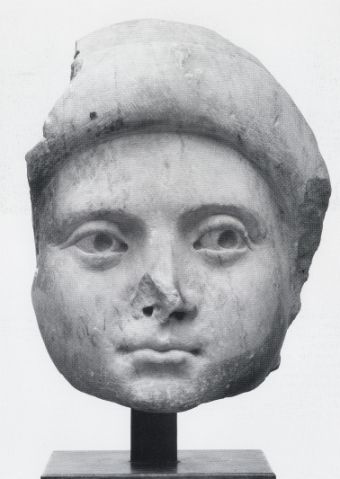
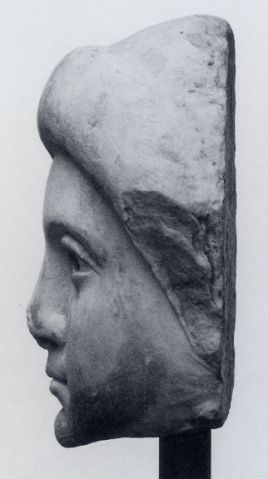
Portrait of woman with bonnet and holes for inlaid irises. Southern Italy. Later fifth to early sixth century
Record details
Photographs
Bibliography
- Johansen, F. , Catalogue of the Roman Portraits III; Ny Carlsberg Glyptotek, (Copenhagen 1995), 202-203, no. 89
Discussion
DESCRIPTION (Object)
Fragmentary life-size head. H: 21 cm. White marble.
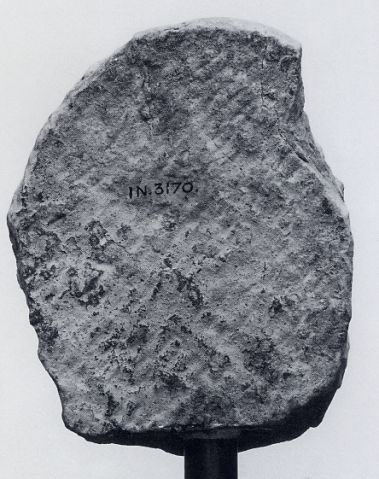
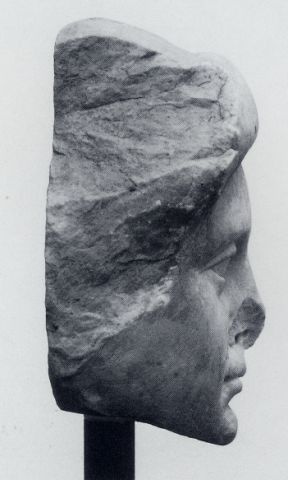
The fragment preserves the face and the top and front of the head. The back is flat, and the surface is evenly worked with a flat chisel; Johansen suggests that the head was from a relief. The right side of the head is broken. The tip of the nose is broken.
The eyeballs have a large round hollow to receive a coloured insert. The inner canthi of the eyeballs are drilled.
PROVENANCE
The head was acquired from H.P. L’Orange in 1956. It allegedly came from Italy.
DESCRIPTION (Subject)
The head shows a woman whose hair is entirely covered by a cloth bonnet that rises into a raised roll around the face. The face is without any indication of age. The forehead is tall and smooth; the cheekbones are widely spaced, and the cheeks full. The nose and mouth are small. The lips are fine, and the central area of the upper lip hangs over the lower lip. The chin is rounded and projecting.
DATE
The hair is entirely covered by a cloth, and the irises were set into deep hollows. The cloth head covering can be seen on a female portrait from Stratoniceia, LSA-446, which should belong no earlier than the middle of the fifth century. The technique for the eyes is mainly a western phenomenon and can be seen on a series of female portraits which belong to the late fifth or early sixth century, LSA-755, LSA-756, and LSA-757. All of those heads also wear a bonnet. These latter three portraits have a more stylised physiognomy with larger eyes and thus for stylistic reasons may be considered slightly later than the head in discussion here.
Discussion references
- Meischner, J., Bildnisse der Spätantike : 193-500 : Problemfelder : die Privatporträts , Berlin 2001, 132, fig. 383 (under 457-500)
- Schade, K., Frauen in der Spätantike--Status und Repräsentation, Mainz 2003, 210-11,no. I 50, pl. 57 (first quarter fifth century)
Cite: Last Statues of Antiquity, LSA-815 (J. Lenaghan).