
LSA-816
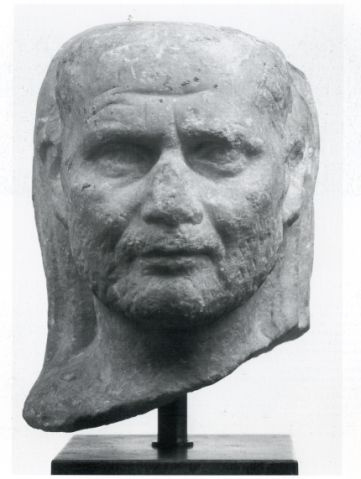
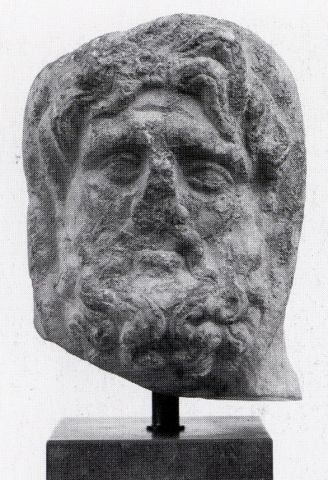
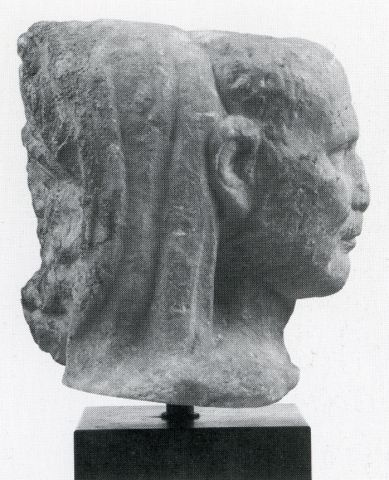
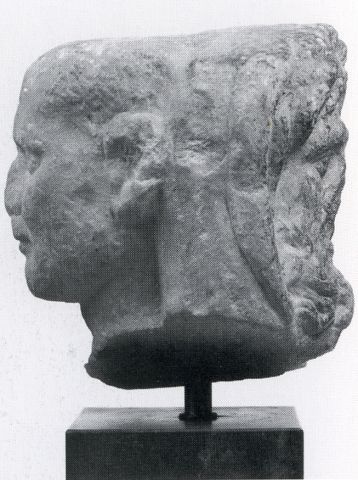
Double herm with emperor and bearded divinity. From Italy. Late third century.
Record details
Photographs
Bibliography
- Johansen, F. , Catalogue of the Roman Portraits III; Ny Carlsberg Glyptotek, (Copenhagen 1995), 134-5, no. 56 (Constantine)
- Poulsen, V., Les portraits romains II, Copenhagen 1974, 175-7, no. 180, pls. 291-2 (Carus)
Discussion
DESCRIPTION (Object):
Under life-size, double herm. H: 17 cm. White marble.
The double herm is broken just below the neck. The tip of nose of the portrait of the older man is chipped; the nose of the divinity is missing entirely.
The eyes of the portrait head appear to have engraved irises and pupils marked with a drill hole. The hair and bear is rendered with a flat chisel.
Provenance
The herm was purchased in Rome by a J. A. Jerichau. In 1884 his estate in Copenhagen was sold. The head reappeared on the art market and was purchased in 1966 by the Ny Carlsberg Glyptotek.
DESCRIPTION (Subject):
The double herm shows a veiled long-haired and long-bearded senior male divinity and a short-haired, balding man with a short-beard. The divinity has thick locks which spring to either side from a central part. He also has a long moustache and full curling beard which has a central part. His brow is traversed by a deep crease below which it bulges.
The portrait of the man has signs of age. The broad brow has both horizontal and vertical furrows. The eyes are deep set and have loose skin below them. The cheekbones project, and the cheeks are slightly hollow beneath them. The naso-labial folds are deep, and there are creases at the corners of the mouth. The nose was hooked. There is no trace of clothing around the neck.
DATE AND HONORAND
The portrait of the man wears a later third-century fashion style. The fact that he is combined with a senior divinity, possibly Saturn or Jupiter, has led all scholars to assume that the man is an emperor. His hard-bitten and elderly aspect plus the cubic form of the head led L’Orange to identify him as Diocletian. The receding hairline compelled Poulsen to consider him Carus, the only late-third century emperor who appears balding on coin portraits.
Discussion references
- L'Orange, H. P., Das spätantike Herrscherbild von Diokletian bis zu den Konstantin-Söhnen, 284-361 n. Chr. Das Römische Herrscherbild. III. Abteilung ; Bd. 4 , Berlin 1984, 97-8, pl. 12c-d (Diocletian)
Cite: Last Statues of Antiquity, LSA-816 (J. Lenaghan).