
LSA-821
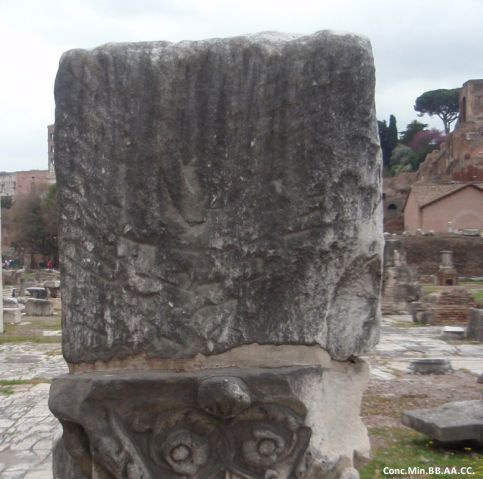
Top of base for statue of Maximian, emperor. Rome, Forum. 286-305
Record details
Photographs
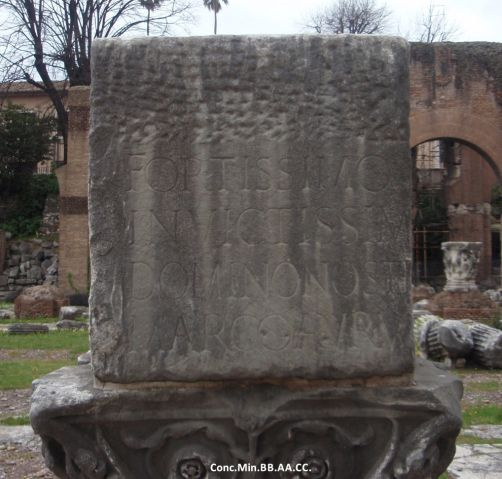
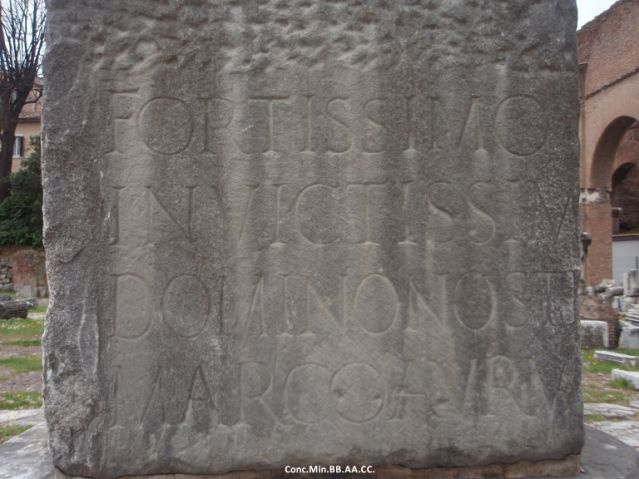
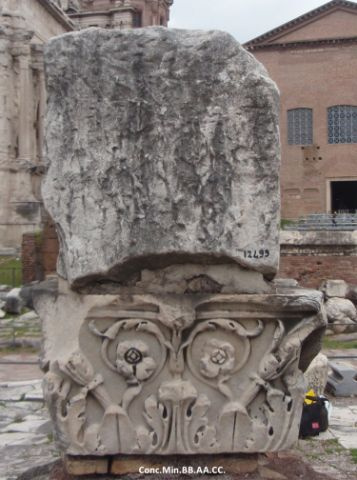
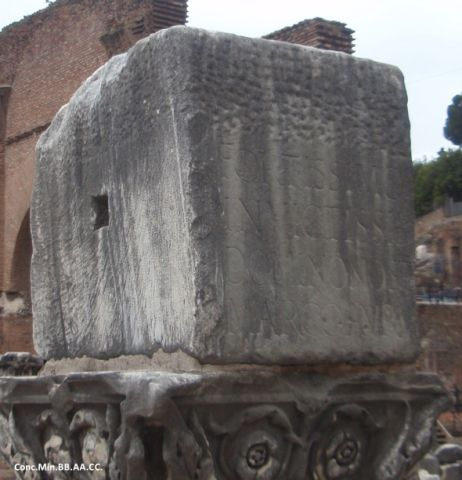
Inscription
Fortissimo [et] / invictissim[o], / domino nostr[o] / Marco Aur(elio) Va[l(erio)] / [M]axi[mi]an[o], / [pio, felici, Aug(usto)...].
Inscription translation
To the most powerful and most invincible, our lord Marcus Aurelius Valerius Maximianus, pious, fortunate, Augustus ...
Bibliography
- Corpus Inscriptionum Latinarum; , VI, 1127=36886 (+p 4326)
Discussion
INSCRIPTION
In 6 lines, of which only four survive:
Fortissimo [et] / invictissim[o], / domino nostr[o] / Marco Aur(elio) Va[l(erio)] / [M]axi[mi]an[o], / [pio, felici, Aug(usto)...].
‘To the most powerful and most invincible, our lord Marcus Aurelius Valerius Maximian, Pious, Fortunate, Augustus.’
Large classicising letters, 7 cm high.
DESCRIPTION
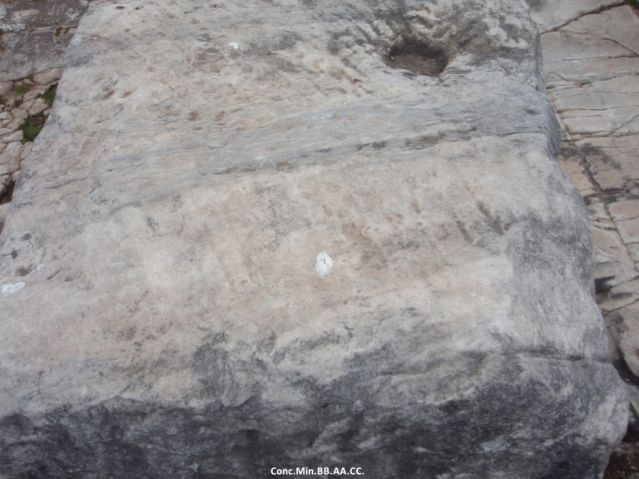
Top left part of a marble base, subsequently cut down and re-used as a square ashlar block. H 67 cm x W 62 cm x D 70 cm. The front face has been cut back for re-use on the right-hand side and (almost certainly) at the bottom. It once had a moulding at the top, which has been roughly cut back with a point (presumably at the time of re-use). The epigraphic field was finished with a claw chisel, and originally had a moulding on the left (which has also been roughly cut back). The left face of the base is original to it and is finished with a claw chisel; at the top is a rough band finished with a point where the base's upper moulding has been removed. In the centre of this face is a deep dowel hole, presumably dating from the time of re-use. The back of the base is very roughly finished, which may or may not be an original feature. The right face, which dates entirely from the period of re-use, is roughly finished with a point. The top of the base, which is probably original to it, is uneven and roughly dressed with a point; it has a shallow hole on the right front side.
PROVENANCE AND CURRENT LOCATION
The base was discovered in 1849 during the excavation of the Basilica Iulia, in the Roman Forum (CIL; Lanciani 2000, 377). The basilica was rebuilt during the tetrarchic period, following the fire of 283. It is still there.
HONORAND AND DATE
The statue was dedicated to Maximian, Augustus from 286-305. There is no evidence for a more precise dating.
Discussion references
- Lanciani, R., Storia degli scavi di Roma e notizie intorno le collezioni romane di antichità, vol. 6 (1700-1878), Rome 2000
Cite: Last Statues of Antiquity, LSA-821 (Carlos Machado).