
LSA-824
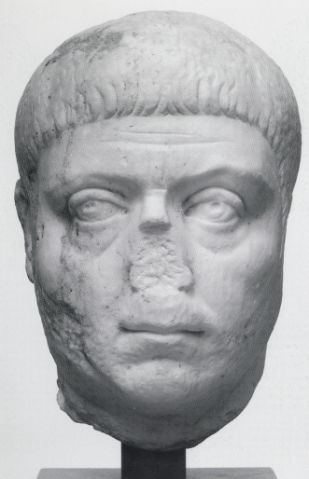
Portrait head, re-cut, of man with stubble beard and short hair. From Rome? Later third or fourth century.
Record details
Photographs
Bibliography
- Johansen, F. , Catalogue of the Roman Portraits III; Ny Carlsberg Glyptotek, (Copenhagen 1995), 108-109, no. 43
Discussion
DESCRIPTION (Object)
Head broken from statue (or sarcophagus lid). H: 26 cm. “Aphrodisian” marble with “grey mica” on the right side of the face.
The head is broken diagonally through the neck and preserves a neck pillar behind the head and possibly part of the clothing on the right side of the neck. The nose was repaired and the repair is now missing. The left ear may also have been repaired; it is now missing and the photograph is not clear enough to distinguish.
The portrait may have been re-cut from another head. The short hair and beard have been rendered mainly with small strokes of a flat chisel. The locks over the brow have been rendered in more careful curves with a flat chisel; they part slightly at the centre of the brow. Although not proof of more than one use, the head has certainly been repaired.
PROVENANCE
The head was acquired in 1989 from the same “Danish Manor” has some fifty other antiquities. They are alleged to have come from Palazzo Braschi.
DESCRIPTION (Subject)
The head shows a mature heavy set man with a rectangular face and short-cropped hair. The hair follows an unbroken arc between the ears and clings closely to his brow in small C-shaped locks. He has creases across his forehead, large eyes, a small mouth, and sagging skin under the eyes and around the mouth.
The eyes have projecting upper eyelids, the upper line of which is deeply cut. The irises consist of two small drill holes, and the irises are almost circular.
DATE
The portrait has been labelled Balbinus and so dated to the early third century.
The arching hair over the brow with its C-shaped locks and central part would seem equally to fit in the fourth century. Meischner, for example, places it between 293-305.
The repaired nose and the neck pillar and the “grey mica” on the right side of the face give the head an archaeological look that makes a provenance of Asia Minor, given its marble type, seem just as plausible as the alleged Braschi one.
Discussion references
- Meischner, J., Bildnisse der Spätantike : 193-500 : Problemfelder : die Privatporträts , Berlin 2001, 69 (listed but typo), fig. 206 (under 293-305)
Cite: Last Statues of Antiquity, LSA-824 (J. Lenaghan).