
LSA-827
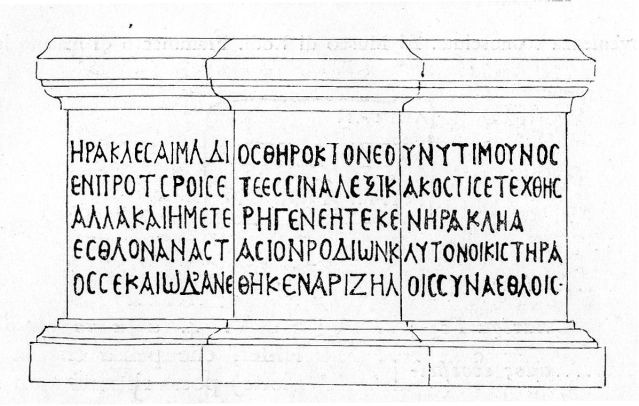
Base for statue, probably of Anastasius (but possibly of Hercules). Rhodos (Insulae). Fourth to earlier fifth century.
Record details
Photographs
Inscription
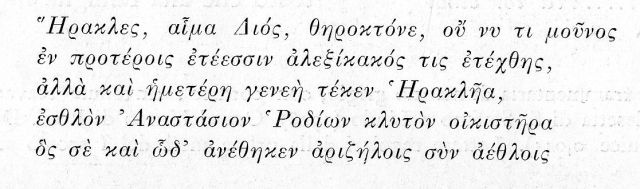
Ἥρακλες, αἵμα Διός, θηροκτόνε, οὔ νυ τι μοῦνος / ἐν προτέροις ἐτέεσσιν ἀλεξίκακός τις ἐτέχθης, / ἀλλὰ καὶ ἡμετέρη γενεὴ τέκεν Ἡρακλῆα, / ἐσθλὸν Ἀναστάσιον Ῥόδιων κλυτὸν οἰκιστῆρα / ὃς σὲ καὶ ὧδ’ ἀνέθηκεν ἀριζήλοις σὺν ἀέθλοις.
Inscription translation
Hercules, blood (= child) of Zeus, beastkiller, you, in days gone by, were not the only one born as a protector against evil. Rather, our generation as well produced a Hercules, the noble Anastasius, the glorious founder of Rhodes, who set you up here with (his) high-minded labours
Bibliography
- Robert, L., Epigrammes du Bas-Empire (Hellenica IV), Paris 1948, p. 117
Discussion
INSCRIPTION
Verse inscription in five hexameters:
Ἥρακλες, αἵμα Διός, θηροκτόνε, οὔ νυ τι μοῦνος
ἐν προτέροις ἐτέεσσιν ἀλεξίκακός τις ἐτέχθης,
ἀλλὰ καὶ ἡμετέρη γενεὴ τέκεν Ἡρακλῆα,
ἐσθλὸν Ἀναστάσιον Ῥόδιων κλυτὸν οἰκιστῆρα
ὃς σὲ καὶ ὧδ’ ἀνέθηκεν ἀριζήλοις σὺν ἀέθλοις
'Hercules, blood (= child) of Zeus, beastkiller, you, in days gone by, were not the only one born as a protector against evil. Rather, our generation as well produced a Hercules, the noble Anastasius, the glorious founder of Rhodes, who set you up here with (his) high-minded labours'
The inscription celebrates Anastasius as a new Hercules.
On the upper moulding, Jacopi (1932) also read Κ Ε ΒΟΗΘΙ (κύριε βοῆθι - Lord, help), shallowly incised.
DESCRIPTION (from Jacopi 1932 and the published drawing)
Described as a hexagonal base of white marble by Jacopi 1932, p. 208 no. 45. From the drawing he reproduced it is clear that the inscription extended over three of the six sides. Mouldings at top and bottom. The only measurement given by Jacopi 1932 is that of one epigraphic field (37 cm x 30 cm, without specification of which is height and which width).
PROVENANCE/ LOCATION
The base was excavated in 1925 in the centre of Rhodes, at the so-called 'Piazza dell'Arsenale'. There is no published record of its present location.
HONORAND AND DATE
There are two possible interpretations of this base. Its first editor Jacopi thought that it referred to the setting up of a statue of Hercules, according to him by the emperor Anastasius (491-518). The wording of the inscription can indeed be simply interpreted as referring to such an act, though Jacopi's late dating is very unlikely, and the Anastasius concerned is much more likely to have been a non-imperial benefactor of the city of a considerably earlier date.
Robert 1948, however, pointed out that the inscription fits in form and motifs late antique honorific inscriptions, arguing that this was a statue to Anastasius himself, with an inscription paralleling his labours on behalf of the city with those of Hercules. The last line of the inscription (ὃς σὲ καὶ ὧδ’ ἀνέθηκεν ἀριζήλοις σὺν ἀέθλοις, 'who set you up here with (his) high-minded labours') would thereby be a metaphorical elevation of Hercules, rather than the setting up of a statue, and indeed ἀριζήλος ('high-minded') would suit the elevated actions of a benefactor better than the mundane setting up of a statue.
The conspicuous labours of Anastasius, that led the inscription to style him 'founder of the city', are not defined, so that the exact status and rank of the honorand is uncertain. Robert thought he could be a private benefactor, but he is perhaps more likely to have been a high-ranking state official, for whom building (and hence his description as 'founder') would be highly appropriate.
Robert saw the allusion to Hercules as pagan, and therefore did not want to date this inscription later than Julian's reign. Mythological allusions, however, are omnipresent in late-antique honorific epigrams and a manifestation of education rather than of religious inclination. If Jacopi was right in reading κύριε βοῆθι (Lord, help) on the upper moulding, and if this was contemporary with the main inscription, then it was certainly set up in Christian times. However, a date after 450 is very unlikely.
Discussion references
- Jacopi, G., Nuove epigrafi dalle Sporadi meridionali, Clara Rhodos 2, 169-255, Rhodos 1932, 208-9 no. 45
- Jones, A. H. M. et al., The Prosopography of the Later Roman Empire. Vol. I 260-395, Cambridge et al. 1971 (1975)
Cite: Last Statues of Antiquity, LSA-827 (Ulrich Gehn).