
LSA-83
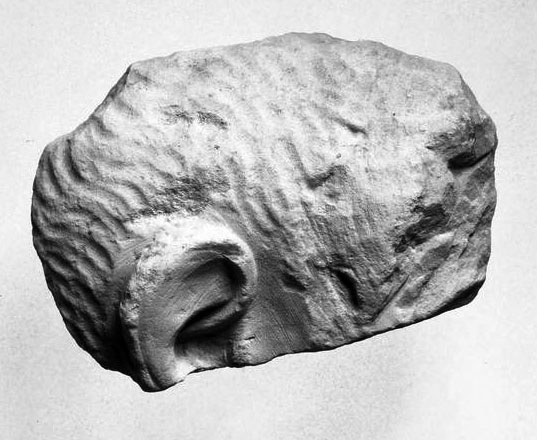
Fragment of male portrait head, possibly re-worked from earlier portrait. Corinth (Achaea). Fourth century.
Record details
Photographs
Bibliography
- de Grazia, C. E., American School of Classical Studies at Athens, "Excavations of the American School of Classical Studies at Corinth:
The Roman Portrait Sculpture," Ph.D. Dissertation
, Columbia University, 1973, pp. 237-8 no. 62
Discussion
DESCRIPTION (Object)
Fine-grained white marble, H 12, W 16, D 4.5 cm. The whole of the head is broken away save for the right ear and a portion of hair above and behind it, and the outline of the right eyebrow.
The hair is indicated by short wavy strokes with a broad flat chisel. The ear appears over-sized and set too high; this and way the hair is set off the smooth area around the ear indicates that the head was re-worked from an earlier portrait. There are rasp marks at the temple; perhaps the head was in an unfinished state.
PROVENANCE/ LOCATION
The provenance of the fragment is unknown; it came into the Corinth Museum Inventory in the first decade of the 20th century (de Grazia 1973). It is now in the Corinth museum, inv. no. S-362.
DESCRIPTION (Subject)
Short-haired male.
DATE
The technique by which the hair is rendered connects this piece with another late-antique Corinthian head (LSA-73, 4th-5th century but most probably Constantinian). The short hair with the wavy strands is best paralleled by heads from the Constantinian period.
Cite: Last Statues of Antiquity, LSA-83 (Amelia Brown/ Ulrich Gehn).