
LSA-830
Fragmentary plaque, probably from base for statue, and probably for Constantine I, emperor. Philippi (Macedonia). 324-337
Record details
Photographs
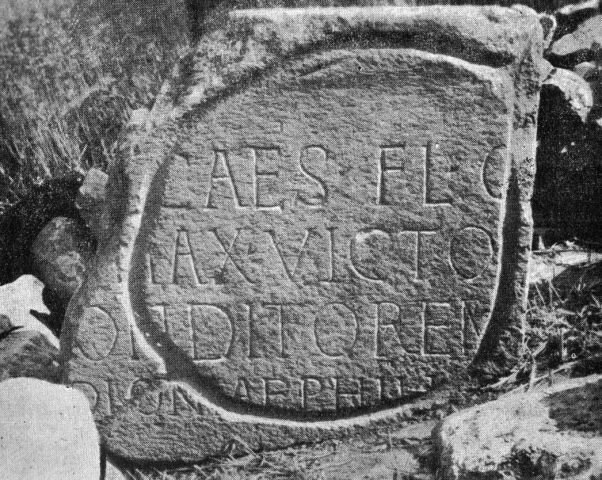
Inscription
[---] Caes(arem) Fl(avium) C[onstantinum] / [---] max(imum) victo[rem] / [---C]onditorem [---] / [---c]oloniae Phili[ppiens(is) ----].
Inscription translation
... (set this up to) the Caesar Flavius Constantinus the most powerful victor ... founder ... of the colony of the Philippians.
Bibliography
- Collart, P., Inscriptions de Philippes, Bulletin de Correspondance Hellénique 56, 192-231, 1932, 209-213 no. 7 fig. 11
Discussion
INSCRIPTION
In four preserved lines:
[---] Caes(arem) Fl(avium) C[onstantinum] / [---] max(imum) victo[rem] / [---C]onditorem [---] / [---c]oloniae Phili[ppiens(is) ----].
'... (set this up to) the Caesar Flavius Constantinus the most powerful victor ... founder ... of the colony of the Philippians'.
DESCRIPTION (from Collart 1932 and the published photo)
Fragment of a large marble plaque broken at left side and at bottom. Top and right side are preserved. The right side is worked to join with another piece; on the top edge, at its right-hand end, there is a cramphole (according to Collart). The back is only roughly finished. If, as we believe, this is a statue dedication, it must have been part of the facing of a base in some other material. On the front, from a phase of later re-use (perhaps as part of a press), there is an irregular roughly-circular groove with a shallow channel entering it at bottom left.
The inscription extends across the entire surviving face. Collart restores '[Imp(eratorem)] Caes(arem) Fl(avium) C[onstantinum]' in line 1, but there are no traces to support his opening with 'Imperatorem'.
PROVENANCE AND CURRENT LOCATION
The plaque was found before 1932 in the Forum of Philippi where Collart recorded it (http://www.trismegistos.org/place/3359).
There it is still in situ.
HONORAND AND DATE
The most probable addressee of this honorific inscription is Constantine I, although the partial survival of the imperial name does not exclude one of his sons (Collart 1932, 212). Constantine I assumed the title 'victor' (line 2) after the defeat of Licinius in 324, hence our terminus post quem, and died in 337.
During the campaign against Licinius in 324, and at the time of the foundation (326) and inauguration (330) of his new capital, Constantinople, the emperor sojourned in northern Greece. A dedication by the city of Philippi in this historical context seems very plausible.
FURTHER DISCUSSION
Statue dedications in Latin are almost invariably in the dative, not in the accusative as here. However, in Greek they are in the accusative, and it seems very possible that a Latin dedication, erected in a Greek-speaking city, quite simply followed Greek grammatical usage. We believe that this inscription was for the dedication of a statue.
Cite: Last Statues of Antiquity, LSA-830 (Ulrich Gehn).