
LSA-831
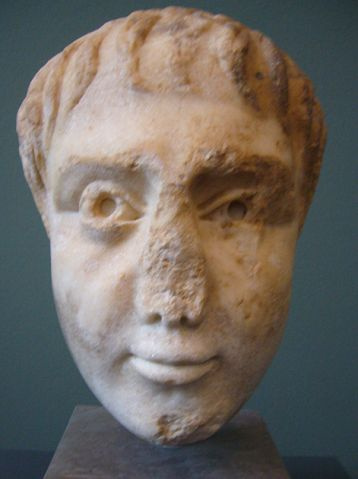
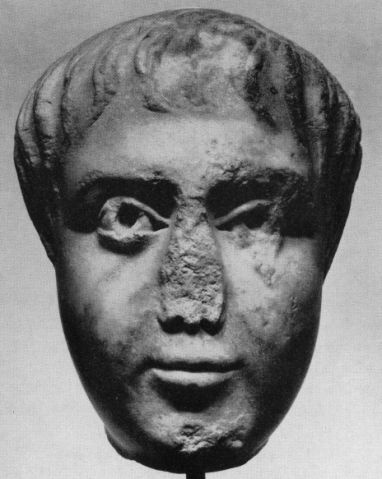
Portrait head of man with straggly hair and inset eyes. Unknown provenance. Mid-fifth century to sixth century.
Record details
Photographs
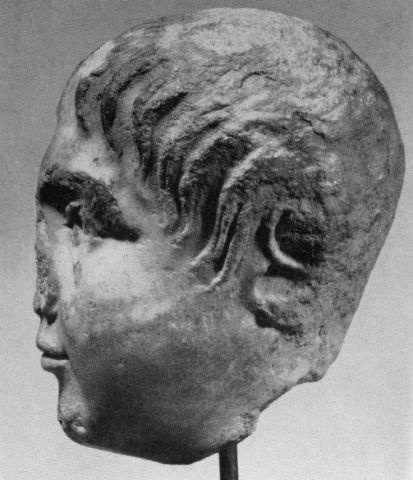
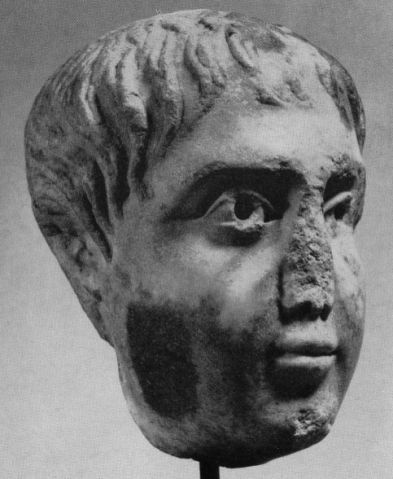
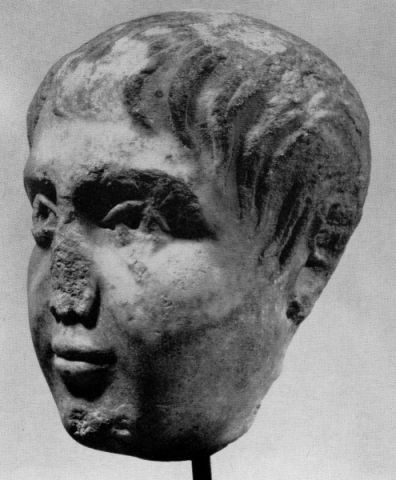
Bibliography
- Kiang, D. 'A Late Antique-Early Byzantine Head', Pantheon. Internationale Zeitschrift für Kunst 28.1, Munich 1970, 3-11, figs. 1-6
Discussion
DESCRIPTION (Object)
Life-size head. H (chin to crown): 20 cm. H (chin to bottom of forehead locks): 16 cm. Coarse-grained yellowish marble.
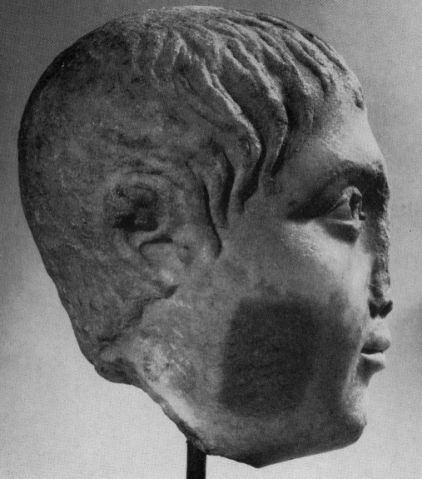
The head has broken at the top of the neck. The nose and the rims of both ears are missing. The left eyebrow and eye and the chin are chipped.
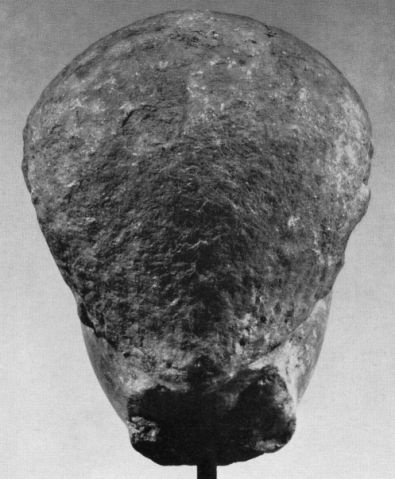
The irises, now missing and presumably of a coloured material, were inset into deep round cavities in the eyes. The back and top of the head have only been roughly finished; they have been shaped but given no representational detail. Some of the locks of hair have deep channels between them made by a drill. Within some of the locks, a few strands are indicated by a flat chisel.
The head seems to me to have been cut back from another head. The back of the head has clearly been reduced. The ears are proportionally too large and seem probably to have lost some of their outer rims to deliberate reduction, rather than simple breakage. The left ear looks particularly large, and close inspection shows that the smaller right ear is missing its lobe. Moreover in the right ear there seems even to be a trace of a lock.
PROVENANCE
Published first in 1970 at which point it was in an American private collection and was assertively declared not to have come from Italy. It was subsequently purchased by the Ny Carlsberg Glyptotek.
DESCRIPTION (Subject)
The head depicts a male of indeterminate age with long straggly hair across the brow. The eyes have large holes for the insertion of a coloured iris and pupil.
The face has an oval shape and full, fleshy cheeks. The brow is smooth and flat. The eyebrows are mainly straight with a downward slope at their outer sides. The eyes have a straight projecting lower lid, an arching upper lid, and a pointed inner corner. The mouth is small with projecting lips. Both lips are, however, rather straight; they lack the rise and fall of the bow-shaped mouth. The chin is deep but does not project.
The hair is rendered only around the brow between the ears. It comes forward onto the brow in long locks which curve gently and taper toward their ends. This leaves areas of bare flesh between them, especially on the left side. On the left side the hair seems more carefully rendered. At the back the outline of the hair is cut short.
IDENTIFICATION
It is impossible to identify the honorand or even to know whether it is intended as a portrait of a specific real individual. It is not even clear to all scholars whether an older man or a youth is intended. Given the hair and the fleshy aspect of the face, the former seems more probable.
DATE
The date of the head depends almost entirely on the technique used for the eyes. Eyes with large cavities for inlays appear in portrait sculpture which is usually dated to the late fifth and early sixth century. These include a portrait head of a man from the Palatine (LSA-1079 ), a man with a diadem from Tusculum (LSA-758 ), a man with a corona civica (LSA-593 ), a head in Forli with a diadem (LSA-762 ), and three portrait heads of female Empresses (all from Rome, LSA-755, LSA-756, LSA-757). The Empresses provide the best indication of date on the basis of their headgear.
All of these head probably come from Italy, and this head is said not to have come from there. Kiang (pp. 7-8) discusses the stylistic differences this head and the others. This head, for example, he notes, has a the full-lipped mouth and straight lower eyelids and differently worked back of the head. These points are no longer entirely valid. The Forli head, unknown to him, has a straight lower lid, and the back of the head here is certainly the result of a re-use.
Discussion references
- Meischner, J., Bildnisse der Spätantike : 193-500 : Problemfelder : die Privatporträts , Berlin 2001, 121, figs. 351-2 (under 430-455)
Cite: Last Statues of Antiquity, LSA-831 (J. Lenaghan).