
LSA-833
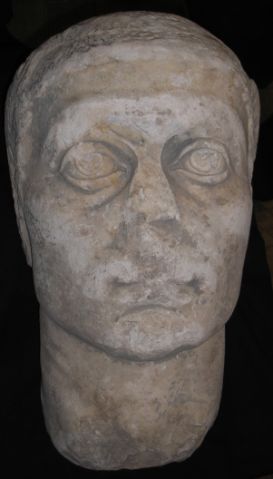
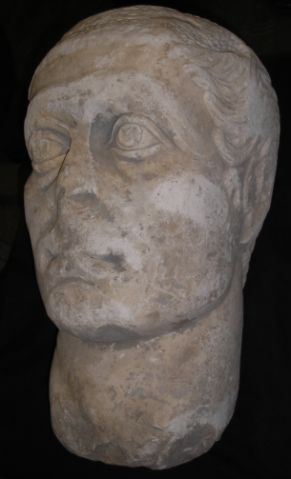
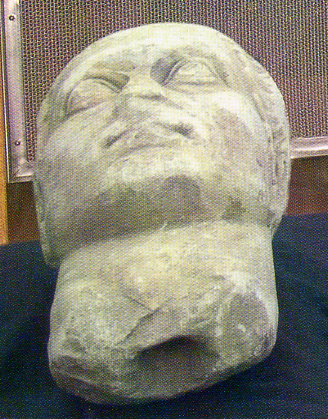
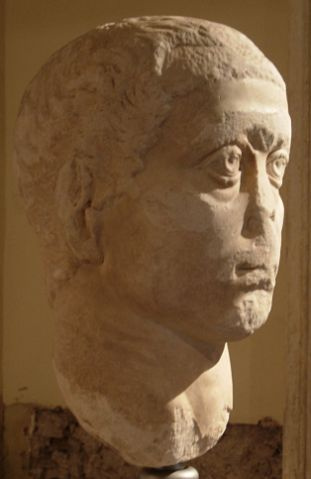
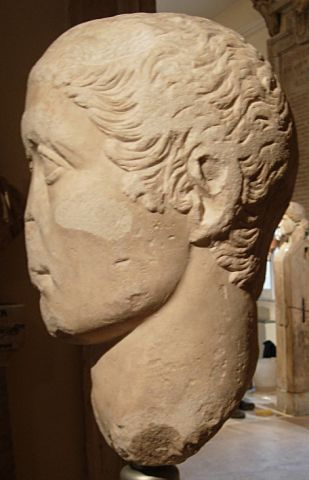
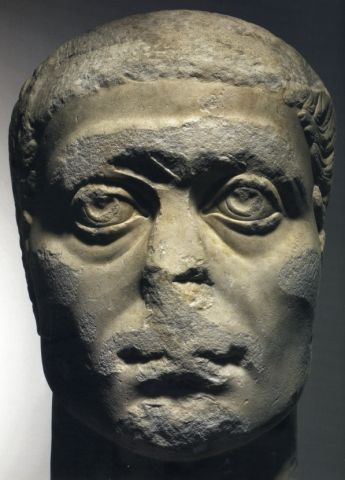
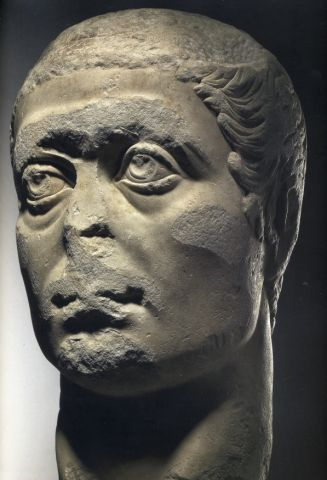
Over life-size head of Constantine. From Rome. Early fourth century.
Record details
Photographs
Bibliography
- Maischberger, M., Konstantin in Berlin, Milan 2006, 1-19 (17-19 by P. Zanker)
Discussion
DESCRIPTION (Object)
Colossal head, worked separately. H: 59 cm. H (of chin to crown): 43.5 cm. White Carrara marble.
The head is preserved with its neck and small socket at the base of the neck. A large dowel hole in the base of the neck (7.8 cm deep and 7.5 x 7.5 cm) was used to attach the head to a body.
The eyebrows, cheekbones, lips, and chin are all chipped. The nose is missing, and the extant surface has been smoothed. Thus, it was repaired or added separately in antiquity.
A band of the hair directly over the brow has been deliberately removed. The missing area is scooped out, and there appear to be point marks on the extant surface.
The hair is rendered entirely with the flat chisel. The irises, three-quarters of a circle, are engraved with a flat chisel and do not touch the lower lid. The canthi are also defined by a line of the flat chisel. The pupils are drilled out in a U-shape, and drill point marks the inner corner of the canthi. A broad, finished channel, in the form of an inverted U, defines the upper border of the chin.
The head has been re-worked from an earlier head, probably an imperial portrait given its size. The eyes have been enlarged and the hair around the face has been shortened and regularized. In front of the left ear, the originally-longer hair has been left and made into curling locks.
PROVENANCE
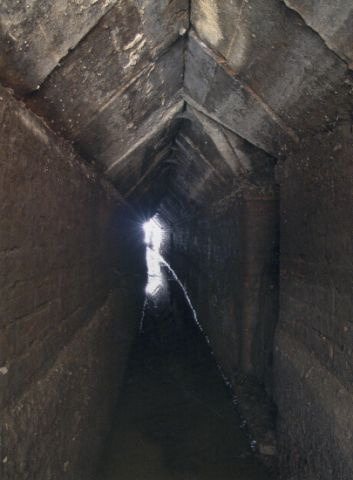
The head was found in June 2005 in a water channel inside the southern colonnade of the Forum of Trajan. It lay at the bottom of the water channel covered by two layers of debris with material from the 10th to 16th century. Architectural fragments from the southern colonnade were found in the same bottom layer. The cover tiles of the drain in the area were found intact, and thus the head must have been sunk through a conductor shaft. It did not fall accidentally into the channel but was deliberately placed there.
The head probably came from a gallery of colossal imperial statues in the Forum of Trajan. It is, however, slightly smaller than the other extant examples of colossal imperial statues found there. These include a head of Agrippina the Elder and fragments of Nerva (?), Vespasian (?) and Livia (?):K. Fittschen and P. Zanker, Katalog der Porträts in den Capitolischen Museen und den anderen kommunalen Sammlungen der Stadt Rom, Band III (Mainz 1983), 6-7, no. 5, pl. 6 and K. Fittschen and P. Zanker, Katalog der Porträts in den Capitolischen Museen und den anderen kommunalen Sammlungen der Stadt Rom, Band I (Mainz 1985), 38-9, nos. 36-8, pl. 40.
DESCRIPTION (Subject)
The head probably belonged to a statue of c. 4 m. It represents Constantine the Great; he is a beardless man with large eyes, medium-length hair, and an added element over his forehead.
He has a curving brow, widely-spaced cheekbones, and a square, strong jaw-line. The mouth is small with up-turned corners and a lower lip that projects over the chin. The skin of the cheeks is modelled; it sags under the eyes and creases at the nabo-lasial folds.
The hair is brushed forward from the crown of the head. It comes forward in wavy locks which twist on the brow. It is long around the ear and falls deep onto the nape of the neck.
The sterno-mastoids are defined on the front of the neck, and on the right side of the neck are two creases. These indicate that the head turned to its right.
DATE
The head certainly represents Constantine and follows the same model as the colossal Constantine from the Basilica Maxentius, LSA-558. This model was conceived early in the reign of Constantine and is that used on the Arch of Constantine. The head is similar to a head found in Frascati, LSA-834; both follow the same type, have been re-worked from an earlier head, and have had the front hair worked off for the addition of an element over the brow.
The element, for which the hair has been worked down, would seem most naturally to be a diadem or crown. This would suggest that the head was renovated after 324 when Constantine celebrate the twentieth year of his reign, the vicennalia. Yet, the portrait of Constantine from Nis, LSA-557, shows the Emperor wearing a jewelled crown. The cutting on this colossal head suggests headgear of a different form, and for this reason, I. Romeo (see LSA-834) suggests that the addition may have been hair.
RE-USE
Zanker believes that the portrait of Constantine represents the third use of this head. He believes that the original head was that of Julio-Claudian Emperor (possibly Caligula or Claudius) which was re-used for a second time in the third century. He sees, in particular, a patch of brow, behind the cutting over the brow.
Discussion references
- Demandt, A. and J. Engemann, (eds.), Konstantin der Grosse, Mainz 2007
, no. I.8.10 (C. Parisi Presicce)
Cite: Last Statues of Antiquity, LSA-833 (J. Lenaghan).