
LSA-834
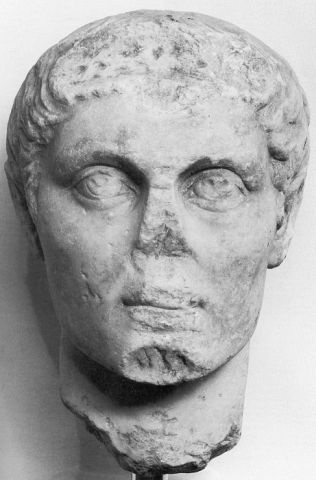
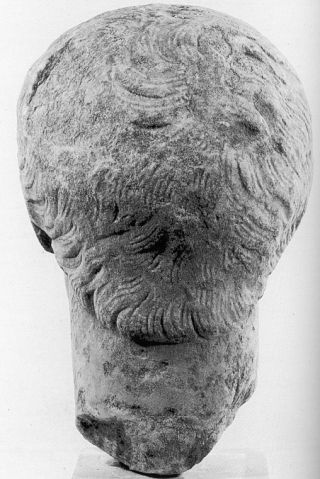
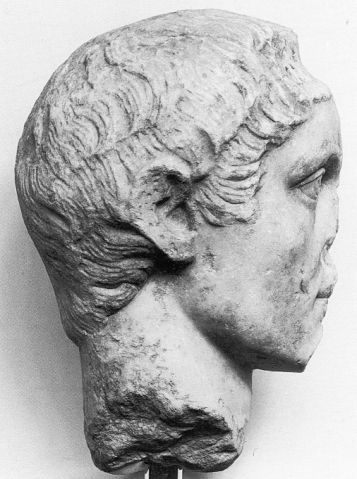
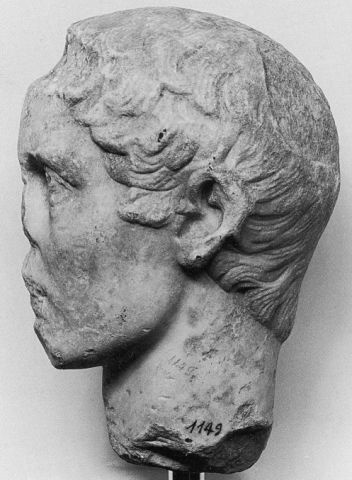
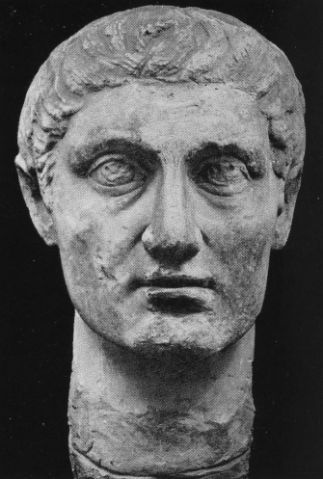
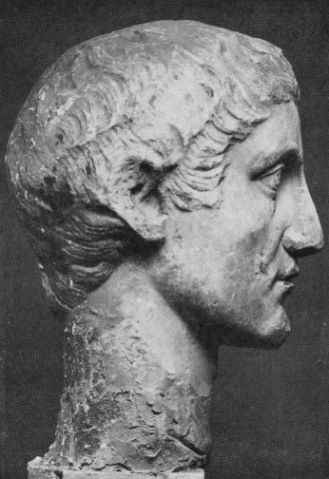
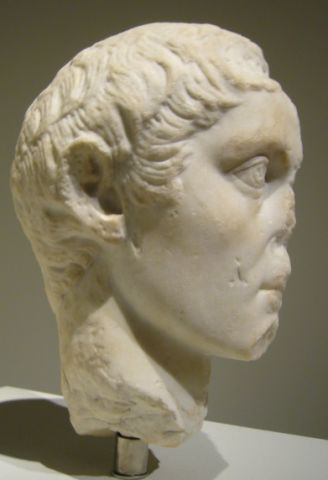
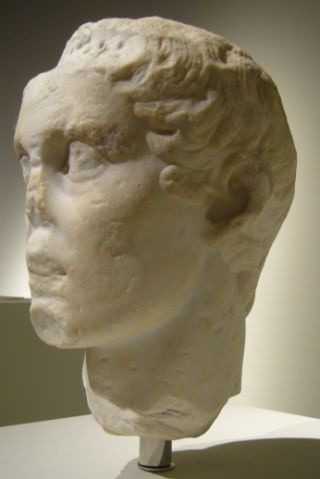
Portrait head of Constantine. From Grottaferrata. Early fourth century.
Record details
Photographs
Bibliography
- Ambrogi, A., D. Bonanome, A. Bravi, et. al., Sculture antiche nell'Abbazia di Grottaferrata, Rome 2008, 64-7, no. 41 (I. Romeo)
Discussion
DESCRIPTION (Object)
Over life-size head. H: 29 cm. H (of head): 24 cm. Fine-grained white marble.
The head is fully preserved with its neck. At the base of the neck, on both sides, are breaks which slant downwards toward the centre. The locks over the brow, nose, chin, and rim of the right ear are all missing. The modern stucco restorations in these areas have all been removed. The lips are badly damaged, and there are chips throughout.
The surfaces of the nose, chin, and ear (where areas are missing) have been tooled which suggests that they had already been repaired in antiquity. The hair over the brow has been deliberately taken down. The missing area is scooped out, and there appear to be point marks on the extant surface.
The hair, especially at the back of the head, is finely engraved. The irises, three-quarters of a circle, are engraved with a flat chisel as are the inner canthi and a line below the lower lid which runs parallel to it. The pupils are drilled out in a U-shape, and a deep but fine drill line separates the upper eyelid and the eyebrow.
The head has been re-worked from an earlier head. The eyes and the hair around the face have been worked over to make them, respectively, larger and more uniform and regular.
PROVENANCE
From the area of Cipriana in Frascati. It was found near a ‘casetta rustica a enormi blocchi di sperone’ beyond the Roman cistern (which was cut through by the Grottaferrata-Frascati train line) on the Frascati side. In the same area, a female head, a small cow, and other marble sculpture were found. See M. Valenti, Ager Tusculanus Forma Italiae. Topografia antica, 41 (Florence 2003), 319, fig. 33.
DESCRIPTION (Subject)
The head turns slightly to its right and probably came from a statue. It represents Constantine the Great; he is shown as a beardless youthful man with large eyes and medium-length hair.
He has a broad brow, widely-spaced cheekbones, and a square, strong jaw-line which once terminated in a projecting chin. The cheeks are pulled tightly around this skeletal structure, and the mouth seems to have been full-lipped and small.
His hair originates in star-fish pattern at the top of the head and falls in tiers. The tier on the brow and behind the ears is combed forward, and that directly above it is brushed backwards. The hair over the right temple is fuller than that around the left temple.
DATE
The head certainly represents Constantine and follows the same model as the colossal Constantine from the Basilica of Maxentius, LSA-558. It is known in c. 15 versions, and the model probably corresponds to an image created for Constantine’s quinquennalia since the type appears on coins first in 311; see, Zanker for discussion of the types. Similar portraits, all likely to have come from the area of Rome, include a head in the Prado (LSA-599) and one in Palazzo Mattei (LSA-899). All of these have been, as this one, re-worked from earlier heads. They all have the same hairstyle and the same strong bone structure.
Like the portrait of Constantine from the Forum of Trajan, LSA-833, this head has a cutting over the brow. This may be either simply to allow for a full rendering either in marble or stucco of Constantine’s brow locks (Romeo) or may reflect the addition of a diadem (Zanker see LSA-833 and A. Zevi Gallina, Museo della abbazia di Grottaferrata [Rome 1976], 9). If the latter were the case, it would then date the final use of the portrait after 324 since the imperial diadem was introduced after the celebration of Constantine’s vicennalia.
Discussion references
- Calza, R., Iconografia Romana Imperiale. Da Carausio a Giuliano (287-363 d. C.), Rome 1972, 220-21, no. 133, pl. 74, 258-9 (Constantine)
- Donati, A. and G. Gentili, Costantino il Grande. La civiltà antica al bivio tra Occidente e Oriente, Milan 2005, 208, no. 6 (I.Romeo)
- Fittschen, K. and P. Zanker, Katalog der Porträts in den Capitolischen Museen und den anderen kommunalen Sammlungen der Stadt Rom, Band I, Mainz 1985, (2)1994, 149, no. A 2 (essential example of Constantine's main portrait type)
- L'Orange, H. P., Das spätantike Herrscherbild von Diokletian bis zu den Konstantin-Söhnen, 284-361 n. Chr. Das Römische Herrscherbild. III. Abteilung ; Bd. 4 , Berlin 1984, 121 (Constantine)
Cite: Last Statues of Antiquity, LSA-834 (J. Lenaghan).