
LSA-835
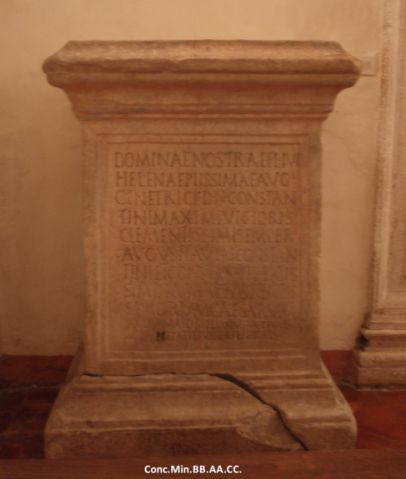
Base for statue of empress Helena, mother of Constantine I. Rome. 325-330
Record details
Photographs
Inscription
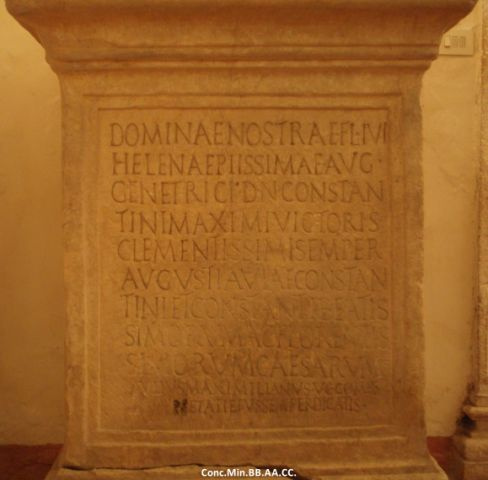
Dominae nostrae Fl(aviae) Iui(iae) (sic) / Helenae, piissimae Aug(ustae), / genetrici d(omini) n(ostri) Constan/tini maximi, victoris, / clementissimi, semper / Augusti, aviae Constan/tini et Constanti beatis/simorum ac florentis/simorum Caesarum. / Iulius Maximilianus, v(ir) c(larissimus), comes, / pietati eius semper dicatis.
Inscription translation
To our venerable mistress Flavia Iulia Helena, most pious Augusta, mother of our Lord Constantine the greatest, most merciful conqueror, forever Augustus, grandmother of Constantine (II) and Constantius (II), most blessed and flourishing Caesars. Iulius Maximilianus, of clarissimus rank, count, forever dedicated to her piety (set this up).
Bibliography
- Corpus Inscriptionum Latinarum; , VI, 1134 (+p.4327)
Discussion
INSCRIPTION
In 11 lines. Letter height: 5-2.5 cm.
Dominae nostrae Fl(aviae) Iui(iae) (sic) / Helenae, piissimae Aug(ustae), / genetrici d(omini) n(ostri) Constan/tini maximi, victoris, / clementissimi, semper / Augusti, aviae Constan/tini et Constanti beatis/simorum ac florentis/simorum Caesarum. / Iulius Maximilianus, v(ir) c(larissimus), comes, / pietati eius semper dicatis.
'To our venerable mistress Flavia Iulia Helena, most pious Augusta, mother of our Lord Constantine the greatest, most merciful conqueror, forever Augustus, grandmother of Constantine (II) and Constantius (II), most blessed and flourishing Caesars. Iulius Maximilianus, of clarissimus rank, count, forever dedicated to her piety (set this up).'
The letters are slightly irregular, but in general carefully aligned, though line 9 dips markedly towards the right, thereby 'squashing' the letters of line 10. The final line, 'pietati eius semper dicatis' can be seen as both a reference to the formula 'devotus numini maiestatique eius' used in imperial dedications, and to the proverbial Christian piety of the empress (on which see Eus., V. Const. 3.46.1-47.3).
DESCRIPTION
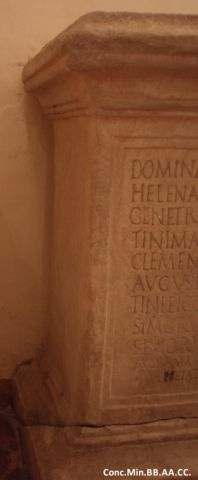
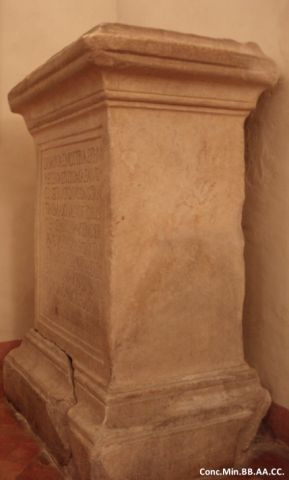
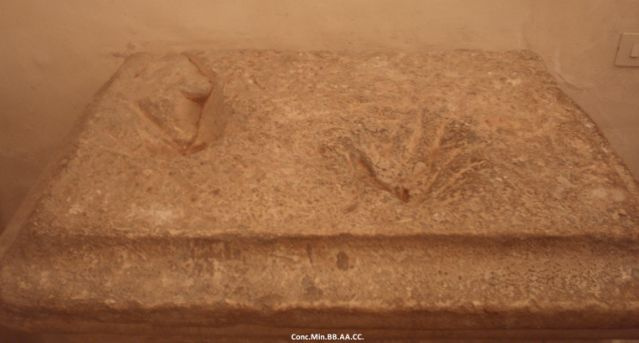
White marble base, broken at the bottom but reassembled, with prominent mouldings on all sides, top and bottom. 143 x 100 x 74 cm. Middle part: 84 x 78 x 51 cm. The base is in a good state of preservation, housed in a chapel dedicated to Helena herself. Right and left sides are plain and smooth.The back cannot be inspected because it is too close to the wall. The epigraphic field is framed by mouldings on all sides, and the quality of finish indicates the erasure of a previous inscription (clearest towards the bottom). The top of the base has two holes, presumably for fitting the statue.
PROVENANCE AND CURRENT LOCATION
The base was discovered in 1571 in the vineyard of the basilica of S. Croce in Gerusalemme, in Rome (CIL; Lanciani 1998, 175), in the area between the church and Aurelian's walls. The church was built as part of the Sessorian palace complex, which belonged to Helena, and was part of a series of works in the area (Pietri 1976, 14-17; Colli 1996). Ligorio records the finding of the base together with statues of Constantine, his sons and Helena 'in certain beautiful ruined buildings' (cited in Lanciani 1998). He probably refers to the so-called 'Temple of Venus and Cupid', part of a large apsidal hall, and to the structures adjoining it, which were still standing at the time (Colli 1996). The base is now in the chapel of St. Helena, inside the Basilica.
HONORAND AND DATE
The statue was dedicated to Flavia Iulia Helena, Augusta between 325 and 330. She was of humble origin, but married Flavius Valerius Constantius with whom she had the future emperor Constantine. They were forced to divorce in 293 when Constantius was made Caesar and married Theodora, the step-daughter of Maximian (PLRE I, 227-228 Constantius 12). She was only made Augusta in 325 (PLRE I, 410-411 Helena 3), when Constantine was already sole ruler of the empire. She died in 330.
Helena is identified as Augusta in the inscription, and therefore the base must date to the period between her promotion (325) and her death (330).
AWARDER
Iulius Maximiianus, a man of clarissimus rank and a count (comes), was probably also responsible for another dedication found in the same area (LSA-1540). He is probably to be identified with Iulius Maximilianus, consularis aquarum, responsible for Rome's water supply, cited in Cod. Theod. 15.2.1, from 330 (PLRE I, 575 Maximilianus 2). This identification confirms 330 as the terminus ante quem for the dedication, as this title is not cited in the inscription.
FURTHER DISCUSSION
If the identification of the awarder as first comes and then (in 330) <consularis aquarum is correct, this base would illustrate the possibilities offered by the presence of the imperial court, or even an empress and her entourage, in Rome or any other city. Maximilianus was of aristocratic standing, and was able to display his loyalty and attachment to the empress and her religious feelings through the dedication of statues, advancing his career in the process.
Discussion references
- Colli, D., "Il palazzo Sessoriano nell`area archeologica di S. Croce in Gerusalemme? ultima sede imperiale a Roma?" , Mélanges de l'École Française de Rome - Antiquité, 108, 1996, pp. 782-795
- Jones, A. H. M. et al., The Prosopography of the Later Roman Empire. Vol. I 260-395, Cambridge et al. 1971 (1975), pp. 227-228 (Constantius 12), 410-411 (Helena 3) and 575 (Maximilianus 2)
- Lanciani, R., Storia degli scavi di Roma e notizie intorno le collezioni romane di antichità, vol. 3 (1550-1565), Rome 1998
- Pietri, C., Roma Christiana. Recherches sur l'Église de Rome, son organisation, sa politique, son idéologie, de Miltiade à Sixte III (311-440) vol. 1, Rome 1976
Cite: Last Statues of Antiquity, LSA-835 (Carlos Machado).