
LSA-838
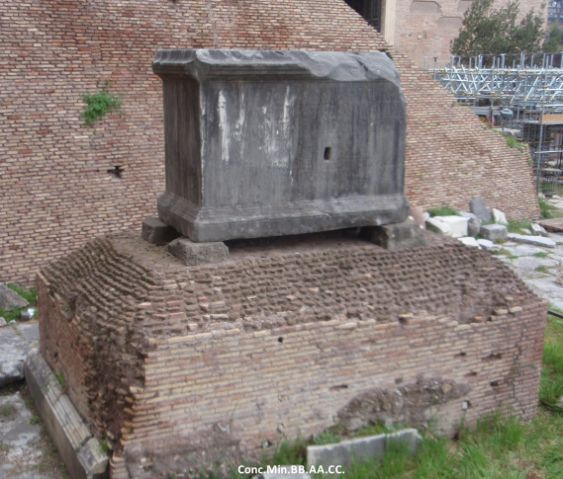
Base for equestrian statue of Constantius II, emperor. Rome, Roman Forum. 352-353
Record details
Photographs
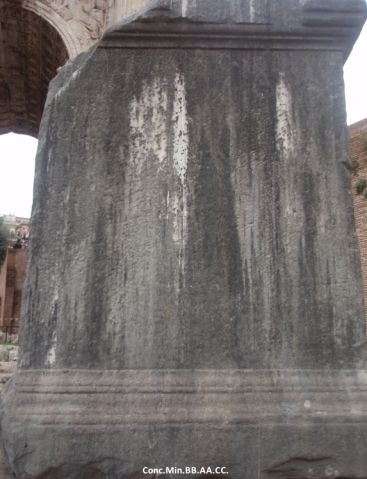
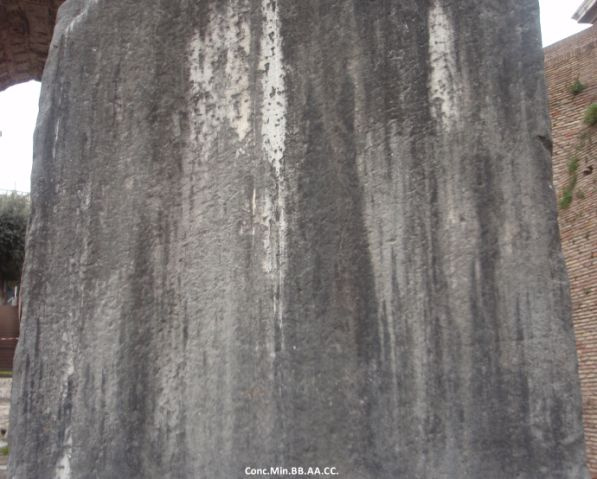
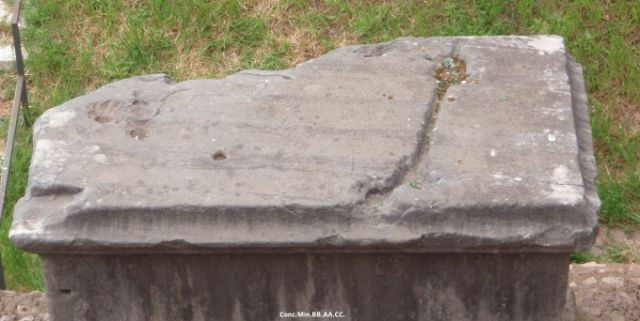
Inscription
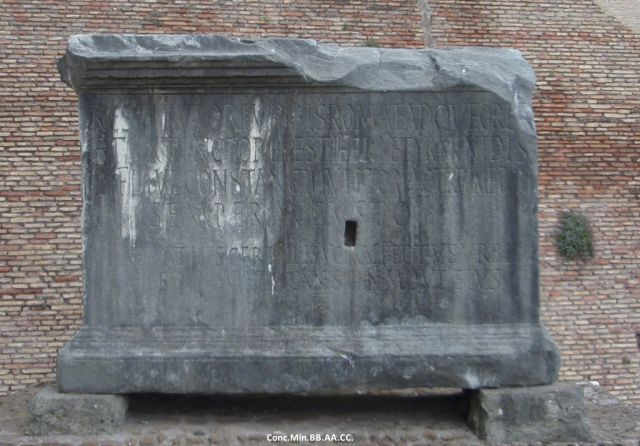
Restitutori urbis Romae adque orb[is], / et extinctori pestiferae tyrannidis, / d(omino) n(ostro) Fl(avio) Iul(io) Constantio, victori ac triumfatori, / semper Augusto. / Neratius Cere[a]lis, v(ir) c(larissimus), praefectus urbi, / vice sacra iudicans, d(evotus) n(umini) m(aiestati)que eius.
Inscription translation
To the restorer of the city of Rome and of the globe, and exterminator of pestiferous tyranny, our lord Flavius Iulius Constantius, victorious and triumphant, forever Augustus. Neratius Cerealis, of clarissimus rank, prefect of the City, judge representing the emperor, devoted to his divine spirit and majesty, [set this up].
Bibliography
- Corpus Inscriptionum Latinarum; , VI, 1158 (+p.4330)
Discussion
INSCRIPTION
In six lines. Letter height 13.5-9 cm.
Restitutori urbis Romae adque orb[is], / et extinctori pestiferae tyrannidis, / d(omino) n(ostro) Fl(avio) Iul(io) Constantio, victori ac triumfatori, / semper Augusto. / Neratius Cere[a]lis, v(ir) c(larissimus), praefectus urbi, / vice sacra iudicans, d(evotus) n(umini) m(aiestati)que eius.
'To the restorer of the city of Rome and of the globe, and exterminator of the pestilential usurpation, our lord Flavius Iulius Constantius, victorious and triumphant, forever Augustus. Neratius Cerealis, of clarissimus rank, urban prefect, judge representing the emperor , devoted to his divine spirit and majesty [set this up].'
The epigraphic field, on one of the the long sides, is 116 cm high and 230 cm wide. Between the 4th and 5th lines it is interrupted by a deep rectangular hole.
DESCRIPTION
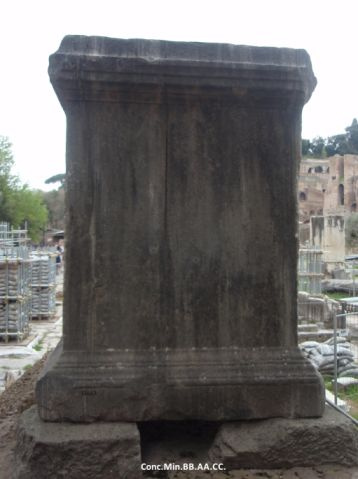
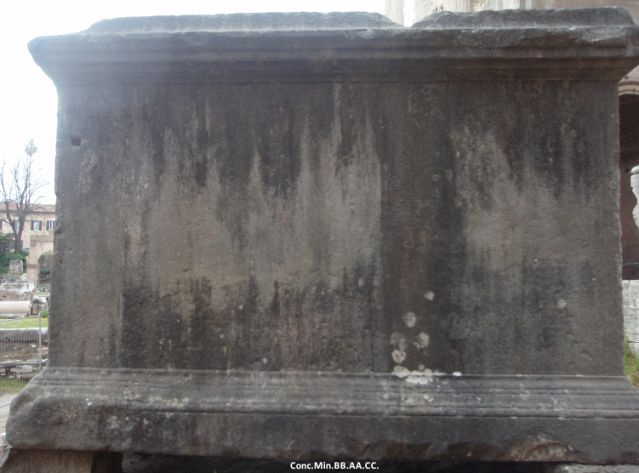
White marble base for equestrian statue: H 180, W 253, D 133 cm. The top right corner is broken and lost. All sides of the base are well finished, with a moulding at top and bottom. The right side of the base bears traces of a point chisel and the faint traces of erased letters towards the top, showing that this was a re-used base, with the first-use inscription on one of the short ends. The left and back sides are finished with a claw chisel.
The top surface is smoothly finished. There is a group of three round holes in the centre towards the right, and a rectangular lowered section at the back right-hand corner, indicating possible repair. The top also has a small round hole towards the back and two rectangular ones linked by a groove of the same depth, which extends as far as the back face. The function of this groove is unclear, and it may have been added after antiquity. The comparatively small number of fixing-holes in the smooth surface of the top of the base suggests that the statue from the first use of the base was re-used in the dedication to Constantius.
The base sits on top of a large brick base, originally faced in marble (of which traces survive towards the bottom).
PROVENANCE AND LOCATION
The base was discovered in 1547 during excavations near the arch of Septimius Severus, together with other altars and bases (Lanciani 1990, 204). It is still there (Sopr. For. Pal. Inv. 12422).
HONORAND, AWARDER, AND DATE
The monument is dedicated to the emperor Constantius II (337-61), and celebrates his victory over the usurper Magnentius (350-3), who had controlled the city of Rome.
The statue was set up by Neratius Cerealis, urban prefect between 352 and 353, and consul in 358. He was a supporter of Constantius II during the usurpation of Magnentius, and related to the Caesar Gallus (PLRE I, 197-199 Cerealis 2). Cerealis was almost certainly the first urban prefect appointed by Constantius after Rome was taken from Magnentius in 352 (Chastagnol 1962, 135-139)
Discussion references
- Chastagnol, A., Les fastes de la Préfecture de Rome au Bas-Empire, Paris 1962
- Jones, A. H. M. et al., The Prosopography of the Later Roman Empire. Vol. I 260-395, Cambridge et al. 1971 (1975), pp. 197-199 (Cerealis 2)
- Lanciani, R., Storia degli scavi di Romae notizie intorno le collezioni romane di antichità, vol. 2 (1531-1549), Rome 1990
Cite: Last Statues of Antiquity, LSA-838 (Carlos Machado).